
You typed “carmel” into a search bar, and now you are staring at squiggly red lines wondering if your brain just broke. Relax, it did not. Caramel is the correct spelling for the sweet, golden treat you drizzle on ice cream, while Carmel is a name used for people and places like Carmel, Indiana or Carmel, California. They sound almost the same out loud, which is exactly why millions of people mix them up in writing every single day.
That one small letter changes everything. Get it wrong in a recipe and you will just look silly. Get it wrong in an address and your package ends up in the wrong state. Let’s fix this confusion for good, in plain English, with zero boring textbook talk.
What Is the Difference Between Carmel or Caramel?
Here is the simplest way to remember it.
Caramel is a food word. It refers to sugar that has been melted and browned, plus the chewy candy, sauce, or color made from it.
Carmel is a name. It shows up as a first name, a last name, and the name of several towns and cities across the United States.
Think of it this way: if you can eat it or pour it on a sundae, it is caramel. If it is on a mailbox, a birth certificate, or a map, it is Carmel.
How Do You Pronounce Carmel or Caramel?
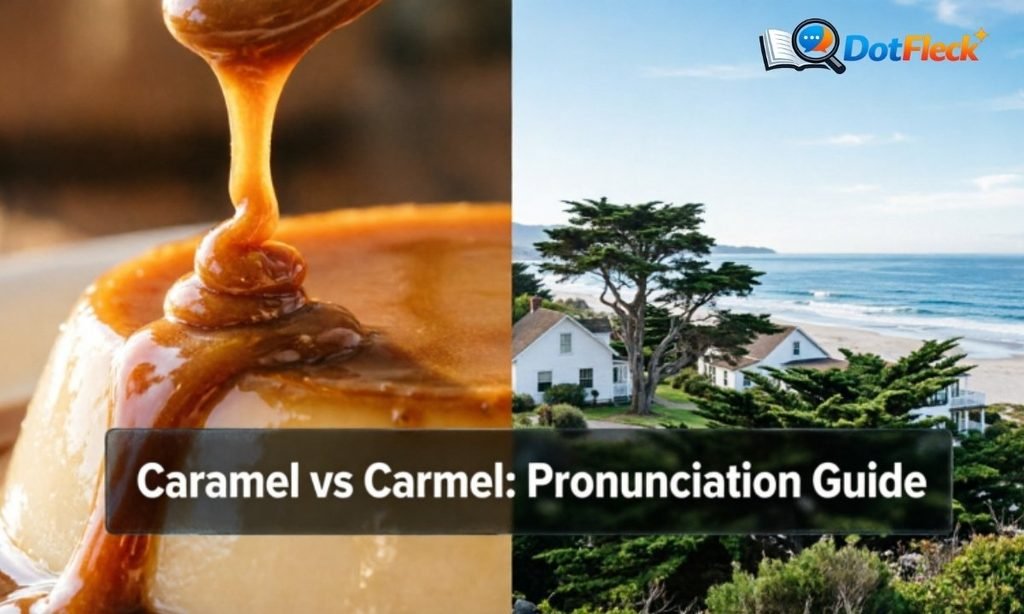
This is where most of the confusion actually starts, because pronunciation does not always match spelling.
Caramel is usually said one of two ways:
- KAR uh mel (three syllables)
- KAR mul (two syllables, more common in casual speech)
Carmel the name is almost always said as:
- KAR mul (two syllables, sounding just like the shorter version of caramel)
So when a small-town Indiana local says “Carmel,” it can sound identical to how a lot of Americans casually say “caramel.” That overlap in sound is the real culprit behind the spelling mix-up, not laziness or bad schooling.
Carmel or Caramel: Quick Comparison Table
| Feature | Carmel | Caramel |
| Word type | Proper noun (name) | Common noun |
| Meaning | A person’s name or place name | A cooked sugar substance |
| Origin | Hebrew, meaning “garden” or “orchard” | Spanish and Latin, tied to sugar cane |
| Common use | Carmel, Indiana; Carmel, California; a first or last name | Caramel candy, caramel sauce, caramel color |
| Capitalization | Always capitalized | Lowercase unless starting a sentence |
| Example sentence | “We are driving to Carmel this weekend.” | “Add caramel syrup to the coffee.” |
Keep this table in your back pocket. If you are ever stuck mid sentence, ask yourself which column your word belongs to.
Where Does the Name “Carmel” Come From?
Carmel has serious historical roots, and they go back thousands of years before anyone thought about melting sugar.
The name comes from the Hebrew word “karmel,” meaning garden, orchard, or plantation. In the Bible, Mount Carmel is a real mountain range along the Mediterranean coast in modern day Israel, mentioned throughout the Old Testament. The mountain range forms the harbor of Haifa today, and the name traces back to a Hebrew root meaning plantation. It is also the setting of one of the Bible’s most dramatic stories, where the prophet Elijah challenges hundreds of false prophets on the mountain’s slopes.
That biblical mountain inspired a religious order too. In the twelfth century, a group of hermits settled near Mount Carmel and devoted themselves to the Virgin Mary, eventually becoming known as the Carmelites. Their community traces back to 1191, when hermits gathered at the foot of Mount Carmel and dedicated themselves to Mary.
Centuries later, that religious connection traveled across an ocean. In 1602, Spanish friars from the Carmelite order sailed along the California coast and celebrated Mass on a beach near what is now Monterey, and the area eventually took the name Carmel in their honor. That is how a mountain in the Middle East ended up lending its name to a beach town in California, and later, indirectly, to places like Carmel, Indiana.
So next time someone writes “Carmel” as a place name, remember it carries a garden, a mountain, and a few hundred years of history behind it.
Where Does the Word “Caramel” Come From?
Caramel has a completely different family tree, one rooted in sugar rather than scripture.
Most word historians trace it back to the Spanish word “caramelo,” which likely came from Medieval Latin “cannamellis,” a blend of “canna” (cane) and “mellis” (honey). The term entered English around 1725 from French, tracing back through Old Spanish, ultimately linked to Medieval Latin “cannamellis,” combining Latin “canna” for cane with “mellis,” the genitive form of honey. In other words, the word literally carries the DNA of “honey cane,” a fitting description for melted sugar syrup.
Some linguists argue for a slightly different path, tracing it instead to Latin “calamus,” meaning reed, which evolved into “calamellus” or “little reed” before becoming “caramelo” in Spanish and Portuguese. Either theory lands in the same place: caramel has always been about sugar, cane, and sweetness, never about gardens or mountains.
By the late 1800s, the word had expanded beyond just “burnt sugar.” By 1884 it described a dark, creamy candy, and by 1909 it was being used as the name of a color. That is why today “caramel” does triple duty: it is a cooking process, a candy, and a shade of brownish tan.
Why Do So Many People Confuse Carmel or Caramel?
Blame the American accent, not your intelligence.
In everyday spoken English, especially across the Midwest and West Coast, “caramel” is frequently shortened to two syllables, “KAR mul.” That happens to be the exact same sound as how residents pronounce the city name Carmel. Your ears cannot tell the difference, so your fingers guess wrong when typing.
Autocorrect does not help either. Many phone keyboards will “fix” Carmel into Caramel because caramel is simply used more often in everyday typing, which trains the software to assume that is what you meant.
| Don’t Miss These Articles |
| FW Meaning in Text: The Ultimate Guide to This Slang (2026) |
| Lieing vs Lying: The Correct Spelling Revealed 2026 |
| Keep vs Kept: Easy Past Tense Rules Explained |
Carmel or Caramel: Which One Should You Use?
Use this quick decision method whenever you are unsure.
- Talking about food, candy, sauce, or a dessert color? Use caramel.
- Talking about a person’s name, or a specific town or city? Use Carmel.
- Writing an address in Indiana or California? Double check the spelling on an official source, since both places genuinely exist and are spelled Carmel, with one R and no extra A.
- Naming a baby or pet after the sweet treat? The name version is technically still spelled Carmel, since it derives from the Hebrew word, not the food.
If you are still stuck, read your sentence out loud and ask “am I eating this or visiting this?” It sounds silly, but it works every time.
Real-Life Examples of Carmel or Caramel in a Sentence
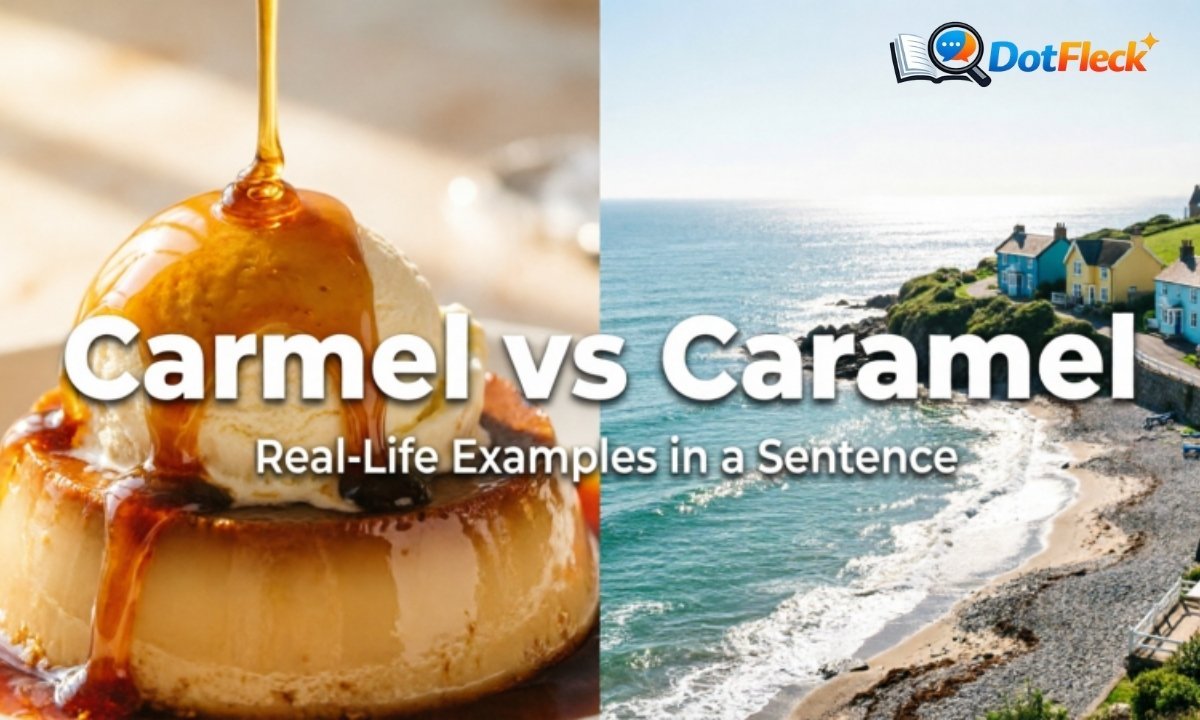
Seeing both words in action makes the difference click faster than any rule ever could.
Caramel examples:
- “I ordered a caramel macchiato on my way to work.”
- “The caramel apples at the fair were sticky but worth it.”
- “Her hair was dyed a warm caramel shade for fall.”
Carmel examples:
- “Carmel, Indiana is regularly ranked one of the best places to live in America.”
- “We spent our anniversary walking the beaches of Carmel-by-the-Sea.”
- “My grandmother’s name was Carmel, after her great aunt.”
Notice how caramel never shows up capitalized mid sentence, while Carmel always does, since it is a proper noun.
Common Mistakes People Make With Carmel or Caramel
Even careful writers slip up here, usually in one of these ways.
- Writing “carmel apple” instead of “caramel apple.” This is the single most common error online, and spellcheck does not always flag it because Carmel is a real word too.
- Typing “Caramel, Indiana” instead of “Carmel, Indiana.” This one is especially embarrassing in emails or resumes listing an address.
- Assuming both spellings mean the same thing. They do not share a root, a meaning, or even a consistent pronunciation pattern once you slow down and say them carefully.
- Trusting autocorrect blindly. Since caramel appears more often in casual writing, some keyboards default to it even when you meant the name Carmel.
A quick trick to catch yourself: if there are two towns in the United States spelled that way, it is Carmel. If there are two A’s in the word (car-a-mel), it belongs in the kitchen.
Carmel in Names and Places You Should Know
Carmel is more common as a real world name than most people realize, which is exactly why the spelling matters so much.
Carmel, Indiana is a large suburb of Indianapolis, frequently ranked among the best places to live in the country thanks to its schools, parks, and roundabouts (seriously, the city has more roundabouts than almost anywhere else in America).
Carmel-by-the-Sea, California is the artsy beach town made famous partly by its architecture and partly by its former mayor, actor Clint Eastwood. Its name traces directly back to those Spanish Carmelite friars mentioned earlier.
Carmel also appears as a first name for both men and women, and as a surname in Jewish and Middle Eastern communities, tied to that same Hebrew word for garden or vineyard.
None of these examples have anything to do with sugar, which is a helpful reminder whenever you are addressing an envelope or writing a bio.
Is “Caramel” Ever Capitalized Like a Name?
Rarely, but it happens in branding. Companies sometimes capitalize Caramel when it is part of a product name, like “Caramel Frappuccino” or “Caramel Delight.” In that context, capitalization follows branding rules, not grammar rules. In regular writing, always keep caramel lowercase unless it starts a sentence.
Quick Cheat Sheet to Remember the Difference Forever
Bookmark this section if nothing else.
- Caramel = food, color, candy. Two A’s, always lowercase.
- Carmel = name, place, person. One A, always capitalized.
- If you can put it in your coffee, it is caramel.
- If you can visit it on vacation, it is Carmel.
FAQs About Carmel or Caramel
Is it Carmel apple or caramel apple?
It is caramel apple. The candy coating comes from cooked sugar, so the food spelling with two A’s is always correct here, never the name spelling.
Why is Carmel, Indiana not spelled Caramel?
Because the city’s name comes from the Hebrew word for garden or orchard, tied to the biblical Mount Carmel, and has no connection to sugar or candy at all. The founders chose the name for its meaning and history, decades before “caramel” became a common household word in America.
Can Carmel be a nickname for someone named Caramel?
Not typically, since these are two separate words with different origins. However, Carmel itself is sometimes used as a given name, and it occasionally shortens to nicknames like Carm or Carmie, similar to the related name Carmen.
Final Thoughts Carmel or Caramel
The mix up between Carmel or caramel is one of the most common spelling slips in English, and now you know exactly why it happens and how to avoid it. One word carries centuries of biblical and geographic history, while the other carries the sweet, sticky legacy of cooked sugar cane. Different roots, different meanings, same confusing sound.
Next time your fingers hesitate over the keyboard, just picture a mountain for Carmel and a candy jar for caramel. Your spelling, and your Indiana road trip directions, will thank you.

Ethan Whitmore is an English language writer who enjoys making grammar, word meanings, and modern slang simple and easy to understand. His content focuses on clear explanations, practical examples, and everyday English usage.