

Typing fast and suddenly unsure if it’s “commit” or “comit”? You’re not alone. This tiny mix-up trips up emails, resumes, and school papers every single day, and one wrong letter can make your writing look careless.
The good news is the fix takes ten seconds. In the debate of commit vs comit, only one spelling is actually a word, and once you know why, you’ll never second-guess it again.
Commit vs Comit: The Quick Answer
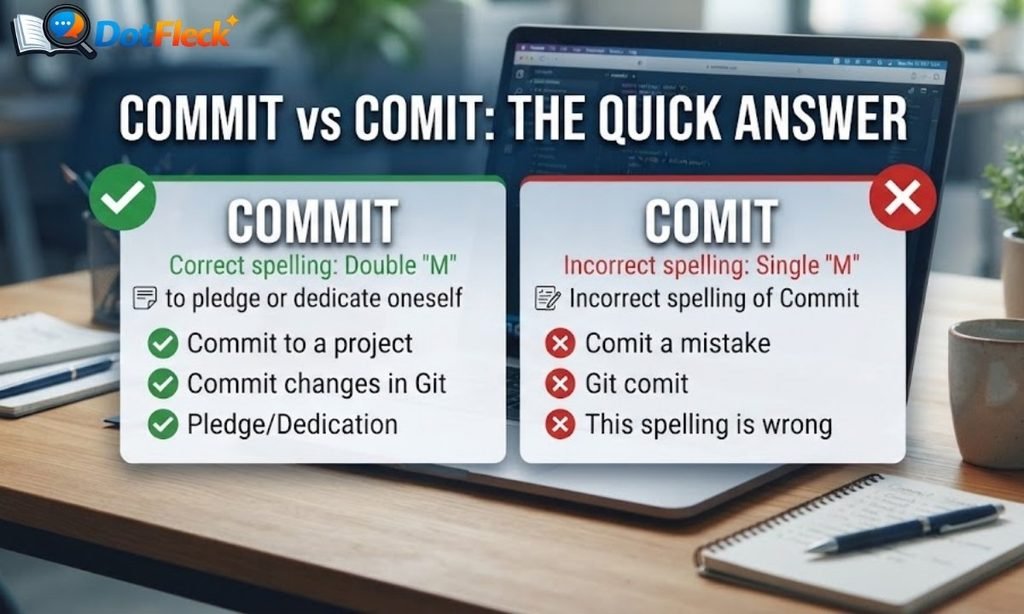
Commit is the correct spelling. Comit is not a recognized English word in any dictionary, formal or informal.
The word always carries two letter M’s: c-o-m-m-i-t. Drop one M and you’ve written something that spell checkers, teachers, and hiring managers will flag instantly. There’s no regional spelling, no British-versus-American split, and no exception here. It’s just commit, every time.
What Does Commit Mean?
Commit means to dedicate yourself to something, to carry out an action, or to promise to do something. It can describe a decision (“I commit to finishing this project”), an act (“commit a crime”), or a mental process (“commit facts to memory”).
The word works as a verb in almost every case, and its meaning shifts slightly depending on what follows it. That flexibility is actually part of why people misspell it. They’re focused on the idea, not the letters.
Pronunciation
Commit is pronounced kuh-MIT, with the stress on the second syllable. The double M doesn’t change how it sounds, which is exactly why so many people forget it’s there. You hear one “m” sound, so your brain assumes one letter does the job.
The Origin of the Word Commit
Commit comes from the Latin word committere, a combination of com- (meaning “together”) and mittere (meaning “to send”). Literally, it meant “to send together” or “to entrust.”
That original sense of entrusting something is still alive in modern English. When you commit to a plan, you’re essentially entrusting your time or effort to it. When you commit a crime, you’re sending yourself down a path with consequences. The Latin roots explain the double M too, since committere already carried two M’s before English ever borrowed the word in the 14th century.
Is Comit a Real Word?
No. Comit is not a word in Merriam-Webster, Oxford, Cambridge, or any other major English dictionary. It doesn’t appear as an alternate spelling, an archaic form, or a regional variant.
If you’ve seen “comit” used somewhere, it’s either a typo, an abbreviation in casual texting, or confusion with an unrelated term (some crypto and tech projects use “Comit” as a brand or protocol name, which has nothing to do with English grammar).
Why Do People Write “Comit”?
The mistake is common enough that it’s worth breaking down exactly why it happens.
Double Letters Can Be Confusing
English is full of words where doubling a consonant feels optional even when it isn’t. Think of occurred, committee, or embarrassed. Writers often drop the second letter because their brain treats it as decorative rather than essential.
Fast Typing
When you’re typing quickly, especially on a phone, your fingers move faster than your spelling instincts. Skipping a repeated letter is one of the most common typing slips there is, right up there with swapping “form” and “from.”
Pronunciation Doesn’t Help
Since the double M in commit doesn’t create a longer or harder sound, your ears give you zero warning that a letter is missing. You say “kuh-mit,” you hear “kuh-mit,” and your fingers follow what they hear.
Commit vs Comit: The Main Difference
The difference is simple: one is a real, dictionary-recognized English verb, and the other is a spelling error with no independent meaning.
| Feature | Commit | Comit |
| Real word | Yes | No |
| Dictionary listed | Yes (all major dictionaries) | No |
| Correct spelling | Yes | No |
| Common in formal writing | Yes | Never appropriate |
| Meaning | To dedicate, perform, or entrust | None |
There’s no debate to settle here the way there sometimes is with words like “gray” versus “grey.” Commit wins because comit was never actually in the race.
What Does Commit Mean in Different Situations?

Commit changes flavor depending on context, which is part of what makes it such a useful word.
Commit an Action
This usage describes carrying out an act, usually a negative one. “The suspect committed the robbery in broad daylight.” Here, commit means “to do” or “to perform.”
Commit to a Goal
This is the motivational sense most people know from fitness apps and productivity advice. “She committed to running three times a week.” It signals a promise you’re making to yourself or others.
Commit Information to Memory
This usage means to memorize something deliberately. “Actors commit their lines to memory before rehearsals begin.” It implies effort, not just casual remembering.
Commit Resources
In business and government, commit often describes allocating money, staff, or time. “The company committed $2 million to the new product line.” This usage shows up constantly in budgets, press releases, and quarterly reports.
| Also Read Confusions |
| Say vs. Said Explained: The 2026 Guide That Finally Clicks |
| Wifes or Wives? Learn the Right Spelling in Under a Minute |
| Felt vs Feel: Difference, Meaning, and How to Use Them |
Common Phrases That Use Commit
Certain commit phrases show up so often that native speakers barely notice they’re idioms. Knowing them helps you use the word naturally instead of sounding textbook-stiff.
Commit a Crime
The standard legal phrase for breaking the law. “He was arrested for committing fraud.”
Commit a Mistake
A slightly formal way to say someone made an error. “The intern committed a mistake in the shipping records.” (Note: in casual American English, “made a mistake” is far more common than “committed a mistake.”)
Commit to a Relationship
Used when someone decides to be exclusive or serious with a partner. “After two years of dating, they finally committed to each other.”
Commit to a Decision
Describes locking in a choice instead of second-guessing it. “Once the board committed to the decision, there was no turning back.”
Commit to Memory
The formal cousin of “memorize.” “Students were asked to commit the poem to memory.”
The Grammar of Commit
Commit follows regular but easy-to-mess-up conjugation rules because of that double consonant.
Base Form
Commit is the base, or infinitive, form. “I commit to finishing this by Friday.”
Third-Person Singular
Add an “s”: commits. “She commits to every project she takes on.”
Past Tense
Double the final consonant before adding “ed”: committed. “They committed to the merger last spring.”
Present Participle
Also doubles the consonant: committing. “He’s committing more hours to the training program this month.”
Noun Form
The related noun is commitment, also carrying the double M. “Her commitment to the team never wavered.”
Word Family of Commit
Commit branches into several related words, and every single one keeps that double M:
- Commitment (noun): dedication or a promise
- Committed (adjective/verb): dedicated, or the past tense of commit
- Committee (noun): a group assigned to a task
- Committing (verb): the present participle
- Commitments (plural noun): multiple obligations or promises
Notice a pattern? If it comes from commit, it keeps both M’s. No exceptions.
Why Does Commit Have Two M’s?
The double M traces straight back to Latin. In committere, the prefix com- ends in “m,” and it’s attached directly to mittere, which starts with “m.” When English absorbed the word, it kept both consonants intact rather than simplifying them.
This is actually common in English words built from Latin prefixes ending in the same letter that follows them. Compare it to accommodate (ac- + commodate), which famously has both a double C and a double M for the same structural reason.
The Rule Behind Double Consonants
English has a general (if occasionally messy) rule for when to double a final consonant before adding a suffix: if a one-syllable-stressed word ends in a single vowel followed by a single consonant, you double that consonant before adding “-ing” or “-ed.”
Commit ends in a single vowel (“i”) followed by a single consonant (“t”), and the stress falls on that final syllable (“kuh-MIT”). That combination triggers the doubling rule, which is why you get committed and committing, not “comited” or “comiting.” Words like permit, submit, and omit follow this exact same pattern, which is genuinely useful once you see the shape of it.
Examples of Commit in Sentences
Real usage sticks better than dictionary definitions, so here’s how commit shows up across everyday American contexts.
In Business
“The startup committed its entire marketing budget to a single ad campaign, betting everything on a strong launch week.”
In Education
“Teachers ask students to commit key formulas to memory before exams, since calculators aren’t allowed on that section.”
In Personal Development
“He committed to waking up at 5 a.m. every day for a month, and by week three it finally stopped feeling brutal.”
In Law
“The defendant was charged with committing wire fraud across three different states.”
Case Study: How One Letter Can Change Professional Writing
A hiring manager at a mid-sized marketing firm once reviewed two nearly identical cover letters. One candidate wrote, “I am fully committed to delivering results.” The other wrote, “I am fully comited to delivering results.”
The second candidate had stronger experience on paper. But the misspelling raised a quiet red flag about attention to detail, the exact trait the job required (a client-facing content role). The first candidate got the callback.
This isn’t a one-off story. Recruiters and editors consistently report that small spelling slips, especially in a word as common as commit, shape first impressions faster than most job seekers realize. Spell check catches “comit” instantly, which means the error usually signals a document that was never proofread at all.
The same pattern shows up in academic writing. A professor grading two essays with equally strong arguments will often rate the error-free paper higher on clarity and professionalism, even if grading rubrics claim to focus purely on content. Readers, whether they’re recruiters, professors, or clients, tend to equate clean spelling with clean thinking, fair or not.
Common Mistakes People Make With Commit
Beyond the base spelling, a few related errors show up constantly in emails, essays, and social posts.
Writing Comit Instead of Commit
The core mistake this article addresses. Always double-check for two M’s before hitting send.
Misspelling Committed
People often drop a letter here too, writing “comited” or “committted” (with three T’s). The correct form is committed, two M’s and two T’s.
Misspelling Commitment
Watch for “comitment” or “commitement.” The correct spelling is commitment, no extra E after the T.
Using the Wrong Phrase
Some writers say “commit a mistake” when natural American English usually favors “make a mistake.” It’s not technically wrong, but it can sound slightly formal or translated in casual writing.
Commit vs Submit
Submit means to give something over for approval or to yield to authority, like submitting a report or submitting to a decision. Commit means to dedicate or carry out, with no sense of handing something to someone else for review. “Submit your application” and “commit to your goals” use completely different actions.
Commit vs Permit
Permit means to allow something to happen, either as a verb (“The rules permit late submissions”) or a noun (“You need a parking permit”). Commit never means “allow.” The two words share a spelling pattern (single vowel, doubled consonant when conjugated) but not a meaning.
Commit vs Omit
Omit means to leave something out or exclude it, the near opposite energy of commit, which means to dedicate yourself to including or doing something. “She omitted her salary history” versus “She committed to a new salary range” shows how differently these two words pull.
Memory Tricks to Remember the Correct Spelling
If double letters keep tripping you up, these tricks make the correct spelling stick for good.
The Double Effort Rule
Commit requires double the letters because it represents double the effort, dedicating yourself fully rather than halfway. Picture two M’s standing side by side like two hands shaking on a promise.
The Commitment Trick
Since commitment is a word most people spell correctly without thinking twice, use it as your anchor. If you can spell commitment, you already know commit needs those same two M’s.
Visual Memory Trick
Picture the word split as com + mit, two small chunks stacked together, just like the Latin roots intended. Seeing it as two pieces rather than one long word makes the double M feel obvious instead of random.
Why Correct Spelling Matters
Spelling errors on a word as common as commit do more damage than most people expect. In professional settings, resumes, emails, and reports, a misspelled common word suggests rushed or careless work, even when the actual content is strong.
Search engines and AI writing tools also flag spelling inconsistencies, which can hurt readability scores and credibility signals on published content. And in everyday communication, small errors slow readers down and shift focus away from your actual message. Getting commit right isn’t about perfectionism. It’s about making sure your writing says exactly what you mean it to say.
This matters even more now that so much writing gets scanned by both people and algorithms. Content that’s clean and accurate tends to rank better, get shared more, and build more trust with readers over time, while sloppy spelling quietly chips away at all three.
FAQs
Is it comit or commit?
It’s always commit, with two M’s. “Comit” is not a correct or recognized spelling in English.
What is the meaning of comit?
Comit has no independent meaning in standard English. It’s simply a common misspelling of the word commit.
What is the difference between comit and commit?
Commit is a real, dictionary-recognized verb meaning to dedicate, perform, or entrust. Comit is not a word at all, just a spelling error missing one M.
What does commit mean?
Commit means to dedicate yourself to an action or goal, to carry out an act, or to entrust something to memory or to someone’s care, depending on the context.
Final Words
The commit vs comit question really comes down to one small but important detail: two M’s, every time, no exceptions. Once that sticks, you’ll spell it correctly in emails, essays, and applications without a second thought.
Language quirks like this one are everywhere in English, but this is one of the easy wins, a single rule that clears up the confusion for good.

Ethan Whitmore is an English language writer who enjoys making grammar, word meanings, and modern slang simple and easy to understand. His content focuses on clear explanations, practical examples, and everyday English usage.