

Brasil is the official name of the country in Portuguese, the language spoken by Brazilians. Brazil is the English version of the same name. Both words point to the exact same country in South America. There is no real difference in meaning. The only difference is the language you are using and the letter used in the middle of the word.
If you are writing in English, you should use Brazil with a “z”. If you are writing in Portuguese, or talking about something local to the country, Brasil with an “s” is correct. This small spelling change happens because English and Portuguese follow different rules for certain letters and sounds.
Simple Origin and Background
The name of the country comes from a tree called pau-brasil, which means brazilwood in English. This tree was found along the coast when European explorers first arrived. It had a deep red colour that was used to make dye for cloth. Traders valued this wood so much that the land itself slowly became known by the tree’s name.
Over time, the local Portuguese name for the wood turned into the name of the whole country. In Portuguese, the country became known as Brasil. When English speakers began writing and talking about the same nation, they changed the spelling slightly to fit English spelling habits. That is how the “s” turned into a “z” in English.
This kind of small spelling change is common with country names. Many nations have one name in their own language and a slightly different spelling in English. It does not mean the country changed. It only means each language shaped the word to match its own style.
The Clear Difference Between Brasil and Brazil
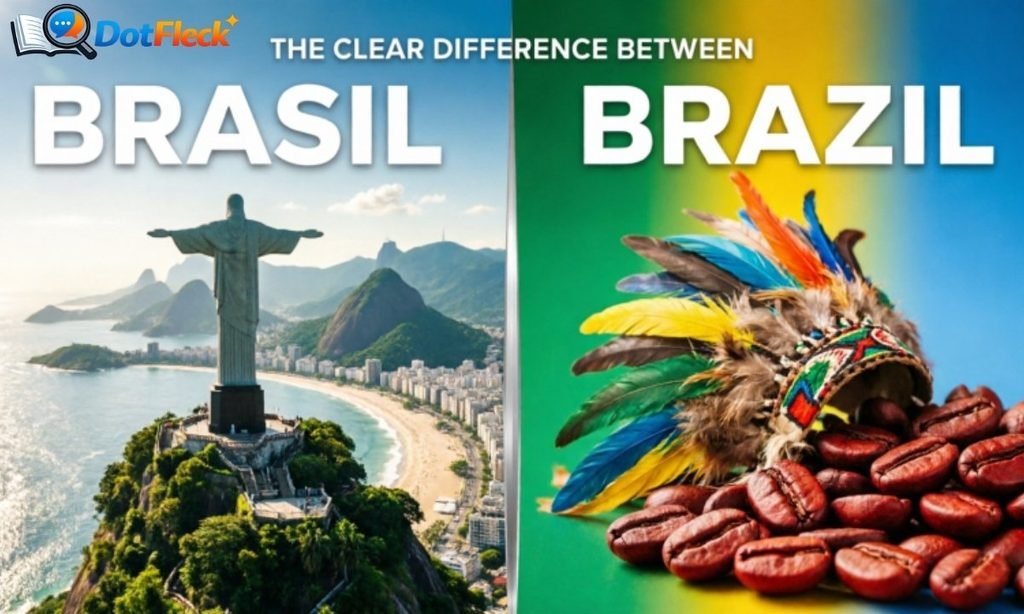
The core difference is language, not meaning. Brasil is used in Portuguese, Spanish, and several other languages. Brazil is used only in English. Both words describe the same flag, the same people, and the same land.
Here is a simple way to remember it:
- Brasil = Portuguese spelling, used inside the country and in official Portuguese documents
- Brazil = English spelling, used in English news, books, and conversations
There is no hidden meaning behind the letter change. It is simply how English handles certain foreign words. Many languages replace an “s” sound with a “z” sound when a word crosses into English, especially when the original sound is soft and buzzy, like the “s” in Brasil.
Comparison Table
| Point | Brasil | Brazil |
| Language | Portuguese | English |
| Used in | Brazil’s official documents, Portuguese media | English news, books, websites |
| Spelling reason | Original Portuguese word | Adapted for English spelling rules |
| Pronunciation | Bra-zil (soft s sound) | Bra-zil (z sound) |
| Correct in official name | Yes, República Federativa do Brasil | Yes, Federative Republic of Brazil |
| Common in | South America, Portugal | United States, United Kingdom, Australia |
This table shows that both spellings are correct. The choice depends only on which language you are writing or speaking.
Brasil or brazil in english
In English writing, Brazil is always the correct spelling. This applies to news articles, school essays, business reports, and everyday conversation. If you are writing for an English speaking audience, you should never use Brasil, even if you have seen it written that way somewhere online.
Many people get confused because they see “Brasil” on football jerseys, product labels, or social media posts made by Brazilians themselves. That does not make it correct in English. Brazilians often write their country’s name the way they know it, but English rules still call for the “z” spelling.
Search engines and style guides also follow this rule. Major English dictionaries, encyclopedias, and news outlets all use Brazil. If you are creating content for an English website, using the correct spelling also helps with search visibility since most people search using the English version.
| Don’t Miss Thses Topics |
| 👉 TTYL Meaning in Text: Discover What It Really Means |
| Carmel or Caramel? The Correct Spelling Revealed |
| Lieing vs Lying: The Correct Spelling Revealed 2026 |
Which One Should You Use and When
Choosing the right spelling depends on your audience and the language of your content. This section makes it simple with clear guidance.
Use Brazil when:
- Writing in English for blogs, articles, or business content
- Talking about the country in an English conversation
- Creating English school assignments or reports
- Making English social media posts about the country
Use Brasil when:
- Writing in Portuguese or Spanish
- Quoting an official Brazilian document in its original language
- Referring to a Brazilian brand name that uses the original spelling
- Writing content specifically for a Portuguese speaking audience
A simple rule to remember: match the spelling to the language of your sentence, not the country itself.
Common Mistakes People Make
Many people mix up these two spellings without realizing it. Here are the most common mistakes and why they happen.
- Copying spelling from logos or shirts: Sports jerseys often use “Brasil” because they are made for the local market, but this does not apply to English writing.
- Assuming both spellings are interchangeable everywhere: While both are correct in their own language, using the wrong one in formal English writing can look like an error.
- Autocorrect confusion: Some phone keyboards suggest “Brasil” if language settings are mixed, leading to accidental misspelling in English texts.
- SEO mistakes: Some website owners use “Brasil” thinking it will help local search results, but for English audiences, Brazil remains the preferred and searched term.
Avoiding these mistakes is easy once you understand the simple rule of matching spelling to language.
Brasil or brazil fifa

Football fans often notice both spellings during World Cup season. FIFA, being an international organization, uses different spellings depending on the language of its content. In English FIFA publications, the team is called Brazil. In Portuguese broadcasts and local media, it is Brasil.
The national team jersey usually says “Brasil” because it is designed primarily for the home audience and international football culture, where many countries keep their traditional football identity in their native spelling. This is similar to how other countries display their name in their own language on jerseys, even in English speaking media coverage.
So when you see “Brasil” on a jersey during a match broadcast in English, remember it is a design and cultural choice, not a spelling rule for English writing. If you are writing a match report in English, Brazil is still the correct spelling to use.
Everyday Real Life Examples
Understanding real examples can make this topic much clearer. Here are a few everyday situations where the difference appears.
Example 1: Travel Blog An English travel blogger writing about their trip would write, “I visited Brazil last summer and loved the beaches in Rio.” This is fully correct English usage.
Example 2: Local Business Card A small business owner in Sao Paulo might print “Brasil” on their business card since it targets local customers who read Portuguese.
Example 3: News Headline An English news channel reporting on elections would write, “Brazil holds national elections this year,” following standard English journalism style.
Example 4: Social Media Post A Brazilian influencer posting in Portuguese might write, “Amo meu Brasil,” which naturally uses the Portuguese spelling since the whole sentence is in Portuguese.
These examples show how spelling naturally shifts based on the language being used, not personal preference.
Learning Tip for Students and Beginners
For students learning English or people new to writing content, a simple trick helps avoid confusion. Think of the letter “z” as the English signal. Just like “organize” becomes different in British and American English, “Brazil” follows English spelling patterns with a “z”.
Here is a short table to help beginners remember quickly:
| Situation | Correct Spelling |
| English essay | Brazil |
| Portuguese essay | Brasil |
| English news article | Brazil |
| Local Brazilian shop sign | Brasil |
| International football commentary in English | Brazil |
A helpful memory trick is this: “Zebras live in Brazil” both words share the “z” sound, making it easier to recall the English spelling.
Conclusion
Both Brasil and Brazil refer to the same beautiful country, known for its culture, football passion, and natural beauty. The only real difference lies in the language being used. Brasil belongs to Portuguese, while Brazil belongs to English. Understanding this simple rule helps you write correctly and confidently, whether you are a student, traveler, content writer, or football fan.
Once you know the reason behind the spelling difference, it becomes very easy to always choose the right one for your writing.

Ethan Whitmore is an English language writer who enjoys making grammar, word meanings, and modern slang simple and easy to understand. His content focuses on clear explanations, practical examples, and everyday English usage.