
English grammar can feel tricky when a simple word like “bite” suddenly changes shape in the past tense. Many students, writers, and even fluent speakers pause for a second when they need to write about something that already happened. Should it be “bited,” “bit,” or “bitten”? This small confusion is common, and it happens because “bite” belongs to a group of verbs that do not follow the usual rules.
This guide breaks the topic down into easy, bite sized sections. You will learn the correct past tense form, see real examples, avoid common mistakes, and pick up simple tricks to remember the rule for good. By the end, using “bite,” “bit,” and “bitten” correctly will feel natural instead of confusing.
Quick Answer
The past tense of “bite” is “bit.” The past participle is “bitten.” Most people mix these two up because English verbs do not always follow simple rules. “Bite” is an irregular verb, so it does not just add “ed” like regular verbs do.
Here is the short version you need to remember:
- Present tense: bite
- Past tense: bit
- Past participle: bitten
If you say “I bit my tongue yesterday,” that is correct. If you say “I have bitten my tongue before,” that is also correct. But “bited” is never correct in modern English.
Simple Background
English has two types of verbs. Regular verbs follow a fixed pattern. You just add “ed” at the end, like “walk” becomes “walked.” Irregular verbs do not follow this pattern. They change their spelling completely, and “bite” is one of them.
The word “bite” comes from Old English. Over hundreds of years, the language changed a lot, but many old verb forms stayed the same. That is why we still say “bit” instead of “bited,” even though it feels strange to new learners.
This kind of change is common in old, everyday words. Verbs like “eat,” “write,” “ride,” and “bite” all follow a similar pattern. They change their middle vowel sound to show past action. Once you notice this pattern, it becomes much easier to remember.
Clear Explanation of the Difference
Many learners confuse “bit,” “bitten,” and “bite” because they sound close in writing. But each one has a different job in a sentence.
| Form | Type | Example |
| Bite | Present tense | The dog can bite if scared. |
| Bit | Simple past tense | The dog bit the mailman. |
| Bitten | Past participle (used with have/has/had) | The dog has bitten someone before. |
| Biting | Present participle | The dog is biting the toy. |
The simple past tense, “bit,” is used alone to talk about something that already happened. You do not need any helping word with it.
The past participle, “bitten,” always needs a helping verb like “has,” “have,” or “had.” You cannot use “bitten” alone in a sentence. For example, “She bitten the apple” is wrong. The correct form is “She has bitten the apple” or simply “She bit the apple.”
Bite past tense sentence
Seeing real sentences helps the rule stick in your memory faster than any explanation. Below are simple examples using “bit” and “bitten” in different situations.
Examples with “bit” (simple past):
- The snake bit the farmer near the river.
- I bit into the sandwich before checking what was inside.
- She bit her nails during the exam.
- He bit his lip out of nervousness.
Examples with “bitten” (past participle):
- I have never bitten a hot pepper before today.
- The child had bitten the toy so many times it broke.
- Has the dog ever bitten anyone in the family?
- The apple was already bitten when I found it.
Notice how “bit” stands alone, but “bitten” always comes with a helper word. This small detail is the biggest reason people make mistakes with this verb.
Comparison Table
This table gives you a full picture of how “bite” changes across all its forms, along with quick usage notes.
| Tense | Form | Usage Rule | Example Sentence |
| Present | bite / bites | Use for habits or facts | Dogs bite when they feel threatened. |
| Past | bit | Use alone for finished actions | She bit into the pizza slice. |
| Future | will bite | Use for actions not yet done | The mosquito will bite if you stand still. |
| Present Perfect | has/have bitten | Use for past action with present result | He has bitten his nails since childhood. |
| Past Perfect | had bitten | Use for action completed before another past action | The dog had bitten the rope before we noticed. |
| Present Continuous | is/am/are biting | Use for action happening now | The puppy is biting the shoe. |
Keeping this table handy is useful for students, writers, and anyone learning English as a second language.
Which One to Use and When
Choosing between “bite,” “bit,” and “bitten” depends on the timing of the action and the sentence structure. Here is a simple way to decide which form fits.
Use “bite” when:
- You are talking about something that happens regularly or is a general fact
- You are giving instructions or warnings, like “Do not let the dog bite”
- You are using it after words like “can,” “will,” or “may”
Use “bit” when:
- The action is fully finished and happened in the past
- You are telling a short story about something that already happened
- There is no helping verb before it
Use “bitten” when:
- You are using a helping verb like “has,” “have,” or “had”
- You want to connect a past action to the present moment
- You are forming a passive sentence, such as “The apple was bitten”
A simple trick many teachers use is this: if you can add “have” or “has” in front of the word and it still sounds correct, then “bitten” is the right choice. If it sounds fine standing alone, “bit” is correct.
| Don’t Miss Today |
| SZN Meaning in Text: Discover What It Really Means |
| OML Meaning in Text: Discover What It Really Means |
Common Mistakes People Make
Even confident English speakers slip up with this verb sometimes. Here are the most common errors and how to fix them.
- Using “bited” instead of “bit.” This is the most frequent mistake. “Bited” is not a real word in standard English, even though it feels natural because most verbs add “ed.”
- Using “bitten” without a helping verb. Saying “She bitten the apple” is incorrect. It should be “She bit the apple” or “She has bitten the apple.”
- Mixing up “bit” with “beat.” These two words look and sound similar but mean completely different things. “Bit” comes from “bite,” while “beat” comes from “beat,” meaning to hit or defeat.
- Forgetting the helping verb in questions. People sometimes ask, “Bitten you before?” instead of the correct form, “Have you been bitten before?”
- Confusing “bit” as a noun and a verb. “Bit” can also mean a small piece of something, like “a bit of cake.” This double meaning sometimes confuses learners about which usage is correct.
A quick way to avoid these mistakes is to read your sentence out loud. If a helping verb is missing before “bitten,” your ear will usually catch it.
Bite past tense pronunciation
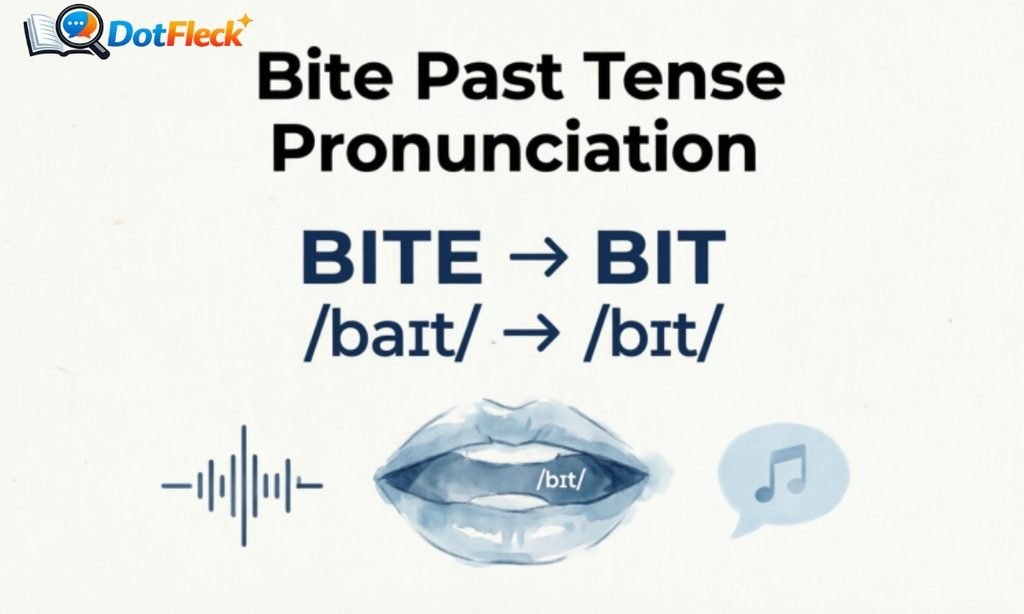
Pronunciation matters just as much as spelling when learning irregular verbs. Saying these words wrong can make sentences hard to understand in conversation.
Here is how each form sounds:
- Bite: sounds like “bahyt”
- Bit: sounds like “bit,” rhymes with “sit” and “hit”
- Bitten: sounds like “bit-n,” with a short pause between the two parts
A simple tip is to compare “bite” with other similar words you already know. “Bite” rhymes with “kite” and “site.” “Bit” rhymes with “fit” and “sit.” “Bitten” rhymes with “written” and “kitten,” which makes it easy to remember since “kitten” is such a common word.
Practicing these sounds out loud, even for a few minutes daily, helps build muscle memory for correct pronunciation.
Everyday Real Life Examples
Seeing this verb used in daily life situations makes the grammar rule feel less like a classroom lesson and more like something practical.
At the doctor’s office:
- “I got bitten by a mosquito last night, and now my arm is swollen.”
- “The doctor asked if I had ever been bitten by a snake before.”
At home:
- “My little brother bit into the wrong end of the corn cob.”
- “The cat has bitten the curtain again.”
At work or school:
- “She bit her pen while thinking about the answer.”
- “He had bitten off more work than he could finish by Friday.”
This last example shows an idiom, “bite off more than you can chew,” which means taking on too much responsibility. English has several common phrases built around this verb, which shows how useful it is to learn correctly.
Short Learning Section for Students
Students often need quick memory tricks instead of long explanations. Below are simple methods that make this verb easier to remember for exams and daily speaking.
Memory tricks:
- Think of “bit” as short and quick, just like a quick bite of food.
- Remember “bitten” rhymes with “kitten,” and both need something extra: kittens need care, and “bitten” needs a helping verb.
- Practice with flashcards showing all three forms together: bite, bit, bitten.
Simple practice exercise: Fill in the blank with the correct form of “bite.”
- Yesterday, the dog stole my shoe. (Answer: bit)
- I have never been into raw onion. (Answer: bitten)
- Be careful, that spider might you. (Answer: bite)
- The child already had the cookie before dinner. (Answer: bitten)
Doing small exercises like this regularly is one of the best ways to make irregular verbs feel natural instead of confusing.
Conclusion
Learning the past tense of “bite” is simple once you break it down into small steps. Remember that “bit” works alone for finished actions, while “bitten” always needs a helping verb like “has,” “have,” or “had.” Avoid the common trap of saying “bited,” since that form does not exist in standard English.
With a bit of daily practice, reading real sentences, and paying attention to pronunciation, this verb becomes easy to use correctly in both writing and speaking. Keep the comparison table from this guide handy, and you will rarely make a mistake with “bite,” “bit,” or “bitten” again.
Frequently Asked Questions
What is the past tense of bite?
The simple past tense of “bite” is “bit.” For example, “The dog bit the mailman yesterday.”
Is bited a real word?
No, “bited” is not correct in standard English. The correct past tense form is always “bit.”
What is the difference between bit and bitten?
“Bit” is used alone for a finished past action, while “bitten” always needs a helping verb like “has,” “have,” or “had.”
How do you pronounce bitten?
“Bitten” is pronounced like “bit-n,” and it rhymes with common words like “kitten” and “written.”
Can bitten be used without a helping verb?
No, “bitten” should always come with a helping verb such as “has,” “have,” or “had” to be grammatically correct.
What is the past participle of bite?
The past participle of “bite” is “bitten,” used in sentences like “She has bitten her nails since childhood.”
Is bite a regular or irregular verb?
“Bite” is an irregular verb because it does not follow the normal “add ed” rule for past tense forms.

Ethan Whitmore is an English language writer who enjoys making grammar, word meanings, and modern slang simple and easy to understand. His content focuses on clear explanations, practical examples, and everyday English usage.