
Have you received a text saying “TYSM” and wondered what those four letters mean? You may have seen it in an Instagram comment, Snapchat message, TikTok reply, or everyday conversation. It’s a popular form of internet shorthand that makes expressing gratitude quick and easy.
Understanding the TYSM meaning in text is simple once you know what each letter represents. However, the way someone uses it can also tell you something about their tone, appreciation, and feelings.
Quick Answer: What Does TYSM Mean in Text?
TYSM stands for “Thank You So Much.” It is a casual texting abbreviation people use to express gratitude, appreciation, or excitement when someone does something kind or helpful. You can use TYSM in text messages, social media comments, online chats, and friendly conversations instead of typing the complete phrase.
What Does TYSM Stand For?
TYSM is made from the first letter of each word in the phrase “Thank You So Much.”
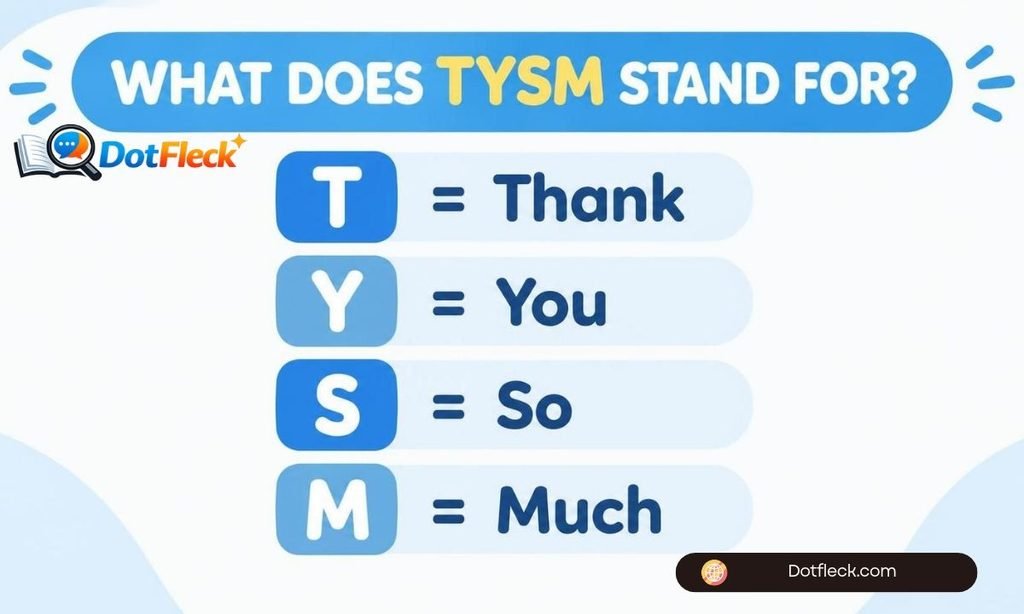
Here is the simple breakdown:
| Letter | Stands for |
|---|---|
| T | Thank |
| Y | You |
| S | So |
| M | Much |
When someone writes TYSM, they are expressing appreciation without typing the entire sentence.
For example:
- “TYSM for the gift!” means “Thank you so much for the gift!”
- “Aww tysm!” means “Aww, thank you so much!”
- “TYSM for checking on me” means “I really appreciate you checking on me.”
The abbreviation is easy to understand and works naturally in everyday digital conversations.
What Does TYSM Mean in Text Messages?
In text messages, TYSM is a friendly way to acknowledge someone’s kindness, help, support, or generosity.
People often use it when a simple “thanks” doesn’t feel expressive enough. The abbreviation communicates appreciation while keeping the message short.
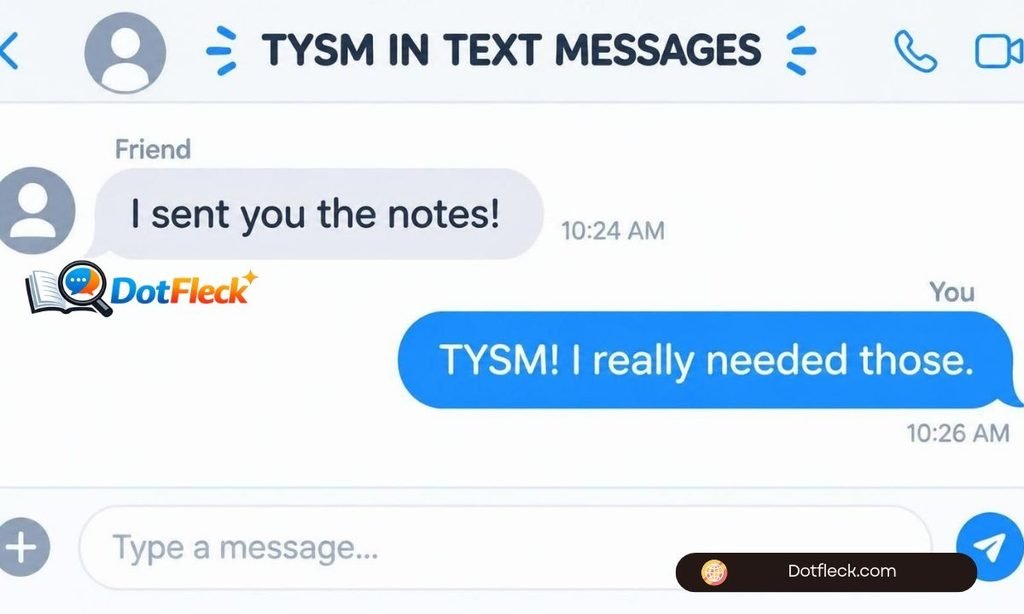
For example, imagine your friend shares important notes before an exam.
Example conversation:
Alex: Hey, I sent you the notes from today’s class.
Jamie: TYSM!! I really needed those.
Alex: No problem!
In this conversation, Jamie uses TYSM to show genuine appreciation for Alex’s help.
Here are some common situations where people use it:
- After receiving help: When someone helps you complete a task or solve a problem.
- After receiving a compliment: When someone says something nice about you.
- After receiving a gift: When a friend or family member gives you something thoughtful.
- After getting support: When someone encourages you during a difficult time.
- After receiving information: When someone shares useful details, links, or documents.
The meaning stays the same in each situation. Only the reason for expressing gratitude changes.
Is TYSM Slang, an Acronym, or an Abbreviation?
TYSM is commonly described as internet slang or a texting abbreviation. More precisely, it is an initialism because people understand and read its individual letters rather than pronouncing it as one regular word.
There is a small difference between these terms:
- Slang: Informal language commonly used within particular groups or communities.
- Abbreviation: A shortened form of a word or phrase.
- Initialism: An abbreviation formed from initial letters that are pronounced separately.
For example, TYSM is an initialism because its letters represent the first letters of “Thank You So Much.”
Although people sometimes call it an acronym, initialism is the more technically accurate description.
TYSM is also not a traditional formal English expression. It belongs mainly to digital communication, where shorter and faster messages are common.
What Is the Difference Between TYSM, TY, THX, and TYVM?
Several abbreviations express gratitude in online conversations. However, they can communicate slightly different levels of warmth, emphasis, and formality.
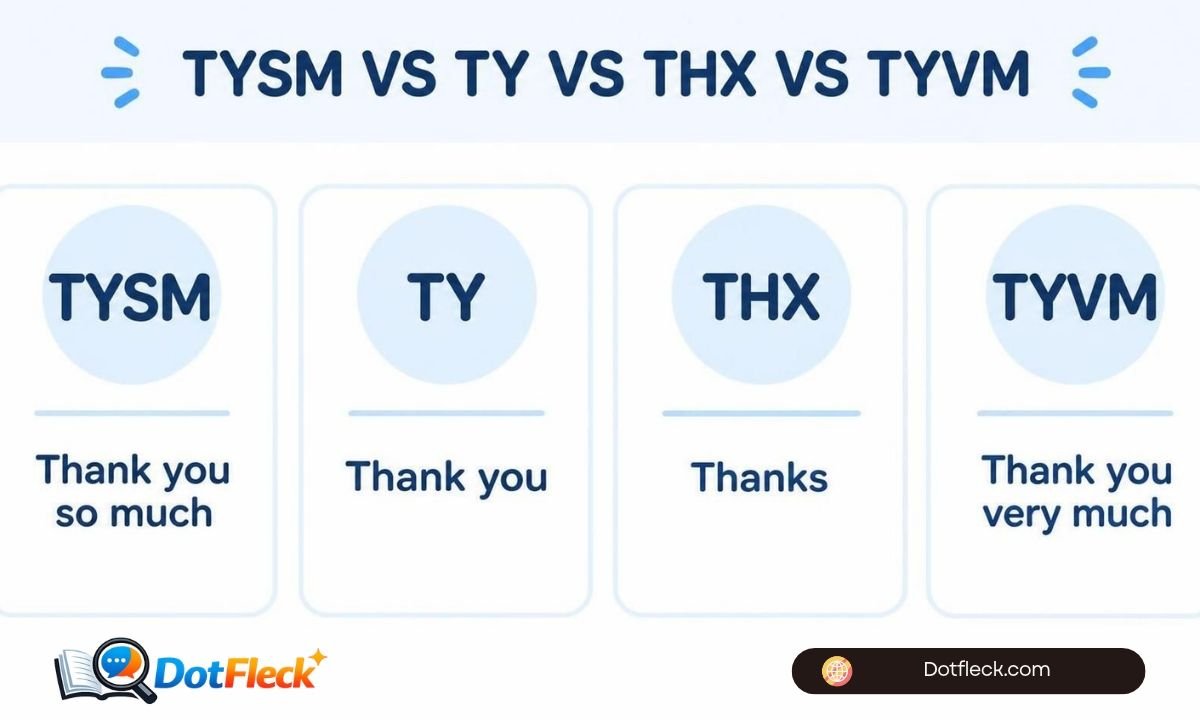
Understanding these differences helps you choose the right expression for a particular situation.
| Abbreviation | Full Meaning | Common Tone |
|---|---|---|
| TY | Thank You | Simple and casual |
| THX | Thanks | Informal and quick |
| TYSM | Thank You So Much | Warm and appreciative |
| TYVM | Thank You Very Much | Polite and appreciative |
| TYS | Thank You So | Less common and context-dependent |
TY vs. TYSM
TY means “Thank You,” while TYSM means “Thank You So Much.”
TY is a quick acknowledgment, whereas TYSM generally places more emphasis on appreciation.
Example:
- TY for sending the picture.
- TYSM for sending the picture. I love it!
Both messages express gratitude, but the second sounds more enthusiastic.
TYSM vs. TYVM
TYSM means “Thank You So Much,” while TYVM means “Thank You Very Much.”
Both expressions communicate strong appreciation. However, TYSM often feels more conversational, while TYVM can sound slightly more formal.
TYSM vs. THX
THX is a shortened form of “Thanks.” It is commonly used when someone wants to acknowledge something quickly.
TYSM usually sounds warmer because it represents a longer expression of gratitude.
Quick tip: Use TY for simple thanks, THX for quick informal replies, and TYSM when you want to show extra appreciation.
How Is TYSM Used on Social Media?
TYSM is not limited to regular SMS messages. People also use it across social media platforms when responding to compliments, comments, gifts, and supportive messages.
Its basic meaning does not change from one platform to another.
TYSM on Snapchat
On Snapchat, TYSM commonly appears in private messages and story replies.
Someone might use it after receiving a picture, a compliment, or a helpful response.
Example:
Friend: I saved those pictures for you!
You: tysm!! ❤️
This response expresses appreciation in a casual and friendly way.
TYSM on Instagram
Instagram users often write TYSM in comments, direct messages, and story responses.
It is particularly useful when replying to compliments or thanking followers for their support.
Example:
User: Your new outfit looks amazing!
Creator: Aww TYSM! 💕
The creator is simply thanking the person for the compliment.
TYSM on TikTok
On TikTok, creators and viewers may use TYSM when responding to comments, recommendations, or positive feedback.
Example:
Viewer: This tutorial helped me so much.
Creator: TYSM for watching! ❤️
It is a quick way to acknowledge someone’s support.
TYSM on WhatsApp
WhatsApp users commonly use TYSM in personal conversations and group chats.
It works well when thanking family members, friends, classmates, or coworkers in relaxed conversations.
Example:
Sarah: I picked up your package.
Emma: TYSM! You’re the best.
TYSM on Facebook and Discord
On Facebook, TYSM can appear in Messenger conversations, comment sections, and group discussions.
Discord users may also use it in gaming communities, private chats, and server conversations when someone shares helpful information or offers assistance.
The platform changes, but the intended expression remains “Thank You So Much.”
What Does TYSM Mean From a Girl or Guy?
When a girl or guy sends TYSM, it generally means the same thing: “Thank You So Much.”
The sender’s gender does not give the abbreviation a different definition. However, the surrounding conversation can help you understand the emotional tone.
What Does TYSM Mean From a Girl?
If a girl sends you TYSM, she is usually expressing appreciation for something you said or did.
For example:
You: I found the book you were looking for.
Her: Aww tysm!! 🥹
She is thanking you for finding the book.
If she adds a heart emoji or affectionate words, her message may sound warmer. However, TYSM alone does not prove that she has romantic feelings.
What Does TYSM Mean From a Guy?
When a guy sends TYSM, he is also expressing gratitude.
For example:
You: Good luck with your interview tomorrow!
Him: TYSM! I really appreciate it.
This is a friendly way to acknowledge your encouragement.
Is TYSM Flirty or Romantic?
TYSM is not inherently flirty or romantic. It is primarily an expression of gratitude.
However, it can appear in affectionate conversations when combined with heart emojis, compliments, or personal messages.
Compare these examples:
| Message | Possible Interpretation |
|---|---|
| TYSM for helping me! | Friendly gratitude |
| Aww tysm ❤️ | Warm appreciation |
| Tysmmm, you’re so sweet! | Enthusiastic or affectionate thanks |
| TYSM 😊 | Friendly and polite |
Remember that one abbreviation cannot reveal someone’s romantic intentions. Look at the entire conversation and the relationship between the people involved.
What Do Lowercase TYSM, Capital TYSM, and Tysmmm Mean?
You may see TYSM written in different ways. Although the spelling can change, the basic definition remains the same.
The differences usually involve emphasis or personal texting style.
| Version | Meaning | Possible Tone |
|---|---|---|
| tysm | Thank you so much | Relaxed and casual |
| TYSM | Thank you so much | Emphatic or noticeable |
| Tysm | Thank you so much | Neutral and friendly |
| tysm!! | Thank you so much | Excited |
| tysmmm | Thank you so much | Extra enthusiastic |
| tysm ❤️ | Thank you so much | Warm or affectionate |
| tysm 🥹 | Thank you so much | Emotional or touched |
These interpretations are not strict rules. Some people type in lowercase all the time, while others use capital letters for every abbreviation.
Does TYSM With Emojis Have a Different Meaning?
No. Emojis usually add emotion to the original message rather than changing the abbreviation itself.
Here are some common combinations:
- TYSM ❤️: Expresses warm appreciation or affection.
- TYSM 😊: Communicates friendly gratitude.
- TYSM 🥹: Can suggest that someone feels touched or especially thankful.
- TYSM 😂: May express playful appreciation or laughter.
- TYSM 🙏: Emphasizes thanks or appreciation.
The surrounding message is the best way to understand what the sender intends.
How to Use TYSM Correctly in Everyday Conversations
TYSM is easy to use because it can replace the complete phrase “Thank You So Much” in most informal messages.
However, choosing the right situation makes your message sound more natural.
1. Use TYSM When Someone Helps You
When someone offers assistance, you can use TYSM to acknowledge their effort.
Example:
Friend: I fixed the problem with your laptop.
You: TYSM! I really appreciate it.
2. Use TYSM After Receiving a Compliment
You can respond to a kind comment or compliment without writing a long reply.
Example:
Friend: You looked great at the party!
You: Aww tysm! That means a lot.
3. Use TYSM When Someone Gives You a Gift
If someone sends you a present or surprises you with something thoughtful, TYSM is a friendly response.
Example:
Mom: I ordered your favorite shoes.
You: TYSM! I can’t wait to wear them.
4. Use TYSM to Thank Someone for Their Support
When someone encourages you or helps you through a difficult situation, TYSM can express appreciation.
Example:
Friend: Don’t worry. Everything will work out. I’m here for you.
You: TYSM for always supporting me.
5. Use TYSM in Group Chats
TYSM also works when you want to thank several people at once.
Example:
Friends: Happy birthday! Hope you have an amazing day!
You: TYSM everyone! Love you all.
How Do You Reply When Someone Says TYSM?
If someone sends you TYSM, you don’t need to write a complicated response. A short, friendly acknowledgment is usually enough.
Your reply can depend on your relationship with the sender and what they are thanking you for.
Here are some natural responses:
| Reply | When to Use It |
|---|---|
| You’re welcome! | A polite and friendly response |
| No problem! | When helping someone was easy |
| Anytime! | When you’re happy to help again |
| Of course! | When you helped someone willingly |
| No worries! | In relaxed conversations |
| Glad I could help! | After providing useful assistance |
| You got it! | In friendly, informal chats |
| ❤️ | When a simple reaction is enough |
Real Conversation Examples
Example 1: Friendly reply
Alex: TYSM for helping me!
Sam: You’re welcome!
Example 2: Casual reply
Mia: tysm for sending the pictures.
Lily: Anytime!
Example 3: Warm reply
Emma: Aww tysm ❤️
Jake: Of course! 😊
Example 4: Professional but friendly reply
Coworker: TYSM for sharing the report.
You: Happy to help!
The best response is one that matches the tone of the original conversation.
Is TYSM Rude or Disrespectful?
No. TYSM is not generally considered rude or disrespectful. It is a polite, informal expression of gratitude.
People use it to thank others for small favors, helpful information, compliments, and thoughtful gestures.
However, the setting matters.
For example, sending “tysm” to a close friend is perfectly natural. Sending the same abbreviation in a formal business proposal or an important professional email may look too casual.
Consider these situations:
| Situation | Is TYSM Appropriate? |
|---|---|
| Texting close friends | Yes |
| Talking with family | Yes |
| Instagram comments | Yes |
| Snapchat messages | Yes |
| Casual group chats | Yes |
| Friendly coworker messages | Usually |
| Formal business emails | Better to avoid |
| Job applications | No |
| Official letters | No |
If you are communicating with a client, manager, professor, or someone you don’t know well, write “Thank you so much” instead.
It sounds professional, clear, and respectful.
Can TYSM Have a Sarcastic Meaning?
Yes, although its usual meaning is positive, TYSM can sometimes be used sarcastically.
Sarcasm happens when someone uses words of gratitude to express annoyance, frustration, or disappointment.
For example:
Alex: I accidentally deleted your presentation.
Jamie: TYSM. Now I have to do everything again.
In this situation, Jamie is not genuinely thanking Alex. The response communicates frustration.
Another example:
Friend: I told everyone your secret.
You: Oh, TYSM for that!
The words appear thankful, but the context makes the sarcastic meaning clear.
How can you recognize sarcastic TYSM?
Look for these clues:
- The sender is responding to something frustrating.
- The message contains an obvious complaint.
- The conversation already has a negative tone.
- The sender uses TYSM ironically after something goes wrong.
Capital letters alone do not indicate sarcasm. Always consider the complete conversation.
Does TYSM Have Any Other Meaning?
In ordinary English texting and social media conversations, TYSM has one widely recognized meaning: “Thank You So Much.”
It is not normally a secret code, romantic abbreviation, or inappropriate expression.
You might occasionally find unusual interpretations on user-generated slang websites, but those should not be confused with the established texting definition.
A few related expressions are worth understanding:
- TY: Thank You.
- TYVM: Thank You Very Much.
- ILY: I Love You.
- ILYSM: I Love You So Much.
- TYSM ILY: Thank You So Much, I Love You.
For example, if someone writes “TYSM ILY,” they are expressing both gratitude and affection.
The meaning of ILY comes from the additional letters, not from TYSM itself.
Common Mistakes to Avoid When Using TYSM
Although TYSM is simple, a few common misunderstandings can cause confusion.
- Assuming it always means romance: TYSM expresses gratitude, not necessarily romantic interest.
- Using it in every professional message: Formal communication usually sounds better with complete words.
- Confusing it with TYVM: Both express gratitude, but they have different full forms.
- Thinking capitalization changes its definition: TYSM and tysm generally mean the same thing.
- Assuming every message is sincere: Sarcasm is possible when the surrounding conversation suggests it.
- Treating it as a spoken English word: TYSM is mainly written shorthand, not a conventional spoken word.
Knowing these differences helps you understand digital conversations without overthinking simple messages.
When Should You Use TYSM Instead of Thank You So Much?
The choice depends on the person you’re communicating with and the type of conversation.
Use TYSM when you want to keep your message short, friendly, and relaxed. Choose the complete phrase when you need a more professional or personal response.
| Use TYSM | Use Thank You So Much |
|---|---|
| Texting close friends | Writing formal emails |
| Replying to social comments | Thanking a professional contact |
| Chatting on Snapchat | Writing an official message |
| Talking in gaming groups | Communicating with clients |
| Sending quick replies | Expressing serious appreciation |
For example:
- Casual: “TYSM for the recommendation!”
- Professional: “Thank you so much for your recommendation. I appreciate your help.”
Both are correct. The difference is the level of formality.
Frequently Asked Questions About TYSM
1. What does TYSM mean in a text from someone?
TYSM means “Thank You So Much.” Someone uses it to express appreciation after receiving help, a compliment, a gift, or a thoughtful message.
2. What does TYSM mean on Snapchat?
On Snapchat, TYSM means “Thank You So Much.” People commonly use it in snaps, private chats, and story replies to express gratitude.
3. What does TYSM mean on TikTok?
On TikTok, TYSM is a casual way to thank viewers, creators, or other users. It often appears in comments and replies to positive feedback.
4. Is TYSM the same as thank you?
Yes. TYSM is a shortened version of “Thank You So Much.” It communicates the same basic message but sounds more informal and conversational.
5. Does TYSM mean I love you?
No. TYSM means “Thank You So Much,” not “I Love You.” However, someone might write “TYSM ILY” to express both gratitude and affection.
6. What does tysmmm mean in texting?
Tysmmm means “Thank You So Much.” The additional letters usually add emphasis and make the message feel more enthusiastic or affectionate.
7. Is TYSM appropriate for professional conversations?
TYSM may be acceptable in relaxed workplace chats with familiar coworkers. However, writing “Thank You So Much” in full is a better choice for formal emails and professional communication.
8. How should I respond to TYSM?
You can reply with “You’re welcome,” “Anytime,” “No problem,” or “Of course.” Choose a response that matches the tone of your conversation.
Conclusion
Understanding the TYSM meaning in text makes online conversations much easier. TYSM stands for “Thank You So Much” and is a popular abbreviation used to express gratitude, kindness, and appreciation.
Whether someone sends it through Snapchat, Instagram, TikTok, WhatsApp, or a regular text message, the basic meaning remains the same.
You can use TYSM when thanking friends, responding to compliments, appreciating gifts, or acknowledging someone’s help. Just remember that it is an informal expression, so writing the complete phrase is usually better in professional situations.
The next time someone sends you “TYSM,” you’ll know exactly what they mean. A simple “You’re welcome!” or “Anytime!” is often all you need to keep the conversation going.

Ethan Whitmore is an English language writer who enjoys making grammar, word meanings, and modern slang simple and easy to understand. His content focuses on clear explanations, practical examples, and everyday English usage.