
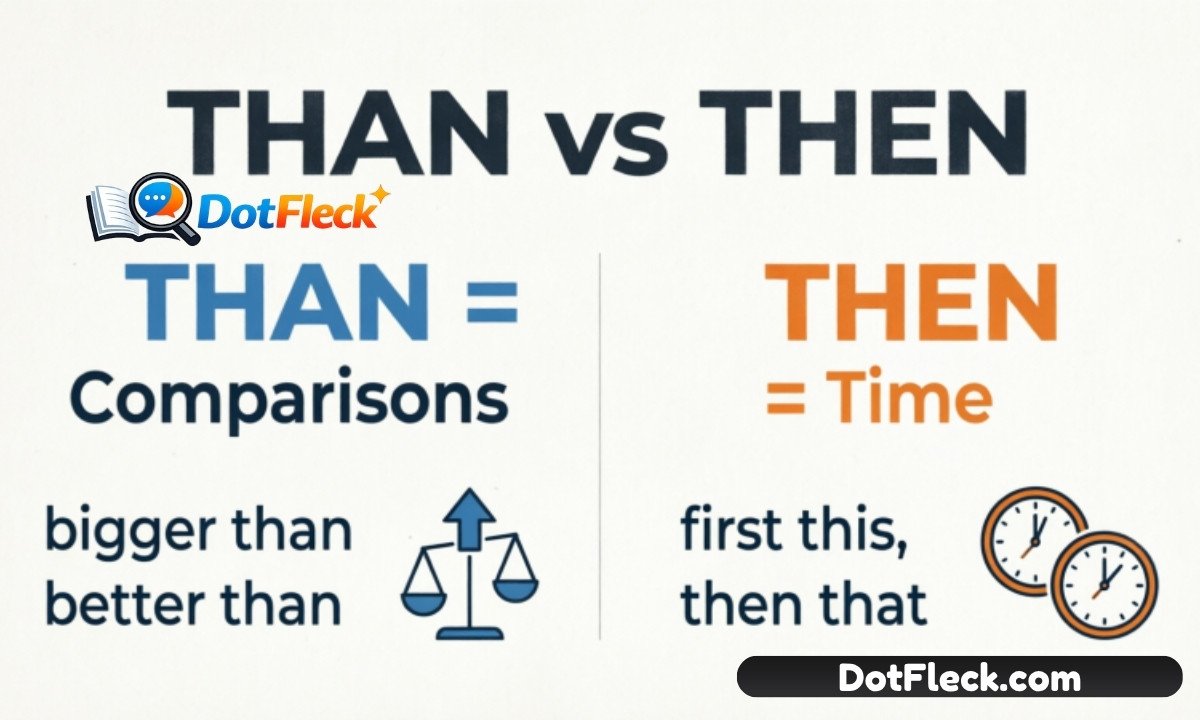
Mixing up Than vs Then is one of the most common slip-ups in English, mostly because the two words look nearly identical and are pronounced almost the same in casual speech.
Here’s the quick answer: than is used for comparisons (“bigger than,” “faster than”), while then is used for time and sequence (“first this, then that”). Once you separate “comparing” from “sequencing,” the confusion disappears.
What Does “Than” Mean?
Than is a conjunction (and sometimes a preposition) used to compare two things. It shows up right after comparative words like bigger, better, more, less, faster, or older.
- Correct: “My coffee is stronger than yours.”
- Correct: “She finished the race faster than he did.”
If you’re weighing one thing against another, than is the word you need.
Read Also : Compliment vs Complement
What Does “Then” Mean?
Then is an adverb that relates to time. It tells you what happens next, what happened before, or what logically follows.
- Correct: “We ate dinner, and then we watched a movie.”
- Correct: “If it rains, then we’ll cancel the picnic.”
Think of then as a timestamp or a signpost pointing to “next” or “at that time.”
Why People Mix Up Than vs Then
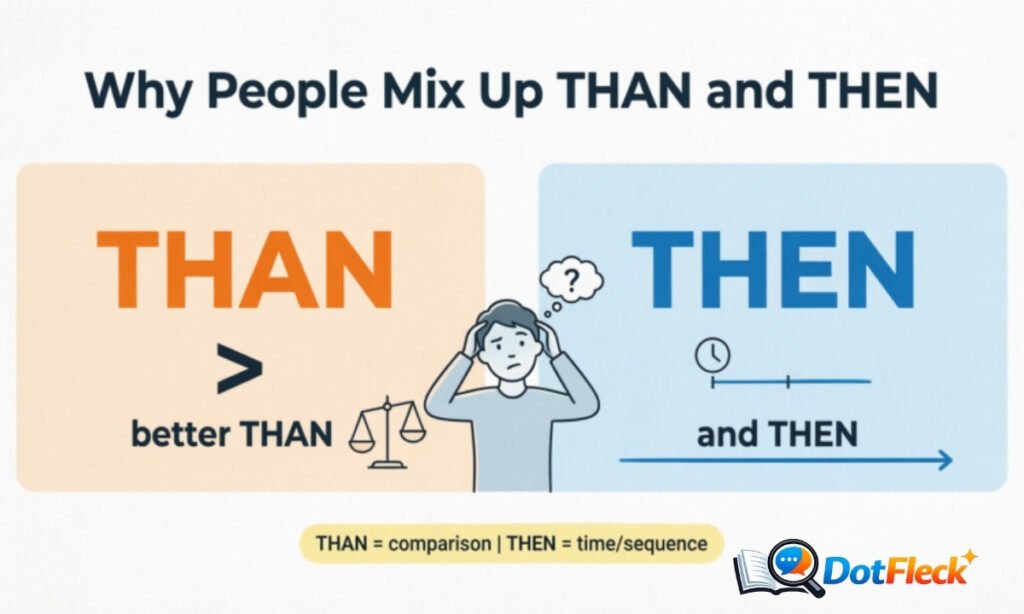
The confusion happens for three simple reasons. First, the words differ by a single letter, so a quick typo turns one into the other. Second, in fast, casual speech, both words can sound like “thun,” making them nearly indistinguishable by ear.
Third, autocorrect and spell check won’t catch the mistake, because both than and then are real, correctly spelled words the software just can’t tell which one you meant.
Than vs Then: The Core Difference
The easiest way to remember the difference is this: than compares, then sequences.
- Use than when you’re stacking one thing up against another.
- Use then when you’re talking about time, order, or a result.
A simple memory trick: then has an “e” for event (a moment in time), while than has an “a” for against (comparing one thing against another).
Read Also : Barrel or Barrell
Quick Comparison Table “Than vs Then”
| Word | Part of Speech | Meaning | Typical Use | Example |
| Than | Conjunction/Preposition | Introduces a comparison | After comparative adjectives (better, more, less) | “This bag is heavier than that one.” |
| Then | Adverb | Refers to time, sequence, or consequence | Describing order of events or cause and effect | “Finish your homework, then you can play.” |
Rules for Using Than Correctly
- Use than after comparative adjectives or adverbs (taller, smarter, more quickly, less often).
- Use than with words like rather, other, and else when making a comparison.
- Than can introduce a full clause, even if part of it is left out: “She’s smarter than I am” (or simply “than I”).
Correct: “I’d rather walk than drive in this traffic.” Correct: “There’s no one else here than us.”
Rules for Using Then Correctly
- Use then to show what happens next in a sequence of actions.
- Use then after “if” to show a result or consequence.
- Use then to mean “at that time,” referring to a specific past or future moment.
Correct: “Back then, gas cost less than a dollar a gallon.” Correct: “If you’re not busy, then let’s grab lunch.”
Real-Life Examples in Context “Than vs Then”
Everyday conversation “Than vs Then“:
- “I like tea more than coffee.”
- “We’ll grab groceries, and then head home.”
Text messages “Than vs Then“:
- “omw, be there in 10, see u then“
- “honestly ur cooking is better than mine lol”
Workplace communication “Than vs Then“:
- “Please review the draft; then send it to the client for approval.”
- “Q3 sales were stronger than we projected.”
Academic writing “Than vs Then“:
- “The results showed a greater correlation than the researchers expected.”
- “First, the sample was heated; then, it was cooled to room temperature.”
Common Mistakes to Avoid “Than vs Then”
Incorrect: “This movie is better then the last one.” Correct: “This movie is better than the last one.” Why it’s wrong: “Better” is a comparison, so it needs than, not then.
Incorrect: “First we’ll eat, than we’ll go shopping.” Correct: “First we’ll eat, then we’ll go shopping.” Why it’s wrong: This sentence describes a sequence of events, which calls for then.
Incorrect: “If you finish early, than you can leave.” Correct: “If you finish early, then you can leave.” Why it’s wrong: “If…then” is a fixed pairing that signals a result, not a comparison.
A fast way to catch these errors: read the sentence back and ask, “Am I comparing two things, or am I talking about time or order?” If it’s a comparison, it’s than. If it’s about time or sequence, it’s then.
Read More : Advice vs Advise
Practical Tips to Remember the Difference
- Spell trick: Both “than” and “compArison” have an a. Both “then” and “whEn” have an e.
- Read it aloud slowly. In careful speech, the vowel sounds are actually distinct — “than” rhymes with “ban,” while “then” rhymes with “hen.”
- Proofread comparative words. Any time you write more, less, better, worse, rather, or faster, double-check that than follows.
- Proofread sequence words. Any time you write first, next, if, or afterward, check whether then belongs nearby.
Than vs Then in American and British English
There’s no difference in meaning or usage between American and British English here. Both dialects use than for comparisons and then for time or sequence.
This is a spelling and usage distinction that applies universally in standard English, not a regional variation.
Frequently Asked Questions
Is “then” ever used for comparisons?
No. Then never functions as a comparison word. If you’re comparing two things sizes, qualities, amounts the correct word is always than.
Can “than” be used to talk about time?
No. Than does not indicate time or sequence. Save it strictly for comparisons, such as “louder than” or “sooner than.”
What’s an easy way to test which word I need?
Try replacing the word with “compared to.” If the sentence still makes sense, use than. If it doesn’t, and the sentence is really about timing or order, use then.
Is “rather than” or “rather then” correct?
Rather than is correct. “Rather” signals a preference or comparison between two options, so it always pairs with than, never then.
Final Takeaway “Than vs Then”
The difference between than and then comes down to one simple test: comparison versus sequence. If you’re stacking two things against each other, reach for than. If you’re describing what comes next, what happened at a certain time, or what follows logically, use then.
Keep that distinction in mind, and this common mix-up won’t trip you up again.

Ethan Whitmore is an English language writer who enjoys making grammar, word meanings, and modern slang simple and easy to understand. His content focuses on clear explanations, practical examples, and everyday English usage.