
Have you ever typed a word, stared at it, and wondered if it looked wrong? Many writers pause over submission vs submittion when they fill out a form, send in a manuscript, or hand in homework. The verb “submit” ends in a double t, so it feels natural to carry that pattern into the noun, and one wrong letter can make an otherwise polished email or paper look careless.
This guide gives you the correct spelling, the meaning, and the reason behind it. You will also see common spelling mistakes, how related words work, and example sentences you can reuse in your own writing. By the end, you will know which spelling to use and have a simple trick to remember it every time you write, whether you are writing for school, work, or a creative project.
Quick Answer: Is It Submission or Submittion?
The correct spelling is submission. “Submittion” is a spelling mistake, and you will not find it in standard American dictionaries such as Merriam-Webster.
If you are asking “submission or submittion, which is correct?”, the answer never changes. Use submission, with a double s in the middle and no double t.
- Correct: Please send your submission by Friday.
- Incorrect: Please send your submittion by Friday.
What Does Submission Mean?
Submission is a noun with several related meanings. The most common one in everyday American English is the act of handing something in for review, or the thing you hand in. These submission definition and examples show how the meaning shifts with context.
- Handing something in: “The deadline for submission is noon.”
- The item submitted: “The editor read every submission this week.”
- Yielding to authority: “The rebels were forced into submission.”
- A legal argument: “The lawyer made a submission to the court.”
- A combat sports hold: “He won the match by submission.”
The surrounding sentence usually makes the meaning clear. Common synonyms include entry, filing, and proposal for the first senses, and surrender or compliance for the sense of yielding.
Why Is “Submittion” Incorrect?
“Submittion” is incorrect because English has no word spelled that way. Writers take the double t from “submit” and attach a common ending, “-tion,” as in “action” or “creation.” The result looks reasonable but breaks the actual spelling pattern.
The sound of the word also plays a part. The ending sounds like “shun,” and English spells that sound several ways, including “-tion,” “-sion,” and “-ssion.” Because the sound does not tell you which to use, people guess, and “-tion” is the most familiar guess.
Word Origin: Where “Submission” Comes From
Submission traces back to the Latin word submissio, from the verb submittere. That verb combines sub, meaning “under,” with mittere, meaning “to send” or “to let go.” The original idea was lowering something or placing it under another’s authority.
The word reached English through Old French during the Middle Ages. The same root gives us mission, permission, admission, and transmission, which explains why they share the “-mission” ending.
Pronunciation and Syllables of Submission
Submission has three syllables: sub-mis-sion. It is pronounced roughly “suhb-MISH-un,” with the stress on the middle syllable. The “ss” makes a “sh” sound, which is why the ending sounds like “shun” even though no t appears.
The verb “submit” has two syllables and is pronounced “suhb-MIT.” The final t sound in the verb leads some writers to think a t belongs in the noun too. In the noun, that t has changed into “ss.”
Spelling Rule: Why It’s “-ssion,” Not “-ttion”
Many English verbs that end in “-mit” form their nouns by changing the ending to “-mission.” The t does not double. It is replaced by “ss.” This is the submission spelling rule, and it applies to a whole family of words.
- submit → submission
- permit → permission
- admit → admission
- commit → commission
- omit → omission
- transmit → transmission
None of these nouns ends in “-ttion.” If you can spell “permission” or “admission,” you already know how to spell submission.
Word Forms of Submission: Submit, Submitted, Submitting, Submissive
Knowing the full word family helps you avoid mix-ups. Here are the main forms and what each one does.
- Submit (verb): to hand in or to yield. “I will submit the report today.”
- Submitted (verb): past tense and past participle. “He submitted the form yesterday.”
- Submitting (verb): present participle. “We are submitting our entries now.”
- Submission (noun): the act or the item. “Your submission was received.”
- Submissive (adjective): willing to obey. “The dog was calm and submissive.”
The verb doubles the t in “submitted” and “submitting” because the stress falls on the last syllable of “submit.” That is why “submiting” is wrong.
Submission vs Submissive: Noun vs Adjective
Submission is a noun, so it names an act or a thing. Submissive is an adjective, so it describes a person, animal, or behavior. You can make a submission, but you cannot “make a submissive.”
“His submission was late” refers to a document or entry. “His submissive attitude surprised everyone” describes how he behaved. The adverb form is “submissively.”
Common Misspellings of Submission (and Why They Happen)
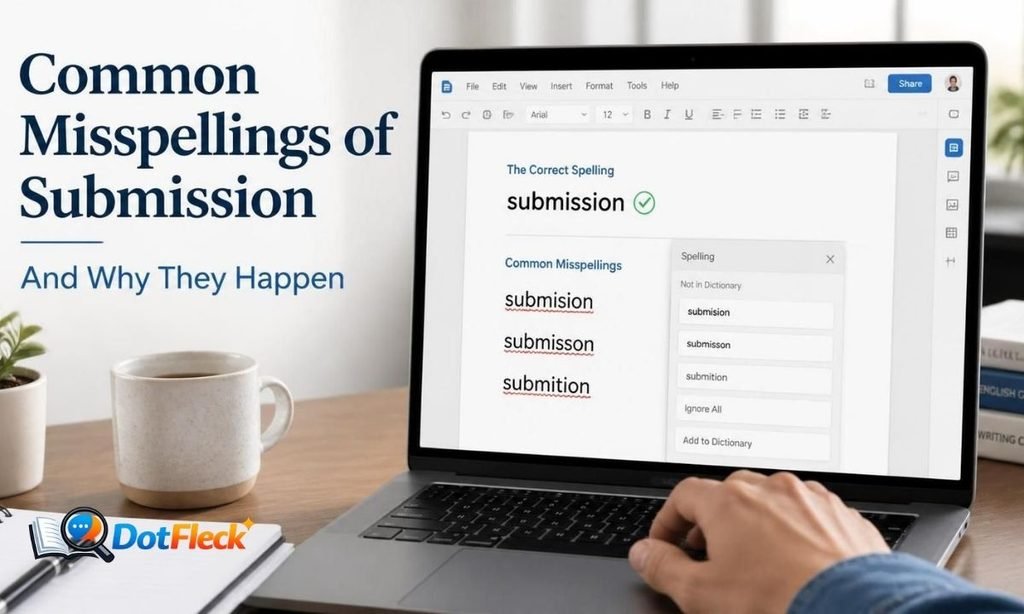
Submission is one of the commonly misspelled English words, and most errors come from a few predictable habits. Writers carry over the double t from the verb, trust the “shun” sound, or skip a letter when typing quickly.
- Submittion: adds a double t and “-tion” by analogy with other words.
- Submition: drops the second t but still uses “-tion.”
- Submision: uses a single s in the middle.
- Sumission: leaves out the b.
In every case, the fix is the same. Remember that the word is built from “sub” plus “mission.”
Other Common Misspellings (“Submition,” “Sumission,” “Submision”)
“Submition” is probably the most common near-miss, because it looks close to the right answer. The single t feels cleaner, but the ending still does not match the “-ssion” pattern.
“Submision” often appears in fast typing, when one s gets dropped. “Sumission” usually comes from a missing b, since the b sits quietly between two consonants. When you proofread, slow down on the first four letters and the double s, where most submittion spelling mistakes and their cousins start.
Submission vs Similar Words: Submittal and Application
Some words overlap in meaning with submission, and the right choice depends on the field you work in. Two of the most common are “submittal” and “application.”
Submission vs Submittal
Submittal is a real word, but it is used much less often. It appears mostly in construction, engineering, and government contracting, where a submittal is a document or sample sent for approval, such as a product data sheet.
In general writing, submission is the safer and more natural choice. Use “submittal” only if it is standard in your field.
Submission vs Application
An application is a request to be considered for something, such as a job, a loan, or a college program. A submission is the act of handing something in, or the item itself.
The two often overlap, since sending in a job application is also a submission. But not every submission is an application. A short story sent to a magazine is a submission, not an application.
How “Submission” Is Used in Real Life: Academic, Legal, and Professional Contexts
The word shows up in many settings, and seeing it in context makes the meaning easier to remember.
Academic Submissions
In school and college, a submission is usually an assignment, essay, or research paper handed to an instructor. Students often see phrases like “assignment submission” and “late submission policy.”
- “The submission deadline is 11:59 p.m. on Sunday.”
Legal Submissions
In law, a submission is an argument or statement given to a court or judge. Lawyers make submissions to explain their position on a point of law or fact.
- “The judge asked for written submissions before ruling.”
Business and Creative Submissions
In business, a submission might be a bid, a proposal, a tax filing, or an expense report. In creative fields, writers, artists, and filmmakers send submissions to magazines, galleries, and festivals.
- “The agency accepts submissions from new authors.”
Example Sentences Using Submission
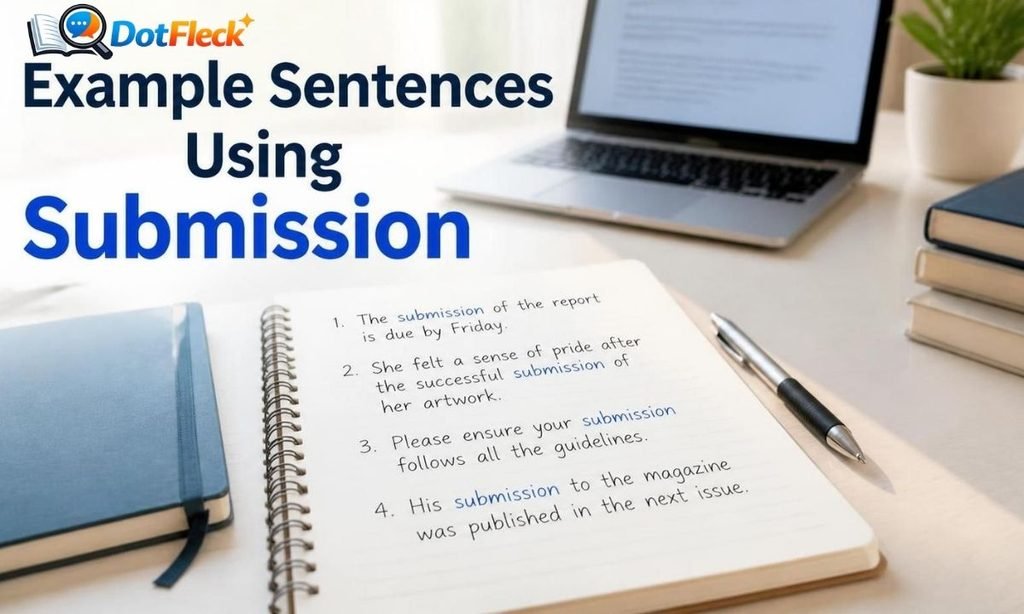
Here are more examples of submission word usage in sentences, covering different meanings.
- Your submission has been received, and we will reply within five days.
- The magazine rejected my first submission but liked the second one.
- The team won the match by submission in the second round.
- The city refused to surrender, so the army starved it into submission.
- All submissions must include a cover page and a works cited list.
- The contest closes to new submissions on March 1.
Memory Trick to Never Misspell Submission Again
Try this simple trick: look for the word miss inside submission. Sub-miss-ion. Since “miss” has a double s, the spelling of submission has one too.
You can also use a short phrase: “Don’t miss the double s.” Another quick check is to compare it with “permission.” If you would never write “permittion,” you should not write “submittion” either.
Practice Exercises: Test Your Understanding
Choose the correct spelling or word form in each sentence.
- The deadline for (submission / submittion) is Friday.
- She is (submiting / submitting) her essay tonight.
- He (submit / submitted) the form yesterday.
- The dog showed a calm, (submission / submissive) manner.
- Which spelling is correct: submition, submision, or submission?
Answer Key
- submission. The noun is spelled with “-ssion.”
- submitting. The t doubles in the present participle.
- submitted. The sentence uses past tense.
- submissive. An adjective is needed to describe the dog.
- submission. The other two are misspellings.
Frequently Asked Questions
What does “submittion” mean?
“Submittion” has no meaning because it is not a real word. It is a common misspelling of the noun submission.
Is submission and submit the same?
No. Submit is a verb meaning to hand in or yield, while submission is the noun naming the act or the item.
Is it correct to say “submitting” or “submiting”?
“Submitting” is correct. The final t in submit doubles before “-ing,” so “submiting” with one t is a misspelling.
Which is correct, “submitted” or “submit”?
Both are correct in different situations. “Submit” is the base form, and “submitted” is the past tense and past participle.
Final Thoughts
The debate over submission vs submittion has a clear winner: submission is the only correct spelling. “Submittion” is a common mistake that comes from the double t in “submit” and the familiar “-tion” ending. The word follows the same “-mission” pattern as permission, admission, and commission, which makes the rule easy to apply once you notice it, and easy to teach to others.
To keep the spelling straight, remember that submission has the word “miss” inside it, and that the verb forms “submitted” and “submitting” keep the double t. Use submission for the act or item handed in, and submissive when you need an adjective. With these points in mind, you can write the word with confidence in emails, essays, and professional documents, and you can spot the error quickly in someone else’s draft.

Ethan Whitmore is an English language writer who enjoys making grammar, word meanings, and modern slang simple and easy to understand. His content focuses on clear explanations, practical examples, and everyday English usage.