

Have you ever stopped mid-sentence and wondered whether a coworker “focusses” on the budget or “focuses” on it? You are not alone. The spelling of focusses or focuses trips up many writers, because both forms appear in print and online. One looks like a typo, the other looks like the normal rule, and only one of them is the standard choice in the United States.
This article explains the correct spelling, what each form means, and where each one is used. You will see how American and British English differ, what major dictionaries say, how the verb and noun forms work, and which mistakes to avoid. By the end, you will know which spelling to use in school papers, emails, reports, and professional writing.
Focusses
“Focusses” is a variant spelling of the third-person singular verb form and, less often, a plural noun form. It is most common in British English, where writers sometimes double the final “s” before adding an ending. You might see it in a sentence such as “She focusses on the details.”
In American English, “focusses” is treated as incorrect or at least unusual. Spell checkers in the US usually flag it, and editors will change it to “focuses.” If you are writing for a US audience, avoid it.
Focuses
“Focuses” is the standard spelling in American English, and it is also fully accepted in British English. It works as the third-person singular present tense of the verb “focus” and as a plural of the noun “focus.” For example: “He focuses on his studies” and “The two studies have different focuses.”
Because “focuses” follows the simple rule of adding “-es” to a word ending in “s,” it looks familiar to most readers. That is one reason it is the safer choice almost everywhere.
Focusses or Focuses: Quick Answer
The quick answer is simple. Use focuses in American English. It is the standard spelling for both the verb and the noun, and it is never wrong in the US.
“Focusses” is a British variant. It is not a mistake in the UK, but it is less common than “focuses” even there, and it should be avoided in American writing.
- US writing: focuses, focused, focusing
- Common UK variants: focusses, focussed, focussing
- Safe choice anywhere: focuses, focused, focusing
The Origin of Focusses or Focuses
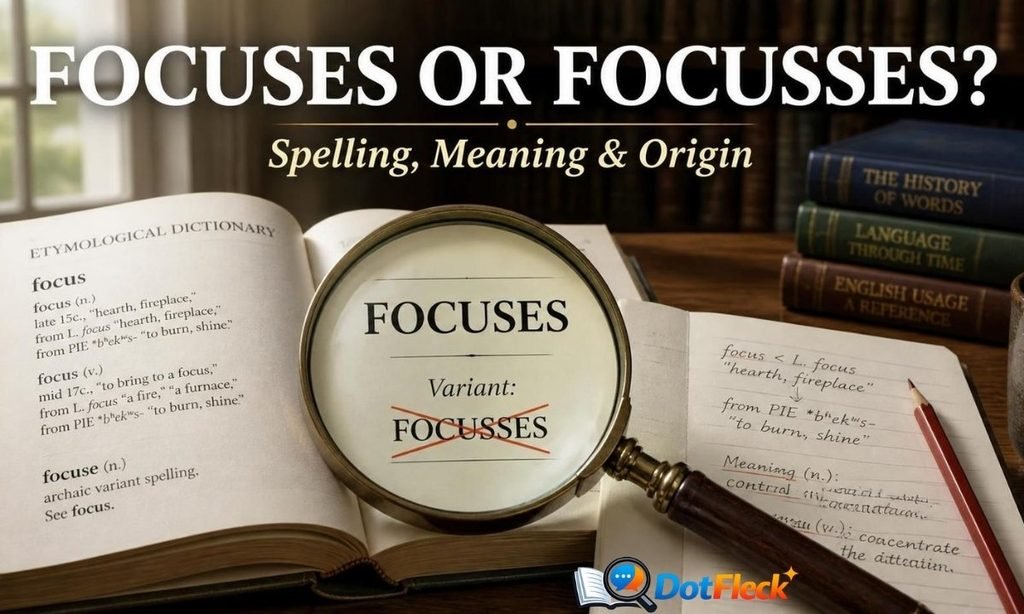
The word “focus” comes from Latin, where it meant “hearth” or “fireplace.” In the early 1600s, the astronomer Johannes Kepler used it in optics to describe the point where rays of light meet. English borrowed it in the 1600s, first as a technical term in geometry and optics.
Over time, “focus” took on its everyday meaning of paying close attention. It also became a verb, which is where the confusion about “focuses” and “focusses” begins. Once English speakers started using it as a verb, they had to decide how to add endings to a word that already ends in “s.”
Why Does British English Double the “S”?
British English often doubles a final consonant before adding an ending, especially when the stress falls near the end of the word. The doubled letter was meant to show how the word is pronounced. Writers applied this habit to “focus” and produced “focussed,” “focussing,” and “focusses.”
The pattern is not consistent, which is why it causes confusion. The stress in “focus” falls on the first syllable, so the doubling rule does not strictly apply. Many British writers and dictionaries have moved toward the single “s” for that reason, and American English dropped the doubled form long ago.
Which Spelling Should You Use?
Choose your spelling based on your audience. If your readers are in the United States, use “focuses,” “focused,” and “focusing.” If you are writing for a British publication that prefers the double “s,” follow its style guide.
When you are unsure, “focuses” is the best default. It is accepted in every major English-speaking country, so it will not look wrong to any reader. Consistency matters too: do not mix “focuses” and “focusses” in the same document.
Focusses or Focuses: UK vs US vs Canada vs Australia vs NZ
Regional preferences differ, but the single “s” form dominates in most places. Here is a general overview:
- United States: Focuses is standard. Focusses is considered a misspelling.
- United Kingdom: Focuses is standard in most modern usage, and focusses is an accepted variant.
- Canada: Canadian English follows American spelling in many cases, and focuses is the usual form.
- Australia: Australian English leans British, and focuses is common, with focusses seen as a variant.
- New Zealand: New Zealand English follows the British pattern, with focuses as the main form and focusses as a variant.
The takeaway is that “focuses” works in every region. “Focusses” appears mainly in British-influenced writing and is never required.
What Do Oxford and Cambridge Dictionaries Say?
Major dictionaries list “focus” as the base word and give “focuses” and “focused” as the main inflected forms. They also note the doubled-“s” forms as variants, mostly in British English. Entries can change over time, so check the current online version of any dictionary you rely on.
For American writers, the guidance is clear. The standard forms are focuses, focused, and focusing. Dictionaries that list the doubled forms present them as secondary spellings, not as the preferred ones.
Focuses vs Focusses and Related Forms (Complete Usage Guide)
The word “focus” works as both a noun and a verb, and its forms depend on that role. Here is a complete guide to the focus verb conjugation and noun forms in American English.
Verb forms
- Base form: focus (“They focus on quality.”)
- Third-person singular: focuses (“She focuses on quality.”)
- Past tense and past participle: focused (“He focused on the task.”)
- Present participle: focusing (“We are focusing on results.”)
Noun forms
- Singular: focus (“The focus of the meeting was safety.”)
- Plural: focuses or foci (“The report has three focuses.” or “The report has three foci.”)
“Foci” is the traditional Latin plural, and it is often used in scientific or formal writing. “Focuses” is more common in everyday writing. Either is correct, but “focuses” usually sounds more natural to general readers.
| Keep Reading These Articles |
| Shiny vs. Shiney: Discover the Correct Spelling! |
| Pursue or Persue? Discover the Correct Spelling |
Common Mistakes with Focusses or Focuses
The most common mistake is using “focusses” in American writing because it looks like the right way to add an ending. Another frequent error is mixing the forms, such as writing “focuses” in one paragraph and “focussed” in the next. Pick one system and stay with it.
Other errors are worth watching for:
- Writing “focuss” or “focusss”: These are never correct.
- Using “focuses” for a plural subject: Write “They focus,” not “They focuses.”
- Dropping the “-ed” or “-ing” ending: Write “She focused on the goal,” not “She focus on the goal.”
- Mixing “foci” and “focuses” in a list: Choose one plural form for the whole piece.
Common Search Confusions About Focuses and Focusses
Many people search for “is focusses or focuses correct” because they see both forms and assume one must be wrong. In reality, the situation is about regional preference. “Focuses” is correct everywhere, and “focusses” is an accepted variant in some British contexts.
Another confusion is whether “focuses” is a verb or a noun. It is both. “She focuses on the problem” uses it as a verb, while “The study has two main focuses” uses it as a plural noun. Context tells you which meaning applies.
Some readers also wonder whether the single “s” is a newer or “Americanized” form. It is not. The single “s” has long been standard in many varieties of English, so choosing it does not mean you are ignoring British usage.
Focusses or Focuses in Everyday Examples
Seeing the words in context makes the rule easier to remember. Here are examples of focuses in sentences that are correct in American English:
- “The teacher focuses on clear writing.”
- “My brother focuses best in the morning.”
- “The company focuses on customer service.”
- “The two projects have very different focuses.”
Here are examples of focusses in sentences as they might appear in British writing:
- “The teacher focusses on clear writing.”
- “She focusses on her health.”
In a US article, those last two sentences would be edited to use “focuses.” For past and present participle forms, American writers use “focused” and “focusing,” as in “He focused on the test” and “They are focusing on growth.”
Focusses or Focuses: Google Trends & Usage Data

Search and usage data generally show that “focuses” is far more common than “focusses” in English overall. That fits what dictionaries say about the single “s” being the standard spelling. The doubled form appears mostly in British-influenced writing.
Exact numbers change over time, so check current figures yourself instead of relying on a fixed number. Tools such as Google Trends and the Google Books Ngram Viewer let you compare “focuses” and “focusses” by region and by year. In the US, you can expect to see “focuses” lead by a wide margin, which supports using it in American writing.
Comparison Table: Focusses vs Focuses
| Feature | Focuses | Focusses |
| Spelling status | Standard | Variant |
| American English | Correct | Considered incorrect |
| British English | Correct and common | Accepted variant |
| Part of speech | Verb (third person) and plural noun | Verb (third person) and plural noun |
| Matching past tense | Focused | Focussed |
| Matching present participle | Focusing | Focussing |
| Best for US readers | Yes | No |
Summary
The main point is that “focuses” is the standard spelling in American English and a safe choice in every English-speaking region. “Focusses” is a British variant that follows an older habit of doubling the final consonant. It is not required, and it is not recommended for US audiences.
Remember the matching forms: focuses, focused, and focusing. Use “foci” if you want a formal plural, and keep your spelling consistent throughout any piece of writing.
Frequently Asked Questions
Is focusses correct spelling?
It is an accepted variant in British English but not standard in American English. For US readers, use “focuses” instead.
Is it correct to say “focuses”?
Yes. “Focuses” is correct as the third-person singular verb, as in “She focuses on details,” and as a plural noun.
Is focuses the plural of focus?
Yes. “Focuses” is a correct plural of the noun “focus.” “Foci” is another accepted plural, often used in formal or scientific writing.
How do Brits spell focused?
Most British writers spell it “focused,” though “focussed” is an accepted variant. The single “s” version is now more common.
Is focusing spelled with one s or two?
In American English, it is “focusing” with one “s.” British English also allows “focussing,” but the single “s” is safer.
Conclusion
When you are deciding between focusses or focuses, the answer for American readers is “focuses.” It is the standard spelling for both the verb and the noun, and it matches the forms “focused” and “focusing.” “Focusses” is a British variant that appears in some UK writing but is not preferred in the United States.
To avoid mistakes, pick the single “s” forms and use them consistently. Remember that “focuses” is correct as a verb and as a plural noun, and that “foci” is a formal alternative. If you follow that simple pattern, your writing will look correct to readers in the US and in most other English-speaking countries.

Ethan Whitmore is an English language writer who enjoys making grammar, word meanings, and modern slang simple and easy to understand. His content focuses on clear explanations, practical examples, and everyday English usage.