
Most people type “can not” without a second thought, then wonder if it’s actually a mistake. Here’s the short answer: cannot is the correct, standard spelling in almost every situation.
Can not is technically valid, but it’s rare and only fits a few specific patterns. If you’re unsure which one to use, cannot is the safe choice.
The Quick Answer
Cannot (one word) is the standard negative form of the modal verb “can.” Use it whenever you mean that something is impossible, not allowed, or not going to happen.
Can not (two words) is grammatically acceptable, but it shows up almost exclusively when “not” belongs to a different phrase, such as “not only,” or when a writer wants to add extra emphasis to the word “not.”
So in everyday writing, texting, school assignments, and business communication, cannot be what you want nearly every time.
Why This Mix-Up Happens
The confusion makes sense once you see where it comes from. English usually keeps “not” as a separate word after helping verbs think “will not,” “should not,” “does not.” Cannot break that pattern by fusing into a single word, and there’s no clean rule explaining why. Spell checkers add to the confusion too, since some older tools flagged “cannot” as wrong when it’s actually the correct form.
On top of that, people sometimes see “can not” used correctly in a sentence like “I can not only cook but also bake,” and assume that means “can not” is always fine. It isn’t. That sentence works because “not” is attached to “not only,” not because “can not” is a general substitute for “cannot.”
Cannot vs. Can Not: What’s Actually Different
The two forms mean the same thing when you’re expressing inability. The real difference is how each one is built and when it’s appropriate.
- Cannot is a single, standard word. It’s the form taught in style guides, used in professional writing, and recognized as correct by every major dictionary.
- Can not is two separate words. It’s grammatically valid but far less common, and using it in place of cannot can look like a typo to most readers.
Neither form is “more British” or “more American” in a meaningful way, though cannot is the dominant choice in both American and British English.
Read Also : Historic vs Historical
Quick Comparison Table
| Term | Correct? | Meaning | Typical Use | Example |
| Cannot | Yes, standard | Expresses inability or impossibility | Everyday writing, formal writing, business communication | “I cannot attend the meeting today.” |
| Can not | Yes, but limited | Same meaning, or “not” belongs to another phrase | Emphasis, or fixed expressions like “not only” | “You can not only sing but also dance.” |
| Can’t | Yes, informal | Contraction of cannot | Conversation, texting, casual writing | “I can’t make it tonight.” |
When to Use Cannot

Use cannot as your default choice whenever you’re saying that something is impossible, forbidden, or won’t happen. This covers the vast majority of real-world sentences.
Correct: “She cannot finish the report by Friday.”
Correct: “You cannot park in this area after 6 p.m.”
Incorrect: “She can not finish the report by Friday.”
The incorrect version isn’t a grammar crime, but it reads as unusual and slightly outdated in a plain statement like this. Readers expect the fused form, so anything else can momentarily slow them down.
When “Can Not” Is Actually Correct
There are two situations where writing can not as two words genuinely make sense.
1. When “not” belongs to a separate phrase, most often “not only… but also.”
Correct: “This plan can not only save money, but also improve efficiency.”
Here, “not” is grammatically tied to “not only,” not to “can.” Splitting it into “cannot only” would sound wrong to a native speaker’s ear.
2. When a writer wants to place heavy emphasis on “not.”
Correct: “I can not stress this enough: check your work before submitting it.”
In speech, this version carries a slight pause and stronger stress on “not” than the smoother, more automatic “cannot” would. It’s a stylistic choice, and it’s uncommon outside of persuasive or emphatic writing.
Outside of these two patterns, sticking with cannot will almost always be the right call.
Real-Life Examples in Context
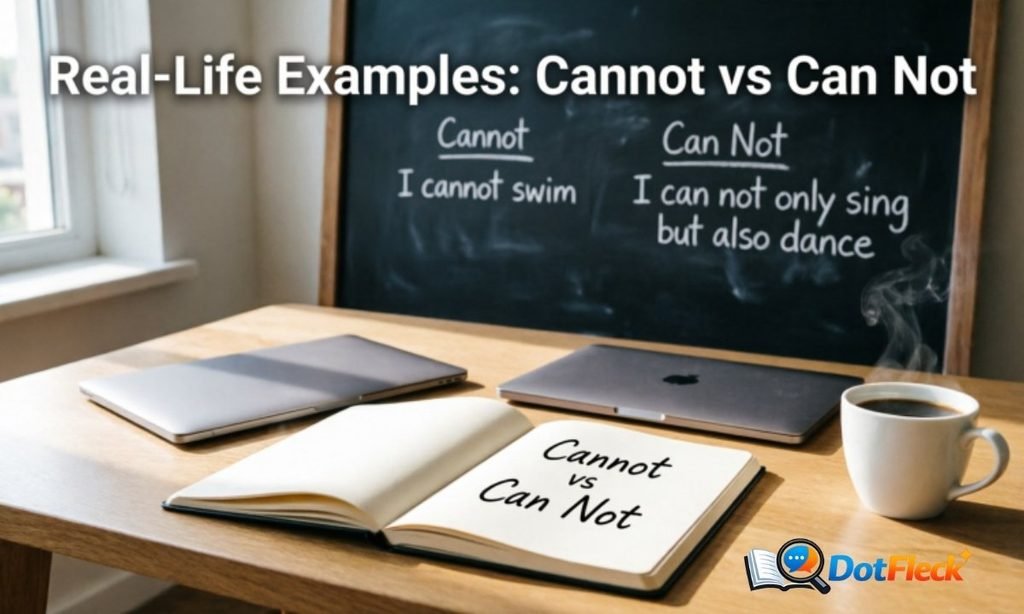
Seeing both forms across different settings makes the rule easier to remember.
Everyday conversation: “I cannot believe it’s already September.”
Text message: “can’t talk rn, cannot find my keys 😩”
School or academic writing: “The data cannot support this conclusion without a larger sample size.”
Workplace email: “Unfortunately, I cannot join the call at 3 p.m., but I’m free after 4.”
Formal writing: “The court cannot grant the motion without additional evidence.”
Emphatic or “not only” construction: “Great leadership can not only inspire a team, but also transform an entire company culture.”
Notice that cannot appear in nearly every context, while can not show up only in that final, specific pattern.
Common Mistakes to Avoid
The most frequent mistake is treating can not as an interchangeable, casual alternative to cannot. It isn’t. Here’s how to keep the two straight.
- Mistake: Writing “I can not go to the party” when you simply mean you’re unable to go. Fix: Write “I cannot go to the party.” Save “can not” for the “not only” pattern or deliberate emphasis.
- Mistake: Assuming can not is more formal because it’s spelled out as two words. Fix: Cannot is the formal, standard choice. Can not is not more proper, it’s simply less common.
- Mistake: Confusing can’t with can not in formal documents. Fix: Avoid can’t in formal writing altogether, and use cannot instead.
A simple way to remember the difference: if you can swap in “cannot” and the sentence still makes complete sense, “cannot” is what you should use. If swapping it in breaks the sentence usually because of a “not only” construction then “can not” is correct.
Cannot vs. Can’t: A Related Distinction
Since these three forms often get grouped together, it helps to separate them clearly.
- Cannot is the full, standard negative form. It works in both formal and everyday writing.
- Can’t is the contraction of cannot. It’s common in speech, texting, and casual writing, but many style guides recommend avoiding it in formal documents like reports, essays, and legal writing.
- Can not is the rare, two-word form reserved for specific grammatical constructions or emphasis.
For formal usage, cannot is your best bet. For casual usage, can’t is completely natural. Can not stay in the background, ready for those “not only” moments.
Practical Guidance for Choosing the Right Form
When you’re deciding which spelling to use, run through this quick mental checklist:
- Are you expressing inability or impossibility in a normal sentence? Use cannot.
- Does the sentence include “not only… but also” or a similar split construction? Use can not.
- Do you want to add strong, deliberate emphasis to the word “not”? Can not work here too.
- Are you writing casually, like a text or social media post? Can’t be perfectly fine.
- Are you writing something formal, like a resume, academic paper, or business report? Stick with cannot and skip the contraction.
Following this checklist removes the guesswork almost every time.
Frequently Asked Questions
Is “can not” grammatically correct?
Yes, but only in limited situations. It’s correct when “not” is part of a separate phrase like “not only,” or when a writer wants to emphasize “not” on purpose. For a plain statement of inability, cannot is the correct and expected form.
What is the difference between cannot and can not?
Cannot is one word and is the standard form used in nearly all writing. Can not is two words and is reserved for specific grammatical patterns or added emphasis. Both express the same core meaning, but cannot be the form readers expect.
Should I use cannot or can’t in an email?
For a professional email, cannot is generally the safer choice, since it avoids the informality of a contraction. For a casual email to a coworker you know well, can’t is perfectly acceptable.
Why does itnot look like one word when other negatives don’t?
There’s no strict grammatical reason; it’s simply a spelling convention that developed over time. Cannot be fused into a single word centuries ago, while similar phrases like “will not” and “does not” stayed separate.
The Bottom Line
Cannot is the correct spelling to reach for almost every time you want to express that something is impossible or not allowed. Can not survive only in narrow cases, mainly the “not only… but also” construction or intentional emphasis.
When in doubt, write cannot as one word, and save can’t for casual conversation. Getting this right is a small detail, but it’s the kind of detail that makes your writing look polished and confident.

Ethan Whitmore is an English language writer who enjoys making grammar, word meanings, and modern slang simple and easy to understand. His content focuses on clear explanations, practical examples, and everyday English usage.