
You are typing a flyer, an email, or a school form, and you stop for a second. Does the word end in “er” or “or”? The question of Sponsor vs. Sponser trips up many writers because both spellings look believable and sound exactly the same when spoken. Only one of them is correct, and the other is a typo that spell checkers flag every time.
This guide gives you the quick answer first, then covers the meaning, origin, pronunciation, and word forms of sponsor. You will also see why people misspell it, how to avoid the error with simple memory tricks, and how to use the word in real sentences. By the end, you will be able to spell and use sponsor with confidence in American English.
Quick Answer: Is It Sponsor or Sponser?
The correct spelling is sponsor. The word ends in “-or,” not “-er.” If you are wondering whether “sponser” is a word, the answer is no. It does not appear in standard American or British dictionaries.
Here is the short version:
- Correct: sponsor, sponsors, sponsored, sponsoring, sponsorship
- Incorrect: sponser, sponsers, sponsered, sponsering, sponsership
If you remember only one thing, remember that the last three letters are “sor,” as in “sponsor.” Everything else in this article explains why.
What Does “Sponsor” Mean?
The sponsor meaning and definition depends on whether you use the word as a noun or a verb. In both cases, the core idea is support. A sponsor backs a person, event, group, or project, usually by giving money, resources, or a formal promise of help.
Dictionaries also list a few narrower senses. A sponsor can be a person who vouches for another, a company that pays for advertising, or an organization that funds an event. Context almost always makes the meaning clear.

Sponsor as a Noun
As a noun, a sponsor is the person, business, or group that provides support. The support may be financial, practical, or moral. Some common uses include:
- A business that pays for a sports team’s uniforms
- A person who guides a new member in a support program
- A legislator who introduces a bill
- A person who vouches for someone applying for a visa or a job
Here are two examples. “The local bakery is the main sponsor of the school fun run.” “She asked her manager to be her sponsor for the leadership program.”
Sponsor as a Verb
As a verb, to sponsor means to provide support for someone or something. The verb often takes a direct object, such as an event, a team, or a person. For example, “A software company will sponsor the conference this spring.”
The verb can also describe formal backing in a legal or official setting. “The council member plans to sponsor the new parks bill.” In each case, the subject is the one giving the support.
Why Do People Misspell Sponsor as Sponser?
The main reason is sound. In everyday American English, the final syllable of sponsor is a weak, unstressed vowel sound that is nearly identical to the ending of “faster” or “teacher.” Since “er” is a very common ending, many writers reach for it without thinking. This is a classic example of common spelling mistakes in English, where a spelling follows the sound instead of the rule.
A second reason is pattern confusion. English has many words that end in “-er” for a person who does something, such as “baker,” “writer,” and “singer.” Because a sponsor is also a person who does something, “sponser” feels like it should follow the same pattern.
The word does not follow that pattern because it comes from Latin, which brings us to the next section. Many Latin-based words keep the “-or” ending, so the sponser spelling mistake is understandable but still wrong.
Word Origin of Sponsor
Sponsor comes from the Latin word sponsor, meaning a guarantor or a person who makes a solemn promise on behalf of another. That Latin noun comes from the verb spondere, which means “to promise” or “to pledge.” The word entered English in the 1600s, first with a religious sense and later with a general meaning of support.
The “-or” ending is a Latin suffix that marks a person or thing that performs an action. It appears in many English words that came from Latin, including “actor,” “doctor,” “tutor,” “mentor,” “investor,” and “director.” Knowing this helps explain why sponser is incorrect: the English word keeps the Latin ending, and it never switched to “-er.”
How to Pronounce Sponsor
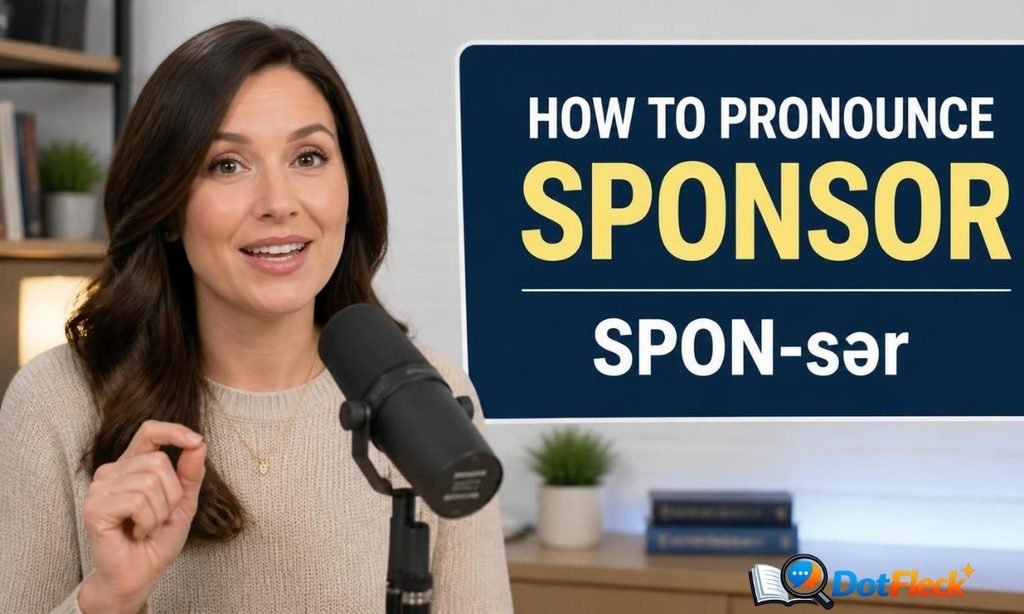
In American English, sponsor is pronounced SPON-ser, with the stress on the first syllable. The first vowel sounds like the “o” in “father,” and the second syllable is short and unstressed. A common phonetic spelling is /ˈspɑːnsər/.
British speakers say it slightly differently, with a shorter first vowel and a softer ending, roughly SPON-suh. Both versions share the same spelling, which is why the sponsor word spelling and pronunciation can feel disconnected. Say it slowly and break it into two parts: “spon” and “sor.”
Word Forms of Sponsor (Sponsored, Sponsoring, Sponsorship)
Sponsor is a regular word, so its forms are easy to build. Here are the main ones:
- Sponsor: the base form, used as a noun or a verb
- Sponsors: the plural noun or the present tense verb (he sponsors)
- Sponsored: the past tense or past participle
- Sponsoring: the present participle
- Sponsorship: the noun for the act or arrangement of sponsoring
Note the correct spelling of sponsorship: it keeps the “-or” in the middle, so it is never “sponsership.” A related form is “cosponsor,” which means someone who shares sponsorship, and in American English it is normally written as one word.
The difference between sponsor vs sponsorship is simple. A sponsor is the person or group giving support, while sponsorship is the support itself or the arrangement. “The airline is our sponsor” names the giver, and “The airline’s sponsorship covered all travel costs” names the support.
Is “Sponser” Ever Correct in British or American English?
No. Whether you follow sponsor spelling in American English or sponsor spelling in British English, the word is spelled the same way. Unlike words such as “color” and “colour” or “center” and “centre,” sponsor has no regional variant.
If you see “sponser” in a published text, treat it as an error. It sometimes appears as a brand name or a username, where creative spelling is a choice, but it is not an accepted spelling for the common word.
Sponsor vs. Sponsorer: Is “Sponsorer” a Word?
Some writers add an extra “-er” and produce “sponsorer,” thinking it names the person who sponsors. This is not a standard word. Sponsor already names the person, so adding “-er” is redundant, much like writing “teacherer.”
If you need a term for the giver, use “sponsor.” If you need a term for the person receiving support, you can use “sponsored” as an adjective, as in “the sponsored athlete,” or simply say “recipient” or “beneficiary.”
Memory Tricks to Never Misspell Sponsor Again
A few simple tricks can lock in the correct spelling. Pick the one that feels most natural to you.
- Think of related “-or” words. Sponsor sits with “mentor,” “tutor,” and “investor,” all people who support or guide others.
- Use the root. The Latin sponsor ends in “-or,” and the English word kept it.
- Link it to the middle. The word “sponsorship” shows the “-or” clearly, so spell that long form once and the short one follows.
When you proofread, scan for the letters “ser” in any word that should be sponsor. A quick search in your document can catch the mistake in seconds.
Types of Sponsors

The word covers many situations, and knowing the common types helps you use it correctly. Each type has the same spelling.
- Corporate sponsor: a company that funds an event, team, or program in exchange for visibility
- Event sponsor: a business or group that pays for part of a conference, festival, or fundraiser
- Immigration or visa sponsor: a person or employer who formally supports someone’s application
- Program sponsor: a person who guides a new participant in a recovery or mentoring program
- Legislative sponsor: a lawmaker who introduces a bill
Sponsor in a Sentence: Example Usage
Seeing the word in context is the best way to learn how to use sponsor correctly. These examples of sponsor in sentences are grouped by setting.
Marketing and Business
- “Our company will sponsor the local marathon this fall.”
- “The brand signed a two-year sponsorship deal with the stadium.”
- “Every post was labeled as sponsored content.”
In business writing, “sponsored” often describes paid promotions. You will see it on social media, in newsletters, and in search results.
Education
- “The professor agreed to sponsor her research project.”
- “A local bank sponsors three scholarships each year.”
- “He needed a faculty sponsor before the club could be approved.”
Schools use the word for funding, supervision, and formal approval. A faculty sponsor is usually an adult who oversees a student group.
Sports
- “A sports drink company is sponsoring the tournament.”
- “The team’s main sponsor appears on the front of the jersey.”
- “She earned a sponsorship after winning the regional title.”
In sports, sponsors often pay for equipment, travel, or naming rights. Athletes may also be “sponsored” by a brand, which means the brand supports them financially.
Sponsor Synonyms and Related Words
If you want variety in your writing, you can use sponsor synonyms that fit the situation. Not every synonym matches every meaning, so choose with care.
- Backer: someone who supports a project, often with money
- Supporter: a general term for anyone who helps
- Patron: a person or organization that gives ongoing support, especially to the arts
- Benefactor: someone who gives generous financial help
- Promoter: someone who organizes or advertises an event
- Guarantor: a person who promises to take responsibility for another
As verbs, “fund,” “finance,” “back,” and “support” can replace “sponsor” in many sentences. Keep in mind that “sponsor” often suggests a formal or public arrangement, while “support” can be casual.
Common Sponsor Spelling and Usage Mistakes
Beyond the “sponser” typo, a few other errors show up often. Watch for these:
- Sponsers: the plural should be “sponsors.”
- Sponsered: the past tense should be “sponsored.”
- Sponsership: the noun should be “sponsorship.”
- Sponsor by: the correct phrase is “sponsored by,” as in “This event is sponsored by Green Bank.”
- Sponser’s vs. sponsors: use an apostrophe only for possession, as in “the sponsor’s logo.”
Another usage mistake involves confusing the noun and the verb. “We are looking for a sponsor” uses the noun, while “We plan to sponsor the event” uses the verb.
Practice Exercises
Test yourself with these short exercises. Choose the correct spelling or fill in the blank.
- Which is correct: sponsor or sponser?
- Fix the error: “The company is a proud sponsered of the event.”
- Complete the sentence: “The bank’s _____ made the festival possible.” (sponsor / sponsorship)
- Choose the correct phrase: “The match was (sponsor by / sponsored by) a car brand.”
- Correct the plural: “The event had five sponsers.”
- Is “sponsorer” a standard English word? Yes or no.
- Write the past tense of “sponsor.”
- Choose the correct spelling: sponsership or sponsorship.
Practice Answer Key
- Sponsor is correct.
- “The company is a proud sponsor of the event.” (Or “was sponsored by” depending on the meaning.)
- Sponsorship.
- Sponsored by.
- “The event had five sponsors.”
- No.
- Sponsored.
- Sponsorship.
Frequently Asked Questions
Which is correct, sponser or sponsor?
Sponsor is correct. “Sponser” is a common misspelling and does not appear in standard dictionaries.
Which is correct, sponsor by or sponsored by?
“Sponsored by” is correct. It uses the past participle to show who provided the support, as in “sponsored by a local bank.”
Is the word sponsor correct?
Yes, sponsor is a standard English word. It works as both a noun and a verb in American and British English.
Is it sponsors or sponsor’s?
Use “sponsors” for more than one sponsor. Use “sponsor’s” to show that one sponsor owns something, as in “the sponsor’s logo.”
Why is sponser incorrect?
The word comes from Latin and keeps the “-or” ending. English never adopted “-er” for this word.
Final Thoughts
The answer to the Sponsor vs. Sponser question is simple: sponsor is the only correct spelling. The mistake happens because the ending sounds like “-er,” but the word comes from Latin and keeps its “-or” ending. This is true in both American and British English, and the same rule applies to sponsored, sponsoring, and sponsorship.
To keep the spelling right, link sponsor to related words like mentor and tutor, or spell out sponsorship once to see the “-or” in the middle. Use “sponsored by” instead of “sponsor by,” and remember that “sponsorer” is not a word. With a little practice, this common mistake will be easy to avoid.

Ethan Whitmore is an English language writer who enjoys making grammar, word meanings, and modern slang simple and easy to understand. His content focuses on clear explanations, practical examples, and everyday English usage.