
You are typing a quick note to a coworker and suddenly stop. Is it messege or message? The ending sounds like it could be spelled more than one way, and even confident writers sometimes hesitate. If that has happened to you, you are not alone, and the answer is simpler than it seems.
This article gives you a clear answer and the reasons behind it. You will learn the correct spelling of message, why “messege” is a spelling mistake, how to pronounce the word, and how to use it in a sentence. You will also see how to avoid mixing it up with “massage,” plus a few memory tricks and a short quiz. Everything here follows American English, so you can write the word right every time.
Quick Answer
The correct spelling is message. It ends in -age, not -ege. “Messege” is a misspelled word and does not appear in standard American English dictionaries.
If you are asking yourself, “is it messege or message,” the answer never changes. Use “message” in emails, texts, essays, resumes, and every other kind of writing. Here is the difference at a glance:
- Correct: message, messages, messaged, messaging
- Incorrect: messege, messeges, messeged, messeging
What Does “Message” Mean?
The message meaning in English is a piece of information sent from one person or group to another. It can be spoken, written, or sent through a device. A note on the fridge, a voicemail, a text message, and an email message all count.
The word also has a broader sense. A message can be the main idea or lesson behind something, such as a movie, a speech, or an advertisement. In that case, it is the point the creator wants you to understand.
The message definition and examples below show both senses:
- She left a message on his desk before she went home. (a written note)
- The voice message was only ten seconds long. (a recorded communication)
- The message of the story is that kindness matters. (the main idea)
How to Pronounce “Message”
In American English, “message” has two syllables and is pronounced MESS-ij. The stress falls on the first syllable. The second syllable sounds like “ij,” with a soft “j” sound at the end.
This is where the confusion starts. Because the ending sounds like “ij,” some writers guess it should be spelled “-ege” or “-edge.” A good message pronunciation and spelling tip is to remember that the spoken “ij” ending is very often written as -age in English.
Say it slowly a few times: mess + age. Splitting the word into “mess” and “age” helps your eyes and ears agree. That small habit makes the correct spelling easier to remember.
Where “Message” Comes From
The word “message” came into English from Old French “message.” That word came from Medieval Latin “missaticum,” which relates to the Latin verb “mittere,” meaning “to send.” The idea of sending is still at the heart of the word today.
Looking at the history helps explain the spelling. The “-age” ending arrived with many French-based words, and English kept it. The spelling has stayed the same for centuries, which is why “messege” has never been accepted as a variant.
This origin also links “message” to its relatives, such as “messenger.” Both words are about carrying information from one place to another. If you can spell “messenger,” you can use it as a reminder of the “mess” at the start of “message.”
Why Do People Misspell “Message” as “Messege”?
Most spelling mistakes come from sound, not carelessness. In “message,” the last syllable is unstressed, so it sounds soft and quick. When a vowel sound is that weak, it is easy to pick the wrong letter for it.
Another reason is the influence of other words. Some well-known words end in -ege, such as “college,” “privilege,” and “sacrilege.” Because “college” is pronounced with the same “ij” ending, the brain may copy that pattern onto “message.”
Fast typing plays a part too. When you type quickly, your fingers may swap letters without you noticing. This is one of the most common English spelling mistakes, and it is easy to fix once you know the rule.
The Spelling Pattern Behind “Message”
The English spelling rules for message are friendly because the word follows a very common pattern. Many words end in -age and are pronounced with the “ij” sound. They include:
- village
- package
- passage
- damage
- language
- image
- manage
- sausage
- cottage
- luggage
By comparison, the -ege ending is much rarer. The short list includes “college,” “privilege,” “sacrilege,” and “allege.” In that group, “college” and “privilege” are the ones most likely to cause trouble, because they sound just like “-age” words.
A helpful rule of thumb is this: when a word ends in the “ij” sound, “-age” is the safer first guess. It is not a perfect rule, but it works for “message” and for most words you will use every day.
Is “Message” a Noun or a Verb?
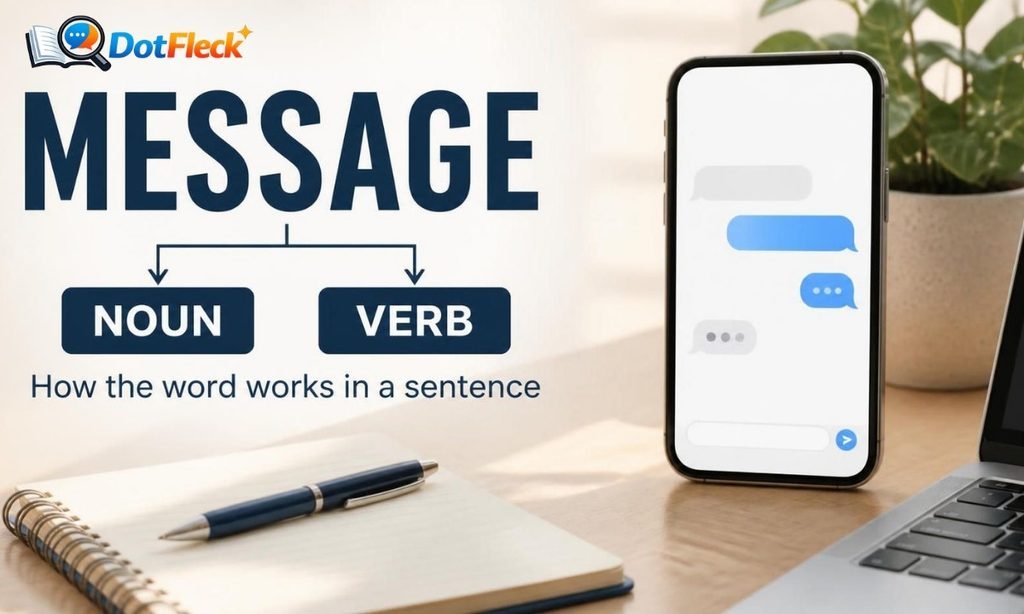
“Message” is mainly a noun. As a noun, it names the information being sent, such as “a message from my manager.” It can be counted, so you can have one message or many messages.
“Message” is also used as a verb, especially in modern American English. To message someone means to send them a written or digital communication. This use is common in everyday speech and informal writing, and it is widely accepted.
Here are both forms in action:
- Noun: I got your message this morning.
- Verb: I will message you when I arrive.
The message plural spelling is simple. Just add “s” to make “messages.” The verb forms are “messages,” “messaged,” and “messaging.” The spelling of the “-age” ending stays the same in all of them, and the final “e” drops only before “-ing,” as in “messaging.”
How to Use “Message” Correctly
Using “message” correctly is mostly about choosing the right verb and preposition. People usually send, leave, receive, read, or delete a message. They leave a message for someone or send a message to someone.
It also helps to know the many forms the word can take. You may see “text message,” “voice message,” “email message,” “error message,” “direct message,” or “message board.” In each case, the base word is spelled the same way.
For variety in your writing, you can swap in a few message synonyms in English, depending on the meaning:
- note
- memo
- text
- notice
- announcement
- communication
- dispatch
- word, as in “Send word when you arrive.”
Example Sentences
Seeing the word in context is one of the best ways to learn it. These example sentences with message show different uses:
- Please leave a message after the tone.
- The teacher wrote a short message on the whiteboard.
- I sent her a message to confirm the time.
- The error message told me the file was missing.
- She will message the group chat tonight.
- The poster has a clear message about recycling.
- He read every message before replying.
- Did you get my message about the meeting?
Notice that each sentence uses the spelling “message” without exception. Whether the word is a noun, a verb, or part of a phrase, the spelling stays the same.
Common Mistakes to Avoid
Even writers who know the correct spelling can slip. Here are the message spelling mistakes to watch for:
- Writing “messege.” The ending should be “-age,” not “-ege.”
- Writing “mesage.” A single “s” drops the double “s” that the word needs.
- Writing “massage” by accident. This is a different word with a different meaning.
- Writing “messeges” for the plural. The correct plural is “messages.”
- Writing “messeging” or “messageing.” The correct form is “messaging.”
A quick proofread will catch most of these. Read the word out loud, check for the double “s,” and make sure it ends in “-age.”
Other Common Misspellings
“Messege” is far from the only word that gives writers trouble. Many of the common English spelling mistakes come from silent letters, double letters, or sounds that can be spelled several ways. Knowing a few of them can make your writing cleaner.
Here are some frequent examples, with the correct spelling first:
- receive, not recieve
- definitely, not definately
- separate, not seperate
- occurred, not occured
- accommodate, not accomodate
- necessary, not neccessary
- embarrass, not embarass
- knowledge, not knowlege
Notice that “knowledge” ends in “-edge,” which is another pattern that sounds like “ij.” These commonly confused English words and spellings show why it pays to slow down on endings. When you are unsure, check a trusted dictionary.
“Message” vs. “Massage”: Don’t Let Autocorrect Trip You Up
The message vs misspelled message problem is not the only risk. Sometimes the mistake is a real word, just the wrong one. “Message” and “massage” look alike, but they mean very different things.
A message is information that is sent or received. A massage is the rubbing or pressing of muscles to relieve pain or help someone relax. The two words also sound different in American English: “message” is MESS-ij, while “massage” is muh-SAHJ.
Autocorrect can make the mix-up worse. A typo like “messege” may be changed to the wrong word, and a spell checker will not always notice a real word used in the wrong place. Compare these sentences:
- Correct: I left you a message about the appointment.
- Incorrect: I left you a massage about the appointment.
- Correct: She booked a massage after a long week.
Always reread the final version of anything you plan to send. A quick check can prevent an embarrassing slip.
Common Idioms and Phrases With “Message”
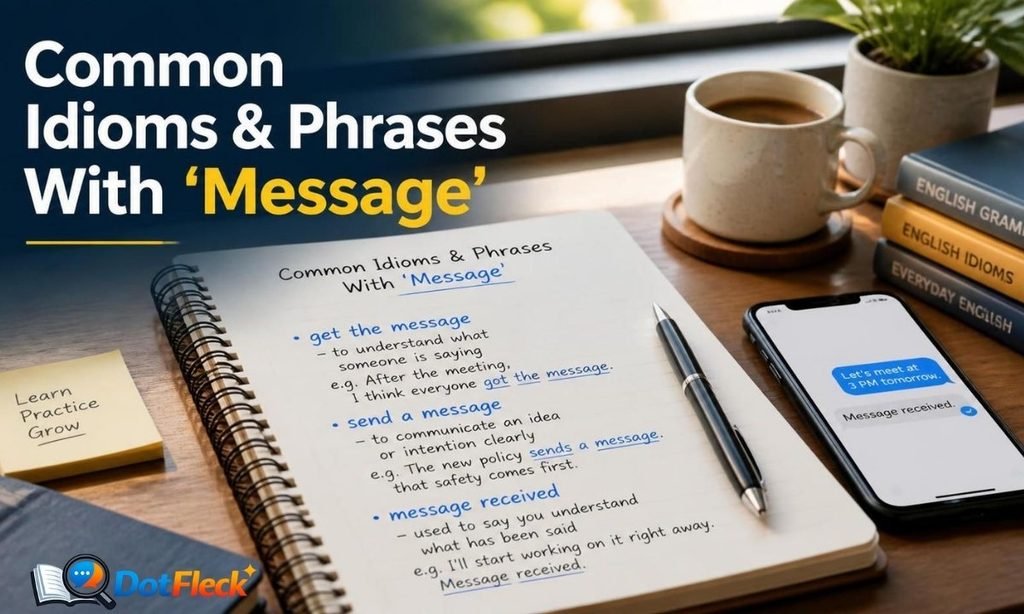
“Message” appears in many everyday expressions. Knowing them can help you understand English better and use the word with more confidence. Each one uses the same standard spelling.
- Get the message: to understand what someone is trying to say. Example: “After the third reminder, he finally got the message.”
- Message received: a way of saying you understand. Example: “Message received. I will be on time.”
- Don’t shoot the messenger: don’t blame the person who delivers bad news.
- Mixed message: a signal that is unclear or contradicts itself.
- Get the message across: to make an idea clear to others.
- On message / off message: staying with, or straying from, the main point in a speech or campaign.
- Message in a bottle: a note sent in a sealed bottle, often a romantic or adventurous image.
- The medium is the message: a famous phrase suggesting that the way information is delivered shapes how it is understood.
Easy Memory Tricks to Remember the Spelling
Memory tricks work well for spelling because they connect a rule to something you can picture. Try one or two of these and keep the one that sticks.
- Split it in two. Think “mess” + “age.” If you can spell those two small words, you can spell “message.”
- Think of other “-age” words. Link it with “package,” “village,” and “passage.” They all share the same ending.
- Remember the sender. A message needs a sender, and “sender” has an “e” near the end, but “age” is how the word finishes.
- Picture a mailbox. Imagine a mailbox with the letters A-G-E on the door. That image tells you the ending is “-age.”
- Remember your age. You carry your age with you, and you also carry a message when you deliver one.
Writing the word correctly a few times also helps. Type it five times, use it in one sentence, and say it out loud. Repeating it in a real context is stronger than memorizing a rule.
Quick Quiz: Test Yourself
Try these questions, then check your answers below.
- Which spelling is correct: messege or message?
- What is the plural of “message”?
- Fill in the blank: Please leave a ______ after the beep.
- Which word means a relaxing rub for sore muscles: message or massage?
- Which spelling is correct: messaging or messageing?
- Is “messege” a word in standard American English?
Answers:
- message
- messages
- message
- massage
- messaging
- No, it is a misspelling.
If you got all six right, you have this spelling under control. If not, review the section on the -age pattern and try again.
Frequently Asked Questions
What is correct, message or messege?
“Message” is correct. “Messege” is a common misspelling and is not accepted in standard American English.
What is the difference between messege and message?
There is no difference in meaning. “Message” is the real word, while “messege” is only a spelling mistake that should be corrected.
What is the difference between a message and a massage?
A message is information sent to someone. A massage is a rubbing of muscles for relief or relaxation. They sound and mean different things.
What do you mean by message?
A message is a piece of information sent from one person to another. It can also mean the main idea of a speech or story.
Is “messege” a word?
No, “messege” is not a word. It is a misspelled form of “message” and will usually be flagged by a spell checker.
How do you spell the plural of message?
Add an “s” to make “messages.” No other letters change, and the “-age” ending stays the same.
The Bottom Line
When you wonder about messege or message, the answer is always message. The word ends in “-age,” follows a very common English spelling pattern, and has come from the idea of sending information for centuries. “Messege” is simply a misspelling, usually caused by the soft “ij” sound at the end of the word.
To keep it right, remember a few easy habits. Split the word into “mess” and “age,” compare it with words like “package” and “village,” and double-check that you did not type “massage” by mistake. With a little practice, you can use “message” correctly in every email, text, and sentence you write.

Ethan Whitmore is an English language writer who enjoys making grammar, word meanings, and modern slang simple and easy to understand. His content focuses on clear explanations, practical examples, and everyday English usage.