
Have you ever reread your own draft and noticed “which” showing up three times in one paragraph? It is a common problem, and it can make writing feel stiff and repetitive. Many writers search for synonyms for “which” hoping for a simple one-word swap, but the real answer is a little more complicated.
That is because “which” works as a pronoun, a question word, and a determiner, so no single word replaces it in every sentence. This article explains what “which” means, which alternatives actually work, and how to choose the right one for your context. You will also see clear examples, common mistakes, and a short practice quiz so you can write with more confidence.
Quick Answer
There is no perfect one-word synonym for “which,” but several words can replace it depending on the sentence. Use that for essential information, who or whom for people, whose for possession, and where or when to replace phrases like “in which.” Use what for open questions and whichever for any choice from a set.
Sometimes the best fix is to rewrite the sentence. For example, “The report, which was long, confused readers” can become “The long report confused readers.” Cutting the clause often works better than swapping the word.
What Does “Which” Mean and What Part of Speech Is It?
“Which” points to a specific thing or group of things. It can ask a question, add information about a noun, or narrow a choice. Because it does three jobs, the right alternative depends on the job it is doing in your sentence.
Knowing the part of speech is the first step to finding another word for which. Here are the three main roles.
Which as a Relative Pronoun
As a relative pronoun, “which” connects a clause to a noun and usually refers to things or animals. It most often introduces extra information set off by commas.
- The library, which opened in 1998, is being renovated.
- She adopted a dog, which was a surprise to her family.
Which as an Interrogative Pronoun
As an interrogative pronoun, “which” stands alone in a question and asks for a choice from a known set. The set may be named or understood from context.
- Which is your favorite?
- Which of these books did you read?
Which as a Determiner
As a determiner, “which” comes before a noun and asks or states a choice. In this role it works like an adjective.
- Which route should we take?
- I can’t remember which restaurant we chose.
Is There a Real Synonym for “Which”?
Not exactly. Dictionaries and thesauruses do not list a true one-to-one match, because every possible replacement covers only part of what “which” can do. Words like “that,” “what,” “who,” and “whichever” overlap with it, but each fits a narrower situation.
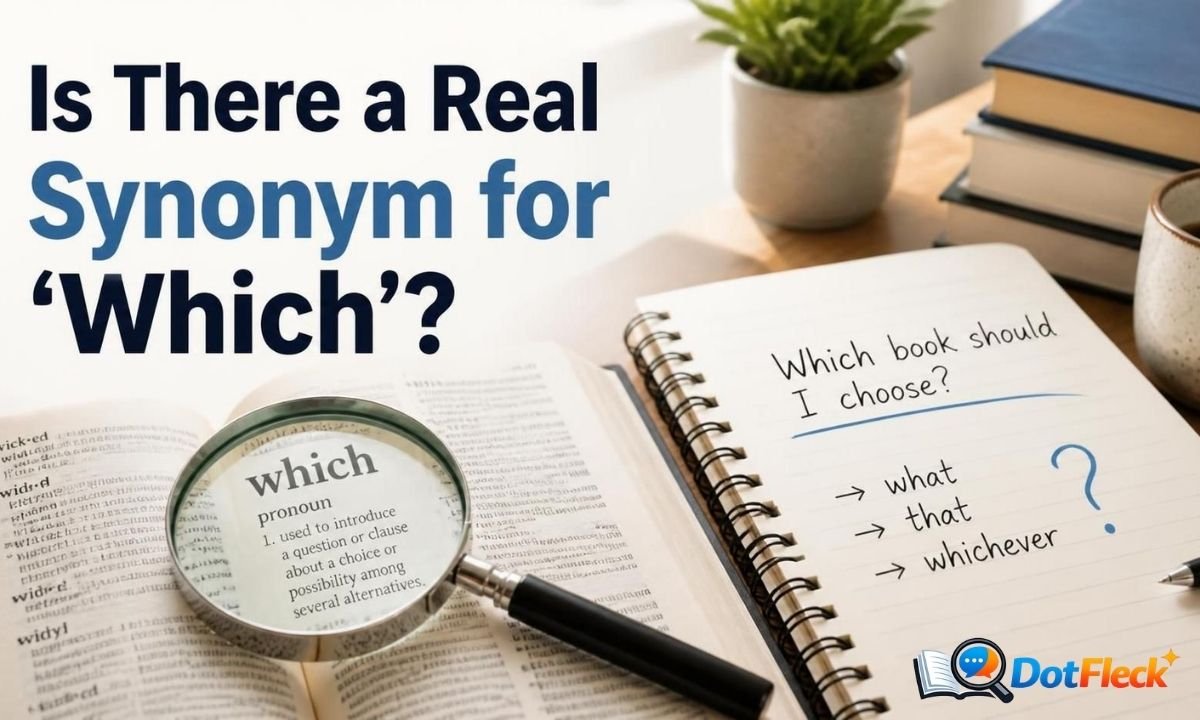
So when people ask for words similar to which, the useful answer is a set of options sorted by function. A replacement for “which” in a question will not work in a relative clause, and the reverse is also true. The next sections show you how to match the word to the job.
How to Choose the Right Alternative to “Which” by Context
Start by asking what “which” is doing in your sentence. Is it asking a question, adding a side note, or limiting the noun? Once you know, the options narrow quickly. Tone also matters, since a formal report and a text message call for different choices.
Formal and Academic Writing
Formal writing favors precise connectors. Phrases such as “whereby,” “in that,” and “of which” keep a serious tone, and “whose” is often cleaner than “of which.” For synonyms for which in academic writing, restructuring is often the strongest move.
- The study used a survey, which produced mixed results. → The study used a survey that produced mixed results.
- The policy, in which costs are shared, was approved. → The policy, whereby costs are shared, was approved.
Informal and Conversational Use
In casual speech, people often drop “which” or swap it for something simpler. “What” and “that” are common in everyday talk, and sentences are usually shorter.
- Which one do you want? → What do you want?
- It’s the movie which I told you about. → It’s the movie I told you about.
Asking Questions
For questions, “which” asks about a limited set, while “what” asks about an open set. Choose based on whether the options are known.
- Which dessert did you order? (A menu is in front of you.)
- What dessert do you like? (Any dessert is possible.)
Introducing Extra Information (Nonrestrictive Clauses)
A nonrestrictive clause adds details that can be removed without changing the main meaning. In American English, these clauses use “which” and are set off with commas. You cannot swap in “that” here.
- My phone, which is two years old, still works well.
To replace “which” in this case, you can use a participle phrase or a separate sentence. “My phone, two years old, still works well” and “My phone is two years old. It still works well” both avoid the word.
Introducing Essential Information (Restrictive Clauses)
A restrictive clause is needed to identify the noun, so it takes no commas. American English prefers “that” here, although “which” is sometimes used. This is the most common answer to how to replace which in a sentence.
- The book that I borrowed was excellent.
- The book I borrowed was excellent. (Dropping “that” is also fine.)
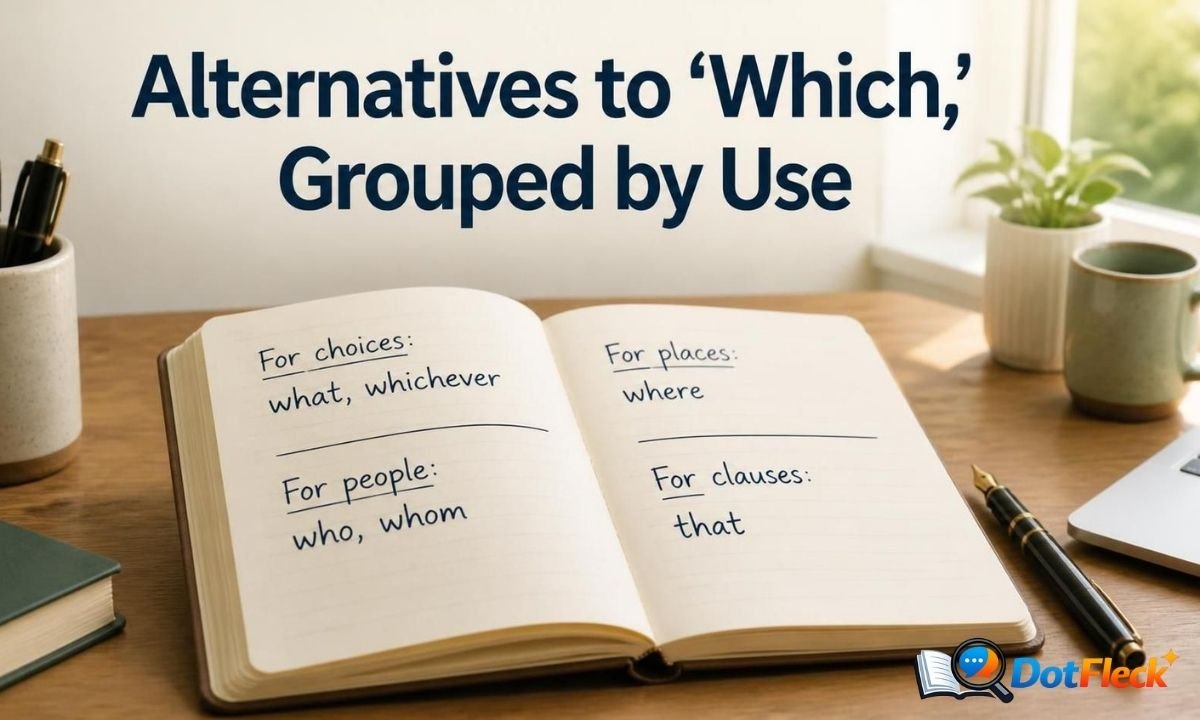
Alternatives to “Which,” Grouped by Use
Grouping alternatives by use is the easiest way to remember them. The lists below show common substitutes for which in writing, with examples that show how each word behaves.
Interrogative Alternatives
These work in questions.
- What: What time works for you?
- Who: Who is coming to the meeting? (for people)
- Whom: To whom should I send this?
- Whose: Whose jacket is this?
Relative Clause Alternatives
These connect a clause to a noun.
- That: The car that I bought is blue.
- Who: The teacher who helped me retired.
- Whom: The man whom I met was friendly.
- Whose: The company whose logo changed is hiring.
- Where/When: The house where I grew up is gone. (instead of “the house in which I grew up”)
Choice-Among-Options Alternatives
These help you point to one or more items from a group.
- Whichever: Choose whichever seat you like.
- Either: Either answer is correct. (two options)
- Whatever: Pick whatever works best.
- This one / that one: Do you want this one or that one?
Formal Phrase Alternatives
These suit reports, essays, and legal or business writing.
- Whereby: The plan allows a system whereby users can opt out.
- In that: The method is useful in that it saves time.
- As a result: The test failed. As a result, we delayed launch. (instead of “which meant we delayed launch”)
- Of whom / whose: The authors, three of whom are students, signed the letter.
“Which” vs. Similar Words
Many errors come from mixing “which” with words that look or sound close to it. These short comparisons clear up the confusion. They also answer the common question “is that a synonym for which?” Sometimes yes, but only in certain clauses.
Which vs. That
Use “that” for essential information and “which” for extra information with commas. This is the standard rule in American English for which vs that grammar rules.
- The laptop that broke was mine. (Identifies which laptop.)
- The laptop, which broke yesterday, was mine. (Adds extra detail.)
Which vs. What
“Which” asks about a limited set. “What” asks about an unlimited one. This is the core difference between which and what, and it answers the question “can what replace which in a sentence?” Only when the choices are open.
- Which pen do you want? (There are three on the table.)
- What pen do you like? (Any pen in general.)
Which vs. Who/Whom
Use “who” and “whom” for people and “which” for things. Questions with a limited group of people are an exception, because “which” can work as a determiner.
- Which candidate impressed you most?
- The woman who called is waiting.
Which vs. Whichever
“Which” refers to a particular choice. “Whichever” means any choice from the group, so it adds freedom. Knowing when to use whichever instead of which helps you avoid awkward phrasing.
- Which option is cheaper? (You are asking about a specific choice.)
- Take whichever option is cheaper. (Any of them will do.)
Which vs. Either
“Either” is for exactly two options, and it means one or the other. “Which” works for two or more.
- Which of the three colors do you prefer?
- Either color looks good on you.
Read Now : 31st or 31th? Discover the Correct Spelling Now
British vs. American English: Does “Which” Ever Replace “That”?
In British English, “which” is often used in restrictive clauses where Americans would use “that.” A British writer might say “The house which I bought is old” without a problem. American style guides generally advise “that” in those cases and reserve “which” for clauses with commas.
For a US audience, the safer choice is to follow the American rule. Use “that” for essential information and “which” for extra information. If you are unsure, read the sentence without the clause. If the meaning changes, the clause is essential and probably needs “that.”
Can You Start a Sentence With “Which”?
Yes, in questions. “Which of these jobs pays more?” is a perfectly correct sentence. As a relative pronoun, “which” can also begin a sentence that refers back to a previous idea, as in “Which is why I left early.” This is a fragment, though, so it works better in casual writing than in formal essays.
In formal writing, attach the clause to the previous sentence with a comma or rewrite it. “I left early, which is why I missed the call” is cleaner than splitting it. “I missed the call because I left early” is cleaner still.
Common Phrases and Expressions With “Which”
“Which” appears in many fixed phrases. Learning them helps you spot natural alternatives.
- Which is why: Used to give a reason. Alternative: “so” or “that is why.”
- Which means: Used to explain a result. Alternative: “so” or “meaning.”
- In which case: Used to introduce a possibility. Alternative: “then” or “if so.”
- At which point: Used for timing. Alternative: “then” or “when.”
- Which is to say: Used to restate. Alternative: “in other words.”
- Of which: Used for parts of a group. Alternative: “whose” or “of whom.”
“Which” in Real-Life Sentences: School, Work, Writing, and Conversation
Seeing synonyms for which in a sentence makes the options easier to remember. Here are examples from four common settings.
School
- Original: The essay, which was due Friday, was late.
- Better: The essay due Friday was late.
- Original: Which of the answers is correct?
- Alternative: Which answer is correct?
Workplace
- Original: We changed the schedule, which caused confusion.
- Better: We changed the schedule, and that caused confusion.
- Original: The tool, in which data is stored, needs an update.
- Better: The tool where data is stored needs an update.
Writing
- Original: The novel, which won an award, was a bestseller.
- Better: The award-winning novel was a bestseller.
- Original: This is the method which I recommend.
- Better: This is the method I recommend.
Conversation
- Original: Which one do you want, the red or the blue?
- Casual: Red or blue?
- Original: I forgot which day the party is.
- Casual: I forgot what day the party is.
Common Mistakes to Avoid With “Which synonyms”
The most frequent mistake is using “which” in essential clauses in American English. “The car which I drove was fast” is understood, but “that” is the preferred form. Another common error is leaving out commas before nonrestrictive clauses, as in “My brother which lives in Denver called.” It should be “My brother, who lives in Denver, called.”
Writers also use “which” for people, such as “the teacher which helped me.” Use “who” instead. A final mistake is stacking several “which” clauses in a row, which makes sentences hard to follow. Break them up, trim them, or replace some with “that,” “where,” or participle phrases.
Quick Practice: Choose the Right Word
Try these short exercises. Choose the best word for each blank, then check the answers below.
- The movie ____ we watched last night was funny. (that / who)
- My car, ____ is ten years old, still runs well. (that / which)
- ____ shoes are these? (Which / Whose)
- Take ____ seat is open. (whichever / either)
- The woman ____ called you left a message. (which / who)
Answers: 1. that, 2. which, 3. Whose, 4. whichever, 5. who.
Frequently Asked Questions “Synonyms for Which”
What can I use instead of “in which”?
Use “where” for places, “when” for times, or “whereby” for methods. You can also rewrite the sentence to remove the phrase.
What can I replace which with?
Replace it with “that,” “who,” “whose,” “where,” or “what,” depending on the sentence. Sometimes simply deleting the clause works best.
What’s another way to say “which” means?
You can say “this means,” “that is,” “in other words,” or “so.” Each one introduces an explanation without repeating “which.”
What can I say instead of “which” in an essay?
Try “that,” “whereby,” “whose,” or a participle phrase. Splitting a long sentence into two shorter ones also keeps essays clear.
Key Takeaways “Synonyms for Which”
- “Which” has three roles: relative pronoun, interrogative pronoun, and determiner.
- No single word replaces it everywhere, so match the alternative to the job.
- Use “that” for essential clauses and “which” with commas for extra information in American English.
- Use “who” and “whom” for people, “whose” for possession, and “where” or “when” for “in which.”
- Use “what” for open questions and “whichever” for any choice from a set.
- Rewriting the sentence is often better than swapping a single word.
Conclusion “Synonyms for Which”
The best synonyms for “which” depend on what the word is doing. In questions, “what” and “whose” can fit. In relative clauses, “that,” “who,” “whom,” “where,” and “when” are strong choices. For choices among options, “whichever” and “either” work well.
To avoid repeating “which,” look at the clause first. If it is essential, use “that.” If it adds extra detail, keep “which” with commas or shorten the sentence. A little attention to meaning and tone will help you pick alternatives that make your writing clearer and easier to read.

Ethan Whitmore is an English language writer who enjoys making grammar, word meanings, and modern slang simple and easy to understand. His content focuses on clear explanations, practical examples, and everyday English usage.