
Is it encode or incode when you want to say you are turning information into a different format? If you have ever paused over the spelling, you are not alone. The two words look almost identical, and the mix-up shows up in emails, school papers, and even code comments. This guide on Encode vs. Incode gives a straight answer so you can write with confidence.
You will learn what encode means in everyday English and in computing, why incode is not a standard word, and how to use encode in a sentence. You will also see how encoding differs from decoding and encryption, review common mistakes, and test yourself with a short practice set. By the end, you will know exactly which spelling to use and why.
Encode vs Incode: Quick Answer
Encode is the correct spelling. It is a standard English verb that means to convert information into a code, symbol, or special format. Incode is not a standard English word, so it will be marked as an error in dictionaries and spell checkers.
If you are choosing between the two for a sentence, a school assignment, or a technical document, use encode. The only time you will see “Incode” is as a name, such as a company or product, and that is a proper noun rather than a regular word.
What Does “Encode” Mean?
“Encode” is a verb with a simple core idea. It means to put something into a code or a different form so it can be stored, sent, or understood in a specific way. The meaning stays close to that idea whether you are talking about messages, data, or even memories.
Definition in Everyday English
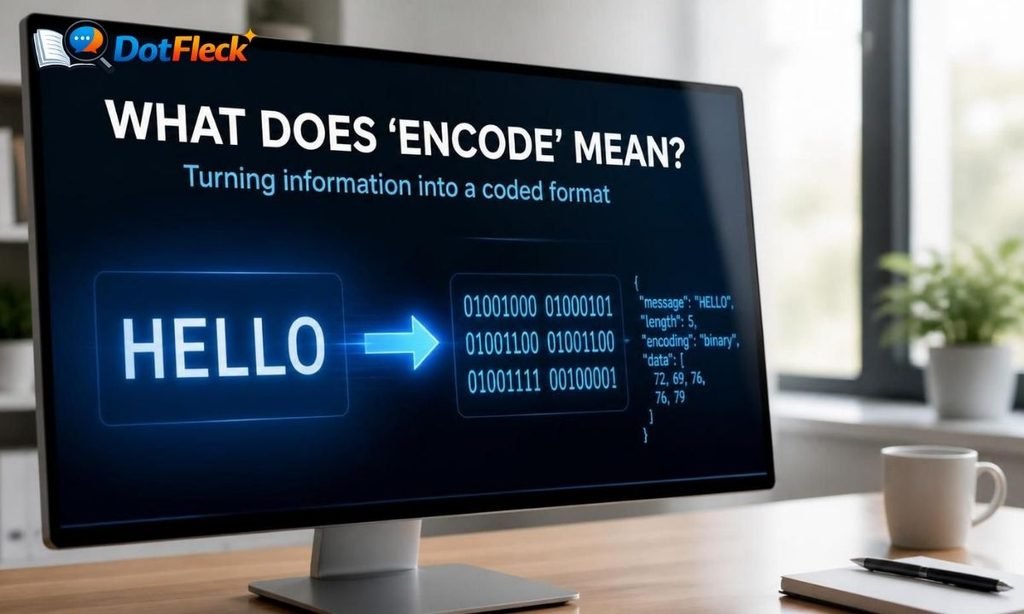
In everyday English, to encode means to turn a message, idea, or piece of information into a code or symbolic form. A spy might encode a note so only a partner can read it. A student might encode a long list of facts into a short phrase to remember it.
The word also appears in psychology. When people say the brain encodes a memory, they mean the brain converts an experience into a form it can store.
Definition in Computer Science
In computer science, to encode means to convert data from one format into another using a defined set of rules. The goal is usually to make the data easy to store, transmit, or display correctly. For example, a program can encode text as numbers so a computer can process it.
Encoding is about format, not secrecy. Anyone who knows the rules can reverse the process, which is why it differs from encryption.
How to Pronounce “Encode” (Syllables)
“Encode” has two syllables: en-code. It is pronounced en-KOHD, with the stress on the second syllable. The first syllable sounds like the “en” in “end,” and the second rhymes with “road.”
If you say it out loud, the spelling is easier to remember. The word starts with a clear “en” sound, not an “in” sound.
Word Origin of “Encode”
The word comes from the prefix en-, meaning to put into or to make, combined with the noun “code.” This pattern is common in English, with words such as “enclose,” “encircle,” and “enable.” The word “code” itself traces back to the Latin word codex, which referred to a book or set of written rules.
Parts of Speech and Word Forms
“Encode” is mainly a verb. Its related forms are used in many different sentence positions.
- Encode: base verb (We need to encode the file.)
- Encodes: third-person singular (She encodes each message.)
- Encoded: past tense and adjective (The encoded file was small.)
- Encoding: present participle, gerund, and noun (Encoding takes time.)
- Encoder: noun for a person or device that encodes
Is Incode a Real Word?
No, “incode” is not a real word in standard English. You will not find it as a regular entry in major dictionaries. When people write it, they are almost always trying to write “encode.”
That said, the string of letters does appear online. Understanding where it comes from helps you avoid it.
Where “Incode” Comes From
Most uses of “incode” come from spelling mistakes. The word sounds like it could start with “in,” because the unstressed first syllable is easy to hear as “in” when people speak quickly. Writers who rely on sound alone often pick the wrong vowel.
Some people also write “incode” because they are thinking of the phrase “in code,” as in “the message is in code.” That phrase is correct as two words, but it is a different construction from the single verb “encode.”
Is “InCode” Ever a Real Word?
“Incode” can appear as a brand or product name. For example, Incode Technologies is a company name in the identity verification field. Names like this are proper nouns, and companies can spell them however they choose.
Outside of a name, you should not use “incode” in regular writing. If you are describing the action of converting data, the correct word is always “encode.”
Why “Encode” and “Incode” Get Confused
The confusion is understandable. English has several word pairs where “en-” and “in-” look interchangeable, and some of them are even both correct. That inconsistency makes it hard to trust your instincts.
For “encode,” only one spelling is accepted. The mix-up is a memory problem, not a grammar rule.
The En- vs In- Prefix Pattern
Both “en-” and “in-” can come from Latin roots meaning “in” or “into.” Over time, English settled on different spellings for different words. Some words accept both forms, while others accept only one.
- Both accepted (with differences): enquire and inquire, ensure and insure (these two differ in meaning in US usage)
- One form preferred: enclose (inclose is rare), endorse (indorse is rare)
- Only one correct: encode (incode is not accepted)
When in doubt, check a dictionary. Do not assume that because “inquire” works, “incode” will too.
Encode vs Incode: Side-by-Side Comparison
A quick comparison makes the difference easy to see.
| Feature | Encode | Incode |
| Standard English word | Yes | No |
| Part of speech | Verb | None (misspelling) |
| Meaning | Convert into a code or format | No standard meaning |
| Correct in writing | Yes | No |
| Seen in names | Rarely | Sometimes as a brand |
| Example | We encode the data. | Not a correct sentence |
The table shows the main point. Encode is a real verb with a clear meaning, while incode is an error unless it is part of a name.
Grammar: Why Only “Encode” Is Correct
Grammar and spelling rules depend on dictionaries and established usage. Dictionaries list “encode” as a verb and give clear definitions for it. They do not list “incode” as a verb, noun, or adjective.
A word also needs consistent use in published writing to become standard. “Incode” has not met that standard, so it remains a mistake in formal and informal writing alike.
Grammar Role and Sentence Patterns
“Encode” is a transitive verb, which means it needs a direct object. You encode something. The object is the thing being converted, such as a file, a message, or a signal.
Common patterns include:
- Subject + encode + object: The system encodes the video.
- Subject + encode + object + as/into + format: The program encodes text as UTF-8.
- Subject + encode + object + in + format: She encoded the message in a simple cipher.
Example Sentences
These sentences show correct and incorrect usage side by side.
- Correct: The software will encode your photos before upload.
- Incorrect: The software will incode your photos before upload.
- Correct: Please make sure the file is encoded in UTF-8.
- Incorrect: Please make sure the file is incoded in UTF-8.
- Correct: Genes encode the instructions for building proteins.
How to Use “Encode” Correctly
Using “encode” correctly mostly comes down to remembering that it needs an object and that it describes a conversion. Once you know the common patterns, the word is easy to use in writing and conversation.
Common Sentence Patterns
You can use “encode” in several reliable ways.
- As a main verb: Developers encode strings before sending them in a URL.
- In the past tense: The team encoded the audio last night.
- As a participle: Encoded files take up less space.
- As a noun (encoding): The encoding of the file caused the error.
More Example Sentences
Here are more examples that show the word in different settings.
- She decided to encode her notes using a short color system.
- The app encodes every video to save storage space.
- The message was encoded so that only two people could read it.
- Our brains encode new memories while we sleep.
- The page uses UTF-8 encoding to show special characters.
Synonyms of Encode (and When They Aren’t Interchangeable)
Several words are close to “encode,” but they do not always fit the same situation.
- Code: often means to write programming instructions, not to convert data.
- Encrypt: means to scramble data so it stays secret.
- Convert: is general and does not suggest a coding system.
- Translate: suggests moving between languages.
- Cipher: usually refers to a secret code system.
If you only want to say that data changes format, “encode” or “convert” is usually the better pick. If secrecy matters, “encrypt” is more accurate.
“Encode” in Real Life
The word is not limited to computers. People use it in many everyday and scientific settings, and the meaning stays consistent: converting something into another form using rules.

Everyday Encoding Examples
Everyday encoding is easy to spot once you look for it. Morse code turns letters into dots and dashes. A barcode turns product details into a pattern of lines. A QR code turns a web address into a square image.
People also encode information mentally. A person might turn a phone number into a rhythm or a short story to remember it better.
“Encode” in Biology and Genetics
In biology, to encode means that a gene contains the instructions for making a specific molecule, usually a protein. A sentence such as “This gene encodes an enzyme” is common in science writing. The genetic code works as a system of rules that translates DNA sequences into the building blocks of proteins.
Types of Encoding
Encoding takes many forms. The four below are among the most common in technology and media.
Character Encoding
Character encoding assigns a number to each letter, digit, or symbol so a computer can store and display text. Common systems include ASCII and Unicode. Without the right character encoding, text can appear as strange symbols.
Binary Encoding
Binary encoding represents information using only two values, usually 0 and 1. Computers use it for numbers, text, images, and sound. Every file on your device is ultimately stored as binary data.
URL Encoding
URL encoding, also called percent encoding, replaces unsafe characters in a web address with a percent sign and a code. For example, a space becomes %20. This keeps web addresses valid and prevents errors when they are sent between systems.
Audio/Video Encoding
Audio and video encoding converts media into a digital file format, often with compression. Formats such as MP3, AAC, and H.264 are common examples. Encoding settings affect file size and quality.
How Encoding Works in Programming
In programming, encoding means applying a defined set of rules to turn data into a new format. A program reads the original data, maps it to a target format, and outputs the result. Another program can then read that format, as long as it knows the same rules.
Why Encoding Is Necessary
Computers can only work with numbers, so text and media must be converted before they can be stored or shared. Encoding also helps different systems agree on how to read data. Without agreed rules, a message might show up garbled or break a web page.
Encoding is also needed because some systems accept only certain characters. Email and web protocols, for example, were built around plain text, so other data has to be converted first.
Common Encoding Methods (Base64, UTF-8)
UTF-8 is a widely used character encoding that can represent nearly every character in Unicode. It uses one to four bytes for each character, which keeps English text compact while still supporting other languages and emoji.
Base64 converts binary data into plain text made of letters, numbers, and a few symbols. It is often used to send images or files inside text-based formats such as email or JSON. Base64 makes data about one third larger, and it is not a security tool.
Encode vs Decode vs Encrypt: What’s the Real Difference?
These three terms are often mixed up. Each one describes a different action, and the difference matters in both writing and technology.
Encode vs. Decode
Encoding and decoding are opposite processes. To encode is to convert data into a new format, and to decode is to convert it back to the original. If you encode a message in Base64, you decode it to read the original text.
- Encode: original data to coded format
- Decode: coded format back to original data
Encode vs. Encrypt
Encoding is about making data usable in a given system, while encryption is about keeping data private. Encryption uses a secret key, and only people with the key can read the data. Encoding uses public rules, so anyone can reverse it.
For example, Base64 encoding is not secure, because anyone can decode it. If you need privacy, use encryption, not encoding.
Where “Encode” Is Used (By Context)
The word appears across many fields. Knowing the context helps you understand which meaning applies.
Computer Science
In computer science, encode refers to converting data into formats for storage, processing, or transmission. This includes character sets, compression schemes, and data serialization. Programmers often write functions called “encode” and “decode” in their code.
Web Development
In web development, encoding keeps pages and links working correctly. Developers use URL encoding for web addresses and HTML encoding to display special characters safely. They also set a page’s character encoding, usually UTF-8, so text shows correctly in browsers.
Digital Communication
In digital communication, encoding turns messages into signals that travel across networks. Phone calls, streaming video, and email all rely on encoding at some stage. The receiving device then decodes the signal so a person can read, see, or hear it.
Common Mistakes to Avoid With Encode and Incode
A few mistakes appear again and again. Knowing them in advance makes them easy to avoid.
Using “Incode” Instead of Encode
The most common error is writing “incode” as a verb. This happens because the first syllable sounds unclear when spoken. Remember that the word begins with “en,” as in “enable” and “encircle.”
Confusing Encode With Encrypt
Many writers use “encode” when they mean “encrypt.” Encoding changes format and offers no secrecy, while encryption protects data with a key. Use the word that matches your meaning, especially in technical or security writing.
Ignoring Context
Context decides which word fits. “In code” as two words means written in a coded form or inside a program’s source, while “encode” is the action of converting. Check whether you need a verb or a prepositional phrase before you choose.
Practice: Test Yourself on Encode vs Incode
Try choosing the correct word in each sentence. Answers are listed below.
- The developer will (encode / incode) the image before sending it.
- Genes (encode / incode) the instructions for proteins.
- The file was (encoded / incoded) in UTF-8.
- Base64 does not (encrypt / encode) data securely.
- The secret note was written (in code / incode).
Answers:
- encode
- encode
- encoded
- encrypt (Base64 encodes but does not encrypt, so “does not encrypt” is the correct statement)
- in code
Frequently Asked Questions
What do you mean by encode?
To encode means to convert information into a code, symbol, or specific format so it can be stored, sent, or understood.
Is encoding the same as encrypting?
No. Encoding changes data format using public rules, while encrypting hides data with a secret key so only authorized people can read it.
What does “incode” mean?
“Incode” has no standard meaning in English. It is usually a misspelling of “encode” or the name of a brand or company.
What’s the difference between code and encode?
“Code” is a system of symbols or instructions, or the act of writing programs. “Encode” means to convert something into such a system.
Final Thoughts
The answer to the Encode vs. Incode question is simple. Encode is the correct spelling, and it is a verb that means to convert information into a code or format. Incode is not a standard word, and it appears mostly as a typo or a brand name. Remember that the word begins with “en,” just like “enable” and “enclose.”
Beyond spelling, it helps to know how the word works. Encoding changes the format of data, decoding reverses it, and encryption protects it with a key. Use encode in everyday writing, programming, and science, and use a dictionary when you are unsure about similar word pairs. With these points in mind, you can choose the right word every time.

Ethan Whitmore is an English language writer who enjoys making grammar, word meanings, and modern slang simple and easy to understand. His content focuses on clear explanations, practical examples, and everyday English usage.