
Have you ever paused mid-sentence and wondered whether the word has one C or two? The question of accross or across trips up many writers because the word sounds simple but looks like it should have a double letter. Typing the wrong version in an email, a school paper, or a work report can make an otherwise polished sentence look careless.
This article gives you the correct spelling right away, then explains what the word means, where it comes from, and how to use it in a sentence. You will also see why the common mistake happens, how across differs from words like through and over, and which memory tricks make the spelling stick. A short practice section at the end lets you check what you have learned.
Quick Answer: Across Is Correct, Accross Is Not
The correct spelling of across is A-C-R-O-S-S. It has one C near the start and a double S at the end. “Accross” is a spelling mistake, and it does not appear as a valid word in any standard American or British dictionary.
If you are asking “is it accross or across,” the answer is always across. You can use it in any kind of writing, from texts to formal reports, without worrying about a variant spelling.
- Correct: She walked across the bridge.
- Incorrect: She walked accross the bridge.
What Does Across Mean?

The across meaning and spelling go together in a simple way: the word describes movement or position from one side of something to the other. It can also mean on the opposite side of something. For example, “the pharmacy is across the street” tells you where the pharmacy is, while “he swam across the lake” describes movement.
Across can also mean spread over an area or a group. A sentence like “The news spread across the country” suggests something reaching many places. In another sense, it means in contact with or meeting by chance, as in “I came across an old photo.”
Where Does the Word “Across” Come From?
The word “across” comes from Anglo-French and Old French phrases that meant “in the form of a cross.” It combines the prefix “a-,” meaning on or in, with the word “cross.” Over time, the phrase shifted from describing a crossing shape to describing the act of going from one side to the other.
English speakers have used forms of this word since the Middle English period. The spelling settled into “across” because it keeps the base word “cross” intact. That fact is useful for spelling, since “cross” has a double S and only one C.
How Many Syllables Does Across Have?
Across has two syllables: a-cross. The first syllable is short and unstressed, and the second syllable carries the stress. Counting syllables helps with spelling because it shows that the word is built from two parts, “a” and “cross.”
How to Pronounce Across Correctly
In American English, across is usually pronounced “uh-KRAWS,” with the stress on the second syllable. Some speakers say “uh-KROSS,” and both are acceptable. The first sound is a soft “uh,” not a hard “ack.”
This is where across pronunciation and spelling can confuse people. Because the first syllable is unclear, some writers add an extra C to make it feel heavier. The sound only needs one C, so the extra letter is not needed.
What Part of Speech Is Across?
Across works mainly as a preposition and as an adverb. Knowing which role it plays in a sentence makes the across grammar rules easier to follow. In both roles, the spelling stays the same.
The difference lies in whether a noun or pronoun follows the word. If one does, across is a preposition. If nothing follows it, across is usually an adverb.
Across as a Preposition
As a preposition, across connects a noun or pronoun to the rest of the sentence. It shows direction, position, or spread. The across preposition meaning is the most common use in everyday English.
- The children ran across the playground.
- Her office is across the hall.
- Snow fell across the northern states.
Across as an Adverb
As an adverb, across stands alone and describes how or where something happens. It often follows a verb of movement or measurement. No object comes right after it.
- The river is about a mile across.
- He reached across to grab the keys.
- We rowed across and tied up the boat.
Why Do People Misspell Across as “Accross”?
The main reason for the accross spelling mistake is that English has many words with double letters near the start, such as “accept,” “accident,” and “account.” Writers see the “ac” opening and assume a second C belongs there. That pattern does not apply to across.
Another reason is the sound of the word. The first syllable is quick, and the stress falls on the second, so the brain tries to balance the word by adding a letter. The related word “cross” also adds confusion because writers remember a double letter but place it in the wrong spot.
This is one of the commonly misspelled English words because the mistake feels natural. A quick check of the base word helps: across is “a” plus “cross,” and “cross” has only one C.
Is “Accros” (One C) Also Wrong?
Yes, “accros” is also wrong. It drops the second S, and the word needs both S letters at the end. Some writers fix the first mistake but then shorten the ending, which creates a new error.
Here is a simple comparison of the common wrong versions:
- Accross: extra C, incorrect
- Accros: extra C and missing S, incorrect
- Acros: missing S, incorrect
- Across: correct
Is There a British vs American Spelling of Across?
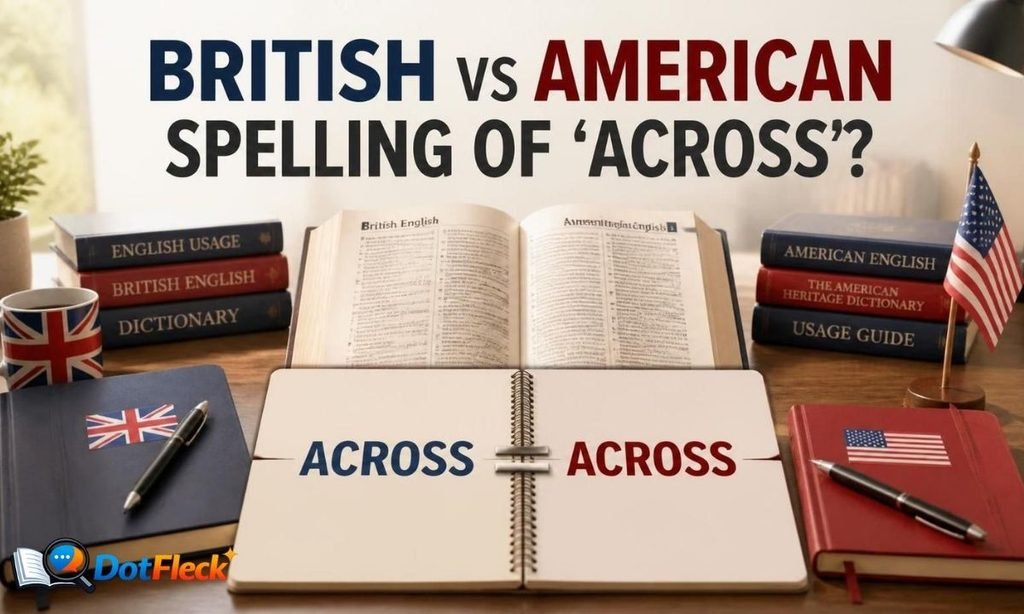
No. Across spelling in American English and across spelling in British English are exactly the same. Unlike words such as “color” and “colour,” across has no regional variant.
The pronunciation can differ slightly. Many British speakers use a short “o” sound, as in “uh-KROSS,” while many American speakers use a longer “aw” sound. The written word stays the same, so you never need to change it for a US or UK reader.
Across in a Sentence: Grammar and Usage
When you use across in a sentence, think of it as a word that links two sides or covers a space. It usually comes before a noun, such as “across the road” or “across the table.” You do not need a comma after it unless the sentence structure calls for one.
Across can also open a sentence for emphasis. For example, “Across the valley, lights began to flicker on.” In that case, a comma after the introductory phrase is standard.
Example Sentences With Across
These examples of the word across show different meanings:
- She drew a line across the page.
- The bakery is across from the library.
- He looked across the room and waved.
- The company has offices across the United States.
- I ran across my old teacher at the grocery store.
- The bridge stretches 300 feet across.
Common Phrases With Across
Across appears in many fixed expressions. Knowing them helps you use the word naturally and spot it in reading.
- Across the board: applying to everyone or everything, as in “The raise applied across the board.”
- Across the street: on the opposite side of a road.
- Come across: to find something by chance, or to seem a certain way, as in “She comes across as confident.”
- Get across: to explain an idea clearly.
- Across the globe: in many parts of the world.
- Across from: opposite to, as in “The park is across from my house.”
Across vs Through vs Over: Key Differences
The words across, through, and over can feel similar, but they describe different paths. Across usually means from one side of a surface or area to the other. Through means moving inside something, such as a tunnel, a forest, or a crowd. Over often means above something or passing above it.
Compare these sentences:
- We walked across the field. (on the surface, side to side)
- We walked through the forest. (inside, between trees)
- We walked over the hill. (up and past the top)
Sometimes more than one word works. “Walk across the bridge” and “walk over the bridge” are both natural, though “across” focuses on reaching the other side.
Across vs Throughout: What’s the Difference?
Across and throughout both describe spread, but throughout means in every part. “Across the country” suggests a wide area, while “throughout the country” suggests that something exists in all of it. The second phrase is stronger and more complete.
Throughout can also refer to time, as in “throughout the day.” Across does not work that way. You would not say “across the day” to mean the whole day.
Synonyms and Similar Words to Across

The across synonyms and meaning depend on how the word is used. Some options work only in certain sentences.
- Opposite: “The bank is opposite the post office.”
- On the other side of: “She lives on the other side of town.”
- Over: “He leaned over the table.”
- Through: “They traveled through Europe.”
- Spanning: “A bridge spanning the river.”
- Throughout: “Rain fell throughout the region.”
- Beyond: “The farm lies beyond the hills.”
Check the sentence before swapping words. For example, “I came across an article” cannot be replaced with “I came through an article” without changing the meaning.
Memory Tricks to Never Misspell Across Again
A few simple tricks can lock in the correct spelling. Pick the one that feels easiest to remember.
- Split it in two: Think “a + cross.” The word “cross” already has one C and two S letters.
- Picture a cross: Imagine crossing a street. You cross from one side to the other, and the word keeps one C.
- Count the letters: Across has six letters: A, C, R, O, S, S.
- Say it slowly: Read it as “a-cross” and write what you hear.
You can also use a short rhyme to remember the double letter: “One C, two S, no more, no less.” Repeat it a few times when you write the word.
Practice: Test Yourself on Across vs Accross
Practice makes the correct spelling automatic. Try the exercises below before checking the answers.
Fill in the Blanks
Choose “across” or “accross” to complete each sentence. Only one is correct each time.
- The cat jumped ______ the fence.
- They built a new school ______ the river.
- She sat ______ from me at dinner.
- The lake is two miles ______.
Answers: 1. across, 2. across, 3. across, 4. across. The word “accross” is never correct in any of these sentences.
Multiple Choice Questions
1. Which spelling is correct? a) accross b) acros c) across d) accros
2. Which sentence uses across correctly? a) We walked accross the park. b) We walked across the park. c) We walked acros the park.
3. How many C letters does across have? a) One b) Two c) Three
Answers: 1. c, 2. b, 3. a.
Frequently Asked Questions
What is the spelling of across?
Across is spelled A-C-R-O-S-S. It has one C and two S letters, and it has no alternate spelling in American or British English.
Which is correct: “a cross” or “across”?
“Across” is one word meaning from side to side. “A cross” is two words, meaning a single cross, such as a symbol or shape.
Does Across have two C’s?
No. Across has only one C. The double letter is the S at the end, so the word is spelled with two S letters.
How do you spell “across” like “across the street”?
Spell it A-C-R-O-S-S, then add “the street.” The full phrase is “across the street,” with one C in across.
Is “accross” ever correct?
No. “Accross” is always a misspelling. Use “across” in every case, whether you are writing formally or casually.
Final Thoughts
The answer to the accross or across question is clear: across is the only correct spelling, and it has one C followed by a double S. The word comes from “a” plus “cross,” which is a helpful reminder when you are unsure. It works as a preposition and an adverb, and it looks the same in American and British English.
Most spelling mistakes with this word come from adding a second C because many similar words, such as “accept” and “account,” have one. Use the memory tricks, review the example sentences, and check the practice answers whenever you need a refresher. With a little repetition, you will write across correctly without stopping to think about it.

Ethan Whitmore is an English language writer who enjoys making grammar, word meanings, and modern slang simple and easy to understand. His content focuses on clear explanations, practical examples, and everyday English usage.