
Did you just type “meating” in an email and wonder if it looks right? You are not alone, and the confusion is easy to understand. The words meet, meat, and meeting sound alike, so a wrong spelling can slip through when you write fast. If you write for work, school, or a blog, this small fix keeps your writing clear and professional.
This guide on Meating vs. Meeting explains which spelling is correct, what each word means, and why the mix-up happens. You will see clear examples, a short look at word origins, simple tips for avoiding the error, and a quick practice quiz. By the end, you will know exactly when to use “meeting” and why “meating” is almost always a typo.
Quick Answer: Is It “Meeting” or “Meating”?
The correct spelling is meeting. It is a noun that means a gathering of people or a planned appointment, and it is also the “-ing” form of the verb meet. If you are talking about a conference call, a school board session, or a coffee date, “meeting” is the word you need.
“Meating” is not a standard English word in everyday writing. Major U.S. dictionaries do not treat it as a common word, so readers will usually see it as a spelling error. So if you are asking meating or meeting which is correct, the answer is “meeting” in almost every situation.
Here is a simple comparison:
- Correct: Our team meeting starts at 10 a.m.
- Incorrect: Our team meating starts at 10 a.m.
- Correct: I am meeting my manager after lunch.
- Incorrect: I am meating my manager after lunch.
Meeting: Definition and Word Origin
Meeting meaning in English covers a few related ideas. The most common sense is a gathering of people to discuss, decide, or share information. A second sense is an arranged encounter between two or more people. A third, less common sense is the point where two things come together, as in “the meeting of two rivers.”
The word comes from the verb meet, which traces back to Old English and carried the idea of coming upon or encountering someone. Over time, adding “-ing” produced a noun for the act or event of people coming together. That history explains the spelling: “meeting” is simply “meet” plus “-ing.”
Here are a few meeting definition with examples:
- A formal gathering: The board held a meeting to approve the budget.
- An arranged encounter: She has a meeting with her advisor on Friday.
- A coming together: The meeting of the two roads created a busy intersection.
What Does “Meating” Actually Mean?
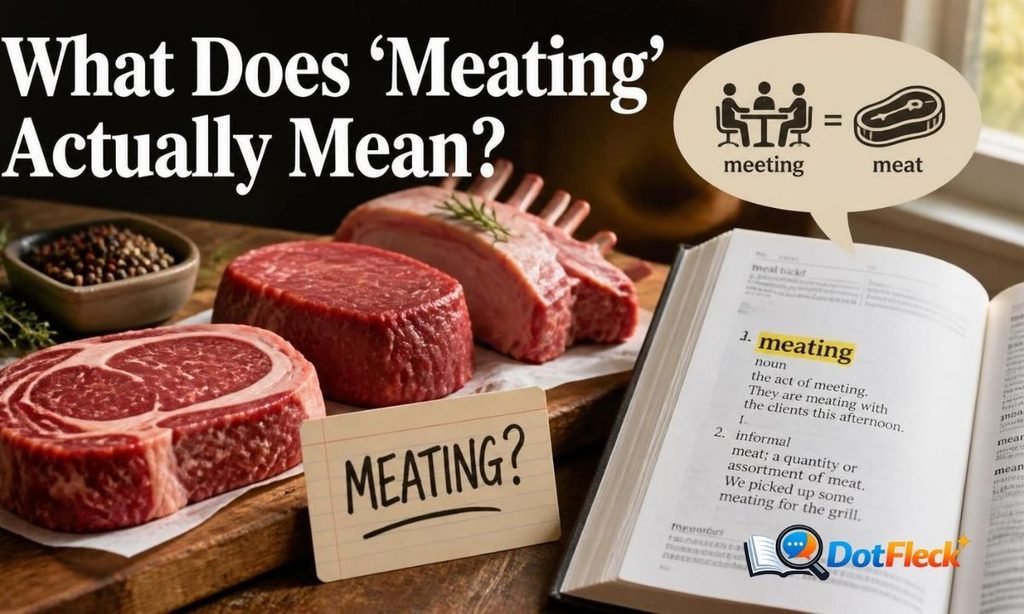
Many readers search is meating a word because the spelling looks plausible. The honest answer is that it is not a standard word in modern American English. You may find it in a few narrow situations, but none of them replace “meeting” for a gathering or appointment.
The Rare, Archaic Sense
In older and regional writing, “meat” was sometimes used as a verb that meant to feed or provide food. In that setting, “meating” could refer to feeding or supplying food. This use is very rare, and you are unlikely to see it outside historical texts or dialect studies.
Because this sense is so uncommon, modern readers will not recognize it. If you want to talk about providing food, use clear words like “feeding,” “catering,” or “serving a meal.”
The Modern Slang Sense
Online, “meating” sometimes shows up as wordplay or slang, often in jokes about food or in crude humor. These uses are informal and unstable, so they do not have a fixed dictionary meaning. They also do not belong in professional, academic, or general writing.
If you see the word in a social media post, it is usually a pun, not a spelling lesson. When in doubt, treat it as casual language and avoid it in anything you want people to take seriously.
Why It’s Almost Always a Mistake Today
For nearly every reader in the United States, “meating” has no everyday meaning. When it appears in a sentence about a schedule, a call, or an appointment, it is a typo for “meeting.” Using it in formal writing can make a message look careless, even when your point is clear.
The safest rule is simple. If you mean a gathering, an appointment, or the act of encountering someone, write “meeting.”
Spelling and Pronunciation: Meeting vs. Meating
Meeting pronunciation and spelling are tied together by one sound. Both “meeting” and “meating” would be pronounced the same way: MEE-ting. That identical sound is the main reason people mix them up, because the ear cannot tell you which spelling is right.
So why is meeting spelled with two e’s? The long “e” sound in English can be written several ways, and “ee” is one of the most common, as in meet, feet, and sheet. Since “meeting” is built from “meet,” it keeps the “ee” and just adds “-ing.” There is no doubled letter and no silent letter to remember.
A memory trick can help:
- Meeting has two e’s, like two people coming together.
- Meat has “ea,” like the “ea” in eat, because meat is something you eat.
This is one of the English spelling rules for meeting that is easy to remember once you link the “ee” to people and the “ea” to food.
Meeting vs. Meet, Meat, and Meting: How They All Differ
These words sound alike but have different jobs. Seeing them side by side makes the meat vs meet vs meeting difference much clearer.
- Meet (verb): to come together with someone or to encounter them. I will meet you at the station.
- Meeting (noun or verb form): a gathering, or the act of meeting. The meeting ran long. She is meeting a client.
- Meat (noun): the flesh of an animal used as food. We bought fresh meat for dinner.
- Meting (verb form): the “-ing” form of mete, which means to give out or deal out something such as punishment. The judge is meting out fair penalties.
“Meting” is the tricky one because it is a real word and it sounds exactly like “meeting.” It is rare, though, and it appears almost only in the phrase “meting out.” If you are not handing out a punishment, reward, or share, you almost certainly want “meeting.”
Word Forms of “Meet” and “Meeting”
Knowing the forms of “meet” helps you see why “meeting” is spelled the way it is. The verb is irregular, which means its past tense does not follow the usual “-ed” pattern.
| Form | Example |
| meet (base form) | We meet every Monday. |
| meets (third person singular) | She meets clients downtown. |
| met (past tense and past participle) | They met last week. |
| meeting (present participle or noun) | He is meeting us at noon. |
| meetings (plural noun) | I have three meetings today. |
Notice that none of these forms uses “ea.” The “ee” stays in the base word and carries through to “meeting” and “meetings.” The past form “met” shortens the vowel, but the other forms keep it.
How to Use “Meeting” Correctly in a Sentence
You can use “meeting” in two main ways. As a noun, it names an event: The meeting starts at 3:00 p.m. As part of a verb phrase, it shows an action in progress: I am meeting her for lunch.
These common verbs often pair with the noun:
- Schedule a meeting
- Attend a meeting
- Hold a meeting
- Cancel or reschedule a meeting
- Join a meeting (in person or online)
Here are a few more examples that show how to use meeting in a sentence:
- We moved the meeting to Thursday because of a holiday.
- She is meeting her study group at the library.
- The meeting agenda is attached to this email.
- After the meeting, please send me a short summary.
Meeting or Meating in Business English
In the workplace, “meeting” appears in calendar invites, agendas, minutes, and subject lines. A typo in a subject line stands out because it sits at the top of the message. Writing “Project Meeting, Friday at 2:00 p.m.” is clear and correct, while “Project Meating” can distract from the message.
In meeting or meating in business English, only “meeting” is accepted. Check the spelling in invitations and shared documents, since many people read them.
Why Do People Type “Meating” Instead of “Meeting”?
There are a few simple reasons. The first is sound: “meeting” and “meating” are pronounced the same, so spelling by ear can lead to either one. The second is pattern confusion, since many English words use “ea” for the long “e” sound, such as beat, seat, and heat.
Another reason is the existence of “meat” and “meet” as separate words. Writers know one of them uses “ea,” and they sometimes apply that spelling to the wrong word. Fast typing and autocomplete errors can also play a part, especially on phones.
Does Spellcheck Catch “Meating”?
Often it does. Most spellcheckers flag “meating” as an unknown or unusual word, but a few tools may accept it if it has been added to a custom dictionary or if the tool is set to ignore rare words. You should not rely on a tool alone.
Spellcheck also has a blind spot with real words. “Meting” and “meat” are valid words, so a tool may not mark them even when they are wrong for your sentence. A quick read-through for meaning is still important.
Common Mistakes and How to Fix Them
Most errors fall into a few patterns. Use this list to check your own writing:
- Meating instead of meeting: Write “meeting” for any gathering or appointment.
- Meet instead of meeting: Use “meet” for the verb in the base form, and “meeting” for the event. We meet at noon is a verb. The meeting is at noon is a noun.
- Meat instead of meet: Use “meet” for encountering someone. Nice to meet you, not Nice to meat you.
- Meting instead of meeting: Keep “meting” for the phrase “meting out.”
A quick test works well. If you can replace the word with “gathering” or “appointment,” the right spelling is “meeting.”
How to Fix It If You Already Sent “Meating” in an Email
Do not panic. In a casual message, most readers will understand the typo and move on, and a correction is usually unnecessary. In a formal or high-stakes email, a short follow-up is fine.
You can keep it brief and friendly: “Correction: the subject line should read ‘Team Meeting.’ Thank you.” If the message went to a large group, correcting the subject or title in the calendar invite is often the cleanest fix.
Synonyms for “Meeting”
Sometimes the best way to avoid a spelling slip is to choose another word. Meeting synonyms and meaning vary slightly depending on the setting:

- Gathering: a general word for people coming together
- Conference: a larger or more formal event, often with several speakers
- Session: a set period for a specific activity, such as a training session
- Assembly: a formal group meeting, often for a shared purpose
- Appointment: a scheduled time to see someone, such as a doctor or advisor
- Get-together: an informal, social meeting
- Briefing: a short meeting to share key information
- Huddle: a quick, informal team meeting
These words are not always interchangeable. “Appointment” fits a visit with a doctor, while “assembly” suits a school or government setting.
How to Avoid Typing “Meating” by Mistake
A few small habits can help. Start by linking the spelling to the meaning: “meeting” has two e’s because people meet. Then, when you see “ea,” think of “eat” and “meat,” which are food words.
These tips also help:
- Type “meet” first, then add “ing.”
- Add “meeting” to your phone or computer dictionary so autocomplete suggests it.
- Reread subject lines before you hit send.
- Use find and replace to scan long documents for “meating.”
Over time, the correct spelling becomes automatic, and these checks take only a few seconds.
Practice: Test Your Meeting vs. Meating Knowledge
Choose the correct word to complete each sentence.
- The (meeting / meating) is scheduled for 9:00 a.m.
- It was great to (meet / meat) your family last weekend.
- We are (meeting / meating) the client at the hotel.
- The butcher sells fresh (meet / meat) every morning.
- The judge is (meeting / meting) out fair penalties.
- Please attend the staff (meeting / meating) on Monday.
- I have three (meetings / meatings) this afternoon.
- We (met / meat) at a conference last year.
Answer Key
- meeting
- meet
- meeting
- meat
- meting
- meeting
- meetings
- met
Frequently Asked Questions
What is the difference between meeting and meating?
“Meeting” is the correct word for a gathering or appointment. “Meating” is not a standard word and is usually a spelling mistake.
What does meating mean?
It has no common modern meaning. Rare older uses relate to feeding, and online slang uses are informal, so avoid it in everyday writing.
What’s the difference between meet and meat?
“Meet” means to come together with someone. “Meat” is animal flesh used as food. They sound the same but are spelled differently.
What is the difference between a meeting and mating?
A meeting is a gathering of people. Mating refers to animals pairing to reproduce. Mixing them up is usually a typing slip.
Why is meeting spelled with two e’s?
It comes from the verb “meet,” which uses “ee.” Adding “-ing” keeps that spelling, so the word has two e’s together.
Final TakeAway
The main point in Meating vs. Meeting is simple: “meeting” is the correct spelling for a gathering, an appointment, or the act of meeting someone. It comes from the verb “meet,” which explains why it keeps the “ee” and adds “-ing.” The word “meating” has no standard modern meaning and is almost always a typo.
Remember the quick checks. Two e’s can remind you of two people meeting, while “ea” belongs to meat, a food word. Watch for “meting,” which is real but rare, and reread subject lines before sending. With these habits, you can write “meeting” correctly and with confidence.

Ethan Whitmore is an English language writer who enjoys making grammar, word meanings, and modern slang simple and easy to understand. His content focuses on clear explanations, practical examples, and everyday English usage.