
Have you ever typed a word, stared at it, and wondered if it looked wrong? Many writers pause over Comment vs. Coment when they reply to a post, write an email, or leave a note in their code. One version looks right and the other looks almost right, which makes the mistake easy to miss.
This guide gives you a clear answer, explains why the correct spelling works the way it does, and shows how to use the word in real sentences. You will also learn how comment differs from similar words like commend and command, how it works on social media and in programming, and how to avoid common spelling mistakes. By the end, you will know how to spell and use this word with confidence.
Quick Answer: Is It Comment or Coment?
Comment is the correct spelling. It has two Ms in the middle: c-o-m-m-e-n-t. “Coment” is not a word in standard English, so if you are asking “Is Coment a word?”, the answer is no.
The misspelling is common because the double M is easy to skip when typing quickly. Spell checkers usually flag it, but a missed red underline can slip into a final draft.
- Correct: Please leave a comment below.
- Incorrect: Please leave a coment below.
What Does Comment Mean? Definition, Word Forms, and Origin
The word comment refers to a remark, observation, or opinion about something. It can also mean a note that explains or adds information. If you search for the comment meaning and definition, these two ideas cover most everyday uses.
Because the spelling “coment” has no meaning in English, there is nothing to define. Anyone looking up the Coment meaning in English will end up at comment.

Comment as a Noun and a Verb
As a noun, a comment is a spoken or written remark. Examples include a teacher’s comment on an essay, a reader’s comment on a blog, or a short comment during a meeting.
As a verb, to comment means to express an opinion or give a remark. A person might comment on the weather, a news story, or a coworker’s idea. People also use the related noun commentary for a longer series of remarks, such as sports commentary.
Word Forms at a Glance
Knowing the word forms helps you keep the double M in every version. The comment plural form is simply comments.
- Comment (noun or base verb)
- Comments (plural noun, or verb form for he, she, it)
- Commented (past tense)
- Commenting (present participle)
- Commentary (related noun)
- Commenter (a person who comments)
Notice that the double M stays in every form. Adding an ending never removes a letter.
Where the Word Comes From
The word comment came into English from Latin. It traces back to the Latin word commentum, which meant an interpretation or explanation, and is linked to commentari, meaning to think over or discuss. That idea of explaining or interpreting still shows up in the modern meaning.
Understanding the root also supports the spelling. The Latin base contains the sound pattern “comm,” which carried over into English as the double M.
Why Comment Is Correct and Coment Is Not
English spelling can feel inconsistent, but this word follows a pattern you can see once you break it apart. The correct spelling of comment keeps the double M because of how the word is built and how it sounds.
The Double “M” Spelling Rule
Many English words that start with “com” use a double M when the root begins with M. Think of comment, commit, commerce, common, and community. In each case, the “com” part and the “m” that starts the next syllable sit side by side.
Compare these with words that have a single M, such as comet, comic, and comedy. Those words have a different root and a different sound, so the pattern does not apply. This difference is one of the main English spelling rules for comment that learners should know.
Common Misspellings to Avoid
A comment spelling mistake usually comes from typing speed or from guessing at a sound. Here are the errors people make most often:
- Coment (missing one M)
- Comenting (missing one M and one T)
- Commet (missing the N)
- Commnet (letters swapped)
- Commentt (extra T)
If you want to know how to spell comment correctly every time, check that the word has two Ms, one N, and one T at the end.
Memory Trick
Picture two Ms standing side by side like two people having a conversation. A comment is a remark that gets shared, so it takes two Ms to talk. Another trick is to split the word into three parts: com + men + t.
You can also remember that “comment” has the same double M as “commit” and “common.” If you can spell those, you can spell this one.
How Is Comment Pronounced?
In American English, comment is pronounced KOM-ent, with the stress on the first syllable. The first vowel sounds like the “o” in “pot,” and the second syllable is short and soft. The noun and the verb are said the same way in most American speech.
The spelling gives a clue to the sound. The double M does not mean you say the M twice. It simply marks the break between the two syllables: com-ment. Saying it slowly in that way can help you remember where the second M goes, which is useful when you are working on comment pronunciation and spelling together.
How to Use Comment Correctly in a Sentence
Using the word correctly is mostly about choosing the right part of speech. After the spelling is settled, check whether you need a noun (a remark) or a verb (to give a remark). The verb often takes the preposition “on” or “about.”

Comment as a Noun (Examples)
- The teacher wrote a kind comment at the top of my essay.
- She read every comment on her video.
- “No comment” was the only reply the company gave.
- His comment about the schedule surprised everyone.
- You can add a comment to the shared document.
Comment as a Verb (Examples)
- The mayor declined to comment on the new law.
- Several readers commented on the article’s headline.
- Would you like to comment before we vote?
- He is commenting on the game for the local radio station.
- She commented that the soup needed more salt.
These comment in a sentence examples show the word in both roles. Notice that the double M is the same in every one.
Comment vs Commend vs Command
Comment is often confused with two similar words: commend and command. They look alike but mean different things. This is a classic case of frequently confused English words.
Comment vs Commend
To commend means to praise someone or to hand something over for safekeeping. To comment is simply to make a remark. A comment can be neutral or negative, while commend is always positive.
- The principal will commend the team for its hard work.
- The principal will comment on the team’s progress.
Comment vs Command
A command is an order given by someone in authority, or the ability to control something. It can also mean a text instruction in a computer program. A comment does not order anything.
- The captain gave the command to turn left.
- The captain made a comment about the weather.
A quick check: if you are giving an order, use command. If you are giving praise, use commend. If you are sharing a thought, use comment.
Comment Meaning on Social Media and in Everyday Writing
Online, a comment is a reply that a person posts under a photo, video, article, or status update. The word has become part of daily life, so it is a good idea to spell it right even in casual messages.
What a “Comment Section” Is
A comment section is the area below content where readers can post replies and respond to each other. News sites, blogs, and video platforms all use one. It turns a one-way post into a conversation.
Why Comments Matter More Than Likes
A like takes a second and says little. A comment shows that someone read, watched, or thought about the content enough to respond. Many creators and writers value comments because they give feedback, ask questions, and start discussions.
What Is a Comment in Programming?
In programming, a comment is a line of text that the computer ignores. It exists only for people who read the code. Because it is not run as part of the program, you can write plain English in it.
Why Programmers Use Comments
Programmers use comments to explain why a piece of code exists, to leave reminders, and to help teammates understand their work. Good code comments describe the reason behind a choice, not just what the code does. They also help the writer when they return to a project months later.
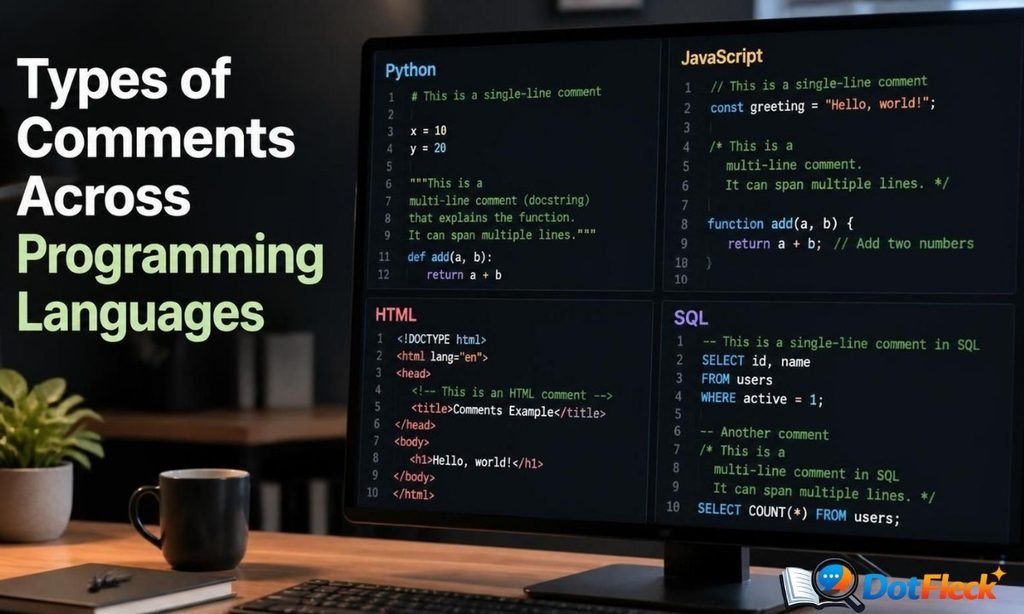
Types of Comments Across Programming Languages
Most languages support a few common styles. The symbols differ from one language to another, but the purpose stays the same.
Single-Line Comments
A single-line comment covers one line of text. In languages such as C, C++, Java, and JavaScript, it starts with two forward slashes (//). In Python, it starts with a hash symbol (#).
Multi-Line (Block) Comments
A block comment covers several lines at once. In C and JavaScript, it begins with /* and ends with */. Python does not have a dedicated block comment, so programmers usually place a # at the start of each line.
Inline Comments
An inline comment sits on the same line as a piece of code, after the code itself. It works best for short notes. For example, in Python: total = price * 2 # includes tax.
Comments in C
C supports both the block style (/* … */) and, in modern versions, the single-line style (//). Early versions of C used only the block style.
Comments in Python and JavaScript
Python uses # for comments. JavaScript uses // for one line and /* … */ for several lines. Both languages ignore everything inside a comment when the program runs.
Comment Out vs Uncomment: What’s the Difference?
To comment out a line of code means to turn it into a comment so the computer skips it. Programmers do this to test a program without deleting code they might need again. To uncomment a line means to remove the comment symbol so the code runs again.
For example, adding // before a line in JavaScript comments it out, and removing the // uncomments it. Note that both terms keep the double M, so avoid writing “coment out.”
Comment Formatting Best Practices in Code
Clear comments make code easier to read. Follow a few simple habits:
- Keep comments short and specific.
- Explain why something is done, not only what it does.
- Update comments when the code changes.
- Avoid commenting on obvious lines.
- Use a consistent style across the project.
Outdated comments can mislead readers, so treat them as part of the code that needs care.
Practice Exercises: Comment vs Coment
Choose the correct spelling or word in each sentence.
- Please leave a (comment / coment) on my post.
- The mayor refused to (comment / coment) on the rumor.
- The coach wanted to (commend / comment) the players for their effort.
- The officer gave a (command / comment) to stop.
- In Python, a (comment / coment) starts with a hash symbol.
- Programmers often (comment out / coment out) old code during testing.
- She was (commenting / comenting) on the new design.
- Readers posted many (comments / coments) under the article.
Answer Key
- comment
- comment
- commend (to praise)
- command (an order)
- comment
- comment out
- commenting
- comments
Frequently Asked Questions
Is “coment” ever correct in English?
No. Coment is not an accepted English word. The correct spelling is comment, with two Ms, in both American and British English.
How do you spell comment correctly in American English?
Spell it c-o-m-m-e-n-t. American English uses the same spelling as British English for this word, so there is no regional difference.
What is the plural of comment?
The plural is comments. Simply add an S to the end and keep the double M, as in “reader comments.”
What are some synonyms for comment?
Common synonyms include remark, observation, statement, note, opinion, and feedback. Choose the one that best fits the tone of your sentence.
What is the difference between comment and commend?
Comment means to make a remark. Commend means to praise someone or something. Only commend always carries a positive meaning.
What does it mean to comment out code?
It means turning a line of code into a comment so the program ignores it. The line stays in the file for later use.
Final Thoughts
The answer to Comment vs. Coment is simple: comment is correct, and coment is a spelling mistake. The word needs two Ms because of its Latin roots and the common “comm” pattern found in words like commit and common. Remember that every form, including comments, commented, and commenting, keeps both Ms.
Beyond spelling, the word works as both a noun and a verb, and it should not be mixed up with commend or command. It also appears in social media, where a comment starts a conversation, and in programming, where a comment explains code to human readers. Use the memory trick of two Ms talking, try the practice exercises, and you will spell the word correctly every time.

Ethan Whitmore is an English language writer who enjoys making grammar, word meanings, and modern slang simple and easy to understand. His content focuses on clear explanations, practical examples, and everyday English usage.