
Is it “my favs” or “my faves”? If you have ever paused over a text message or a caption wondering which spelling looks right, you are not alone. Both words appear everywhere online, and they look so similar that it is easy to assume one of them must be a mistake.
This guide on Favs vs. Faves explains what each word means, where it comes from, and when each one fits in American English. You will also see how the plural forms work, why the apostrophe rule matters, and when to skip both in favor of “favorite.” Clear examples and a short practice quiz are included, so you can leave with a confident answer.
Quick Answer: Favs vs. Faves at a Glance
Favs vs. Faves spellings are informal shortened forms of “favorite,” and neither one is a typo. Favs and faves mean the same thing, so the choice comes down to style and setting rather than correctness. In casual American English, either one works.
The Simple Rule
Use “favs” when you want a quick, clipped look, such as in a text, a tag, or an app button. Use “faves” when you want a spelling that matches the way the word sounds, such as in a blog post, a pop-culture list, or a magazine-style headline. In formal writing, use “favorite” or “favorites” instead.
Which Form Is More Common?
Both forms are widely used, but they tend to live in different places. “Favs” shows up often in texting, hashtags, usernames, and app labels, where short is better. “Faves” is common in entertainment writing, product roundups, and casual conversation, where readers like a spelling that looks like a real word.
If you are unsure, pick the one that matches the platform and stay consistent.
What Do Favs and Faves Mean?
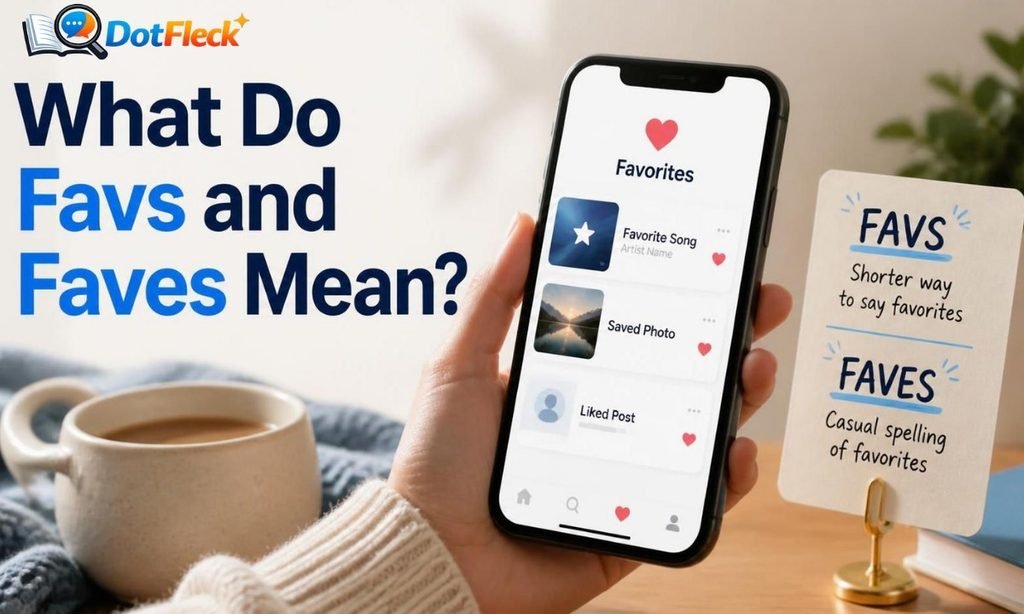
Both words are clipped forms of “favorite.” They name the things you like best, such as songs, foods, shows, places, or people. In English, a clipped word is a shorter version of a longer word, like “info” for “information” or “photo” for “photograph.”
Favs Meaning
Favs meaning in English is simply “favorites.” The word is built by cutting “favorite” down to its first three letters and adding an “s” for the plural. It is quick to type, which is why it fits so well in texts and social posts.
Example: “These are my favs from this year’s playlist.”
Faves Meaning
Faves meaning in English is also “favorites.” The spelling keeps the long “a” sound found in “fave,” so it reads more like a standard English word. Many writers prefer it in published or semi-polished content for that reason.
Example: “Here are my faves from this year’s playlist.”
Singular vs. Plural: Fav/Fave vs. Favs/Faves
Both words have a singular and a plural form. The singular forms are “fav” and “fave,” and the plurals add an “s”: favs and faves plural forms follow the regular English pattern.
- Singular: “This song is my fav.” / “This song is my fave.”
- Plural: “These songs are my favs.” / “These songs are my faves.”
Pronunciation Guide
“Fave” is pronounced like the word “save,” with a long “a” sound. “Faves” rhymes with “waves.” “Fav” is often said with a short “a,” close to the first syllable of “have,” although some speakers say it the same way as “fave.”
Favs vs. Faves: What’s the Actual Difference?
The Favs vs Faves spelling difference is small, but it is real. Each word has a slightly different look, feel, and typical setting.
Spelling Difference
“Favs” drops everything after the first three letters. “Faves” keeps the “e,” which signals the long “a” sound and makes the word look more complete. That single letter is the whole spelling difference.
Meaning Difference
There is no meaning difference. Both words stand for “favorites,” and readers will understand either one. If someone says one is “wrong,” they are talking about style, not meaning.
Tone and Style Difference
“Favs” feels the most casual and speedy. “Faves” feels a little more playful and writerly. Neither is suitable for formal documents, but “faves” is more likely to appear in lifestyle articles, reviews, and entertainment coverage.
Where Favs and Faves Come From (and Are They Real Words?)
Many readers ask, “Is favs a correct spelling?” or “Is faves a correct word?” The short answer is that both are accepted informal words, even if they do not belong in formal writing.
The Origin of Fave and Favs
“Fave” is the older of the two. Dictionaries record it as informal English from the early 20th century, and it grew popular in entertainment and magazine writing. “Fav” is a newer shortening that spread with texting, chat apps, and social media, where fewer characters meant faster messages.
Are “Fav” and “Favs” Real Dictionary Words?
“Fave” and “faves” are listed in major American dictionaries as informal words. “Fav” and “favs” appear in some newer dictionaries and are used so widely online that most readers recognize them at once. Dictionary coverage can change over time, so check a current dictionary if you need to confirm a specific entry.
Fav, Fave, Favs, and Faves vs. Favorite: How They All Relate
All five forms point to the same idea. “Favorite” is the full, standard word, and the others are casual versions of it. Understanding how they relate helps you choose the right one quickly.

When to Use Favorite
Use “favorite” in school papers, work emails, reports, resumes, and any writing where you want a polished tone. The plural is “favorites.” Example: “Her favorite book is on the reading list.”
When to Use Fav or Fave
Use “fav” or “fave” for the singular in casual settings. Example: “Pizza is my fav.” or “Pizza is my fave.” These forms can also act as adjectives in informal speech, as in “my fave show.”
When to Use Favs or Faves
Use “favs” or “faves” when you mean more than one favorite. Example: “Her favs include tacos and ramen.” or “Her faves include tacos and ramen.” Both are casual plurals that work in friendly posts and chats.
Is Favs vs. Faves a British vs. American English Issue?
No. Favs vs Faves in American and British English is not a regional spelling split. The difference between “favs” and “faves” is about style, not geography.
American English Usage
In the United States, both forms are common in texting, social media, and casual writing. American readers also use “fave” in entertainment coverage and product recommendations. The base word is spelled “favorite.”
British English Usage
In British English, people use “fav” and “fave” too, especially online. The difference is that the full word is spelled “favourite,” with a “u.” You may see “faves” and “favs” used the same way as in the US.
How This Differs from Favorite vs. Favourite
“Favorite” and “favourite” are a true regional spelling pair. American English uses “favorite,” and British English uses “favourite.” Is favs short for favourites? Yes, in British writing it can be, but the shortened forms look the same in both countries because the “u” is dropped.
Full Comparison Table
| Feature | Favs | Faves |
| Meaning | Favorites | Favorites |
| Part of speech | Plural noun | Plural noun |
| Singular form | Fav | Fave |
| Tone | Very casual, quick | Casual, playful |
| Typical setting | Texts, tags, app buttons | Blogs, reviews, conversation |
| Pronunciation | Often “favz” (short a) | Rhymes with “waves” |
| Formal use | Avoid | Avoid |
| Region | US and UK | US and UK |
When Should You Use Favs?
Choose “favs” when brevity matters more than polish. It is a strong fit for any place where space is tight or speed is the goal.
Texting and Social Media
Favs or faves in texting is mostly a personal habit, but “favs” tends to win when people type fast. It works well in captions, replies, and group chats. Example: “Send me your favs from the new album.”
Buttons, Tags, and App Interfaces
Interface designers often choose “Favs” for menu labels and tags because it takes up less room. You might see a “Favs” tab in a music app or a “Favs” folder in a photo gallery.
When Should You Use Faves?
Choose “faves” when you want a friendlier, more readable look. It tends to feel more natural in longer text.
Blogs, Reviews, and Pop-Culture Writing
Writers often use “faves” in roundups and headlines. Example: “Our Faves from This Season’s Releases.” The “e” gives the word a smooth look that fits a conversational voice.
Everyday Conversation
When you write the way you speak, “faves” often feels closer to the spoken word. Example: “Those are my faves, hands down.” It works well in friendly emails to people you know well.
When You Should Avoid Both
Informal shortenings do not belong in every setting. Use “favorite” or “favorites” when the audience expects careful writing.
Academic Writing
Essays, research papers, and class assignments call for standard words. Write “favorite authors,” not “fave authors.” Most instructors treat clipped words as informal language.
Business Documents and Professional Emails
Reports, proposals, client emails, and job applications should use “favorite” or a more precise word like “preferred.” A casual shortening can make a professional message feel rushed.
Legal and Technical Writing
Contracts, manuals, and technical documents need exact, formal wording. Stick to full words and standard terms.
Real-Life Examples of Favs vs. Faves
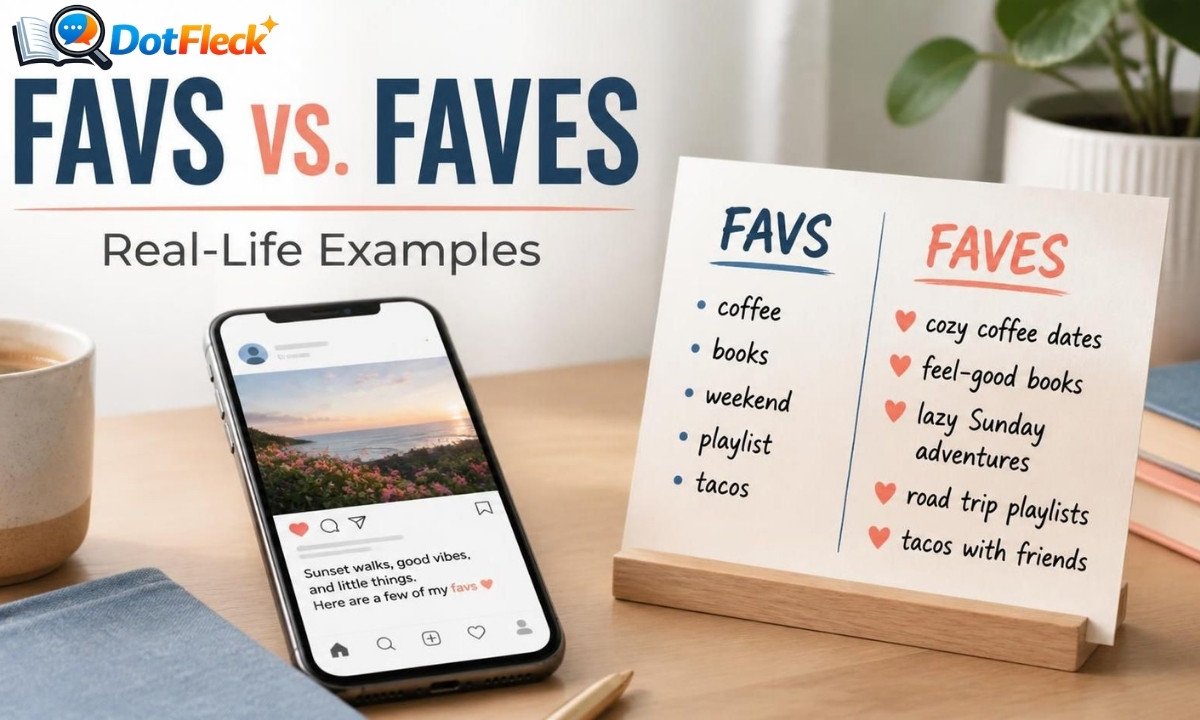
Seeing favs vs faves usage examples side by side makes the choice easier. Notice that the meaning stays the same in each pair.
Social Media and Text Message Examples
- “Drop your favs in the comments.”
- “Drop your faves in the comments.”
- “These are my favs from the road trip.”
- “These are my faves from the road trip.”
- “What are your top three favs this week?”
Marketing, Website, and App Examples
- App tab: “Favs”
- Newsletter heading: “Reader Faves of the Month”
- Product page: “Customer Faves”
- Playlist title: “Summer Favs”
- Email subject: “Our Faves Are Back in Stock”
Incorrect vs. Correct Examples
Most mistakes involve apostrophes, formality, or mixing singular and plural forms.
| Incorrect | Correct | Why |
| These are my fav’s. | These are my favs. | Plurals do not take an apostrophe. |
| She listed her fave’s. | She listed her faves. | Same rule applies. |
| My favs is pizza. | My favs are pizza and tacos. | Plural subject needs a plural verb. |
| Please submit your favs for the report. | Please submit your favorites for the report. | Formal context calls for the full word. |
| Those are my favorites, favs, and faves. | Those are my favorites. | Pick one form and stay consistent. |
Which Spelling Do People Actually Use More?
There is no single answer, because usage depends on where you look. In fast, character-limited spaces, “fav” and “favs” are very common. In longer, friendly writing, “fave” and “faves” appear often.
If you want data for a specific audience, a search trends tool or a large text collection can show current patterns. For everyday writing, the safest approach is to match the platform and your readers.
Favs vs. Faves: Which One Should You Use? (Decision Guide)
Use this short guide to decide in seconds.
- Writing a text or a quick reply? Use “favs.”
- Naming a button, tag, or folder? Use “Favs.”
- Writing a blog post, review, or friendly newsletter? Use “faves.”
- Writing for school, work, or legal reasons? Use “favorites.”
Which Sounds More Natural When Spoken?
“Faves” is closer to how many people say the word out loud, since it rhymes with “waves.” “Favs” is more of a typed shortcut. If you want your writing to match your voice, “faves” is often the better match.
Common Mistakes to Avoid
A few small errors cause most of the confusion. Watch for these as you write.
Treating Them as Formal Words
Both forms are informal. Do not use them in essays, reports, or professional messages.
Confusing Singular and Plural Forms
“Fav” and “fave” are singular, while “favs” and “faves” are plural. Match the verb to the number: “My fave is tacos” but “My faves are tacos and ramen.”
The Apostrophe Rule: Favs, Not Fav’s
Plurals do not use an apostrophe. Write “favs” and “faves,” not “fav’s” or “fave’s.” An apostrophe is only used for possession, as in “my fave’s flavor” meaning the flavor belonging to a favorite item.
Mixing Favorite, Fav, Fave, Favs, and Faves in One Piece of Writing
Pick one form and keep it throughout. Switching between “favs,” “faves,” and “favorites” in the same post looks inconsistent. Consistency makes writing feel more polished.
Practice Session: Favs vs. Faves
Test what you have learned. Fill in each blank with the best word: favorite, favorites, favs, or faves. More than one answer may work in some casual sentences.
Fill in the Blanks
- In a school essay, write about your ______ teacher.
- Text to a friend: “Send me your ______ from the new playlist.”
- Blog headline: “Our ______ of the Season.”
- Business email: “Please list your ______ vendors.”
- App menu label: “______.”
- Which is correct: “These are my fav’s” or “These are my favs”?
Answers
- favorite
- favs or faves
- faves (or favs, if the style is very casual)
- favorite or preferred
- Favs
- “These are my favs.” Plurals do not use an apostrophe.
Frequently Asked Questions
Is it my favs or my faves?
Both are correct informal plurals of “favorite.” Choose “favs” for quick texts and “faves” for a friendlier, more readable style.
Does “favs” mean “favorite”?
Yes. “Favs” is the plural of “fav,” a clipped form of “favorite.” It means the things you like best.
Is “Favourite” or “favorite” the correct spelling in the UK?
“Favourite” is the standard British spelling. “Favorite” is the American spelling. Both refer to the same idea.
What does “my favs” mean?
“My favs” means “my favorites.” It refers to the people, items, or things you like most.
Can I use faves in a work email?
It is best to avoid it. Use “favorites” or “preferred” in professional messages, unless the company culture is very casual.
Is it fav’s or favs?
Use “favs.” Plurals do not take an apostrophe, and “fav’s” would signal possession or a contraction.
Final Words
The Favs vs Faves debate has a friendly answer: both are correct informal shortenings of “favorite,” and they mean the same thing. “Favs” feels quick and works well in texts, tags, and app labels. “Faves” reads more smoothly and suits blogs, reviews, and casual conversation.
Remember the key rules. Use the plural forms without an apostrophe, stay consistent within a single piece of writing, and switch to “favorite” or “favorites” whenever the setting is formal. Pick the spelling that fits your audience, and you will be right in almost every casual situation.

Ethan Whitmore is an English language writer who enjoys making grammar, word meanings, and modern slang simple and easy to understand. His content focuses on clear explanations, practical examples, and everyday English usage.