
You are typing a sentence and you need the plural of “wife.” Your fingers pause. Is it “wifes” or “wives”? Many people stop right there, even fluent English speakers. It is one of those small spelling doubts that can slow down any writer.
The answer matters more than it seems. This word shows up in emails, school essays, wedding speeches, news stories, and legal forms. Getting it right makes your writing look clean and careful. This guide gives you the answer first. Then it explains the reason behind it, the possessive forms, and the common mistakes, all in simple words.
Quick Answer
“Wives” is the correct plural of “wife.” “Wifes” is a spelling mistake. It is not accepted in standard English, in dictionaries, or in style guides.
Here is the whole rule in one line. When “wife” becomes plural, the “f” changes to “v,” and you add “s.” So wives become wives.
| Form | Correct Spelling | Example |
| Singular | wife | My wife is a teacher. |
| Plural | wives | The two wives met at the party. |
| Singular possessive | wife’s | My wife’s car is red. |
| Plural possessive | wives’ | The wives’ meeting starts at noon. |
| Wrong spelling | wifes | Never use this form. |
If you remember only one thing, remember this: one wife, two wives.
Simple Origin and Background
The word “wife” is very old. It comes from Old English, where the word was “wīf.” In early English, it did not only mean a married woman. It simply meant “woman.”
You can still see that old meaning in a few words today. Think of “midwife,” which once meant a woman who is “with” the mother during birth. Think of “housewife” and “fishwife.” Even the word “woman” grew out of “wīfmann,” which meant a woman.
Over time, the sound of the word changed. In Old English, the letter “f” was said like a “v” when it sat between two voiced sounds. So when an ending was added to make a plural, the sound moved toward “v.” Later spelling caught up with speech. That is how “wives” became the standard form.
This is not a random rule. It comes from how people spoke for hundreds of years. Many other everyday words went through the same change.
A quick look at the timeline
- Old English: The word was “wīf,” meaning woman.
- Middle English: The spelling became “wif” or “wyf,” and the plural sound moved toward “v.”
- Modern English: The word is “wife,” and the plural is “wives.”
Clear Explanation of the Difference
The difference is simple. “Wife” means one married woman. “Wives” means more than one married woman. That is all.
The mistake comes from a common habit. Most English nouns make the plural by adding “s.” Cats become cats. Dogs become dogs. So people try the same trick with “wife” and write “wifes.” It feels logical, but it is not correct.
English has a group of words that end in “f” or “fe.” Many of them change the ending to “ves” in the plural. My wife belongs to that group.
Common words that follow the same pattern
| Singular | Plural |
| wife | wives |
| life | lives |
| knife | knives |
| leaf | leaves |
| wolf | wolves |
| shelf | shelves |
| half | halves |
| loaf | loaves |
| thief | thieves |
| calf | calves |
If you can say “knives” and “lives” without thinking, you already know how to say “wives.” The pattern is the same.
Words that do not follow the pattern
Some words that end in “f” or “fe” just add “s.” This is why the rule can feel confusing.
- roof becomes roofs
- chief becomes chiefs
- belief becomes beliefs
- cliff becomes cliffs
- safe becomes safes
- giraffe becomes giraffes
Wife is not one of these. It always takes “ves.”
Wifes or wives possessive
The possessive form shows that something belongs to a wife or to more than one wife. This is where many writers get stuck again. The apostrophe moves depending on the number.
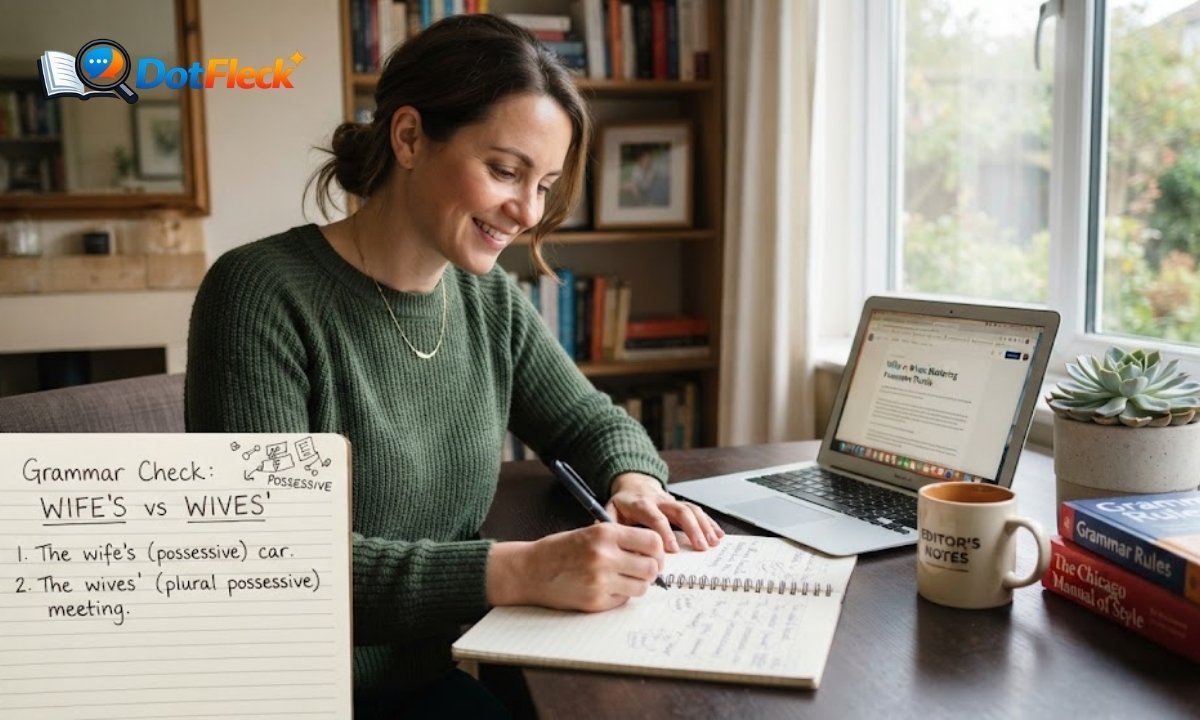
For one wife, add an apostrophe and “s.” That gives you wife’s.
For more than one wife, first make the plural, “wives.” Then add only an apostrophe after the “s.” That gives you wives’.
- My wife’s birthday is in March.
- The wives’ book club meets on Fridays.
- Both wives’ cars were parked outside.
Forms you should never write
Some spellings look close but are wrong. Watch out for these:
- wifes (not a real word)
- wifes’ (wrong plural possessive)
- wive’s (wrong, because “wive” is not a word by itself)
- wives’s (too many letters)
An easy way to check
Say the sentence with “of the.” If you can say “the car of the wife,” use wife’s. If you can say “the cars of the wives,” use wives’.
| Meaning | Correct Form | Sentence |
| Belonging to one wife | wife’s | The wife’s advice was wise. |
| Belonging to many wives | wives’ | The wives’ advice was wise. |
Comparison Table
This table puts every form side by side. Use it as a quick check whenever you feel unsure.
| Spelling | Correct? | Meaning | Example Sentence |
| wife | Yes | One married woman | His wife works at a bank. |
| wives | Yes | More than one married woman | The wives shared their stories. |
| wife’s | Yes | Belongs to one wife | Her wife’s phone rang. |
| wives’ | Yes | Belongs to many wives | The wives’ gifts were lovely. |
| wifes | No | Not a word | Avoid this spelling. |
| wifes’ | No | Not a word | Avoid this spelling. |
| wive’s | No | Not a word | Avoid this spelling. |
Notice how only four forms are correct. Each has one clear job. Once you match the job to the form, the choice becomes easy.
Quick decision guide
- One woman and no ownership? Use wife.
- Many women and no ownership? Use wives.
- One woman and ownership? Use wife’s.
- Many women and ownership? Use wives’.
Which One Should You Use and When?
You should use wives whenever you talk about more than one wife. There is no situation in standard English where “wifes” is the right choice. So the real question is not “wifes or wives.” The real question is whether you need the singular, plural, or possessive form.
Ask yourself two short questions. First, “How many people am I talking about?” Second, “Does something belong to them?” Your answers will point to the right form.
Use “wives” in these cases
- You are writing about a group of married women.
- You are describing a history topic, such as the wives of a king.
- You are writing a story with several married characters.
- You are quoting a common phrase, such as “old wives’ tale.”
Use “wife” in these cases
- You are talking about a married woman.
- You are filling out a form and need to write a relationship.
- You are speaking about your own spouse.
Formal and informal writing
The rule stays the same in both. In a text message, an email to your boss, or a school paper, the plural is always “wives.” Casual writing does not make “wifes” acceptable. A quick fix will keep your writing looking polished.
Also remember that many people use “spouses” when they want a neutral word. For example, “employees and their spouses are invited.” This is a good option when you are not sure who will attend.
Wifes or wives quiz

Ready to test yourself? Pick the correct word for each sentence. Try not to peek at the answers.
- The two chatted while the men cooked. (wifes / wives)
- My favorite song came on the radio. (wife’s / wives’)
- Some of the soldiers wrote letters home. (wifes / wives)
- Both opinions were heard. (wife’s / wives’)
- She has been my for ten years. (wife / wives)
- Which spelling is wrong? (wives / wifes / wife’s)
- The king had many old stories. (wifes / wives)
- My birthday party is tomorrow. (wife’s / wives’)
- All joined the walk. (wife / wives)
- Which one is a correct plural possessive? (wife’s / wives’ / wifes’)
Answer key
| Question | Answer | Why |
| 1 | wives | Plural, two women |
| 2 | wife’s | One wife owns the favorite song |
| 3 | wives | Plural, many women |
| 4 | wives’ | Two wives own the opinions |
| 5 | wife | Singular, one woman |
| 6 | wifes | This is not a word |
| 7 | wives | Plural, many women |
| 8 | wife’s | One wife owns the party |
| 9 | wives | Plural, more than one woman |
| 10 | wives’ | Plural form plus apostrophe |
How did you score?
- 9 to 10: Excellent. You have this rule down.
- 6 to 8: Good. Review the possessive section once more.
- 0 to 5: No worries. Read the learning section below and try again.
Common Mistakes People Make
Even careful writers slip up on this word. The good news is that the mistakes follow a few clear patterns. Once you see them, they are easy to avoid.
The most common error is adding only “s” to the end. That gives you “wifes.” The second most common error is misplacing the apostrophe. Some writers put it in the wrong spot or add it when they do not need it.
Top mistakes and their fixes
| Mistake | Correct Form | Tip |
| The wifes are here. | The wives are here. | Change “f” to “v.” |
| My wifes car is new. | My wife’s car is new. | Add apostrophe and “s.” |
| The wives’s meeting | The wives’ meeting | Only an apostrophe after “s.” |
| Both wive’s ideas | Both wives’ ideas | “Wive” is not a word. |
| Wifes and husbands | Wives and husbands | Always use “wives.” |
Why do these mistakes happen?
- Habit: Most plurals just add “s,” so the brain repeats the pattern.
- Speed: People type fast and do not stop to check.
- Autocorrect: Some devices fix the spelling, but others do not.
- Confusion with the possessive: The apostrophe rules feel tricky.
A smart way to catch errors
Read your sentence out loud. Say “wifes” and it sounds odd. Say “wives” and it sounds right. Your ear often knows the answer before your eyes do.
You can also use a spell check tool. It will underline “wifes” in red. Still, do not depend on it fully. A tool may not catch a wrong apostrophe.
| Don’t Miss These Articles |
| Felt vs Feel: Difference, Meaning, and How to Use Them |
| Eyeing or Eying? The Correct Spelling Revealed |
| Brasil or Brazil? The Surprising Truth Revealed 2026 |
Everyday Real Life Examples
Seeing a word in real sentences helps it stick. Here are examples from daily life. Each one uses the correct form.
At home and with family
- My wife made dinner tonight.
- My brother and my cousin brought their wives to the reunion.
- My wife’s mother lives nearby.
- The wives’ laughter filled the room.
At work
- The manager invited employees and their wives to dinner.
- Please send the invitation to your wife as well.
- The company covers travel for the wife’s ticket.
In school and history class
- The teacher explained how kings once had several wives.
- The story tells of the wives of famous sailors.
- The essay described a wife’s role in old villages.
On social media and in texts
- “Happy birthday to my amazing wife!”
- “Thanks to all the wives who came to the event.”
- “Tonight is the wives’ night out.”
In sayings and phrases
The phrase “old wives’ tale” is a good example of the plural possessive. It means a belief that many people repeat but that may not be true. The tale belongs to old wives, so the apostrophe comes after “s.”
Everyday use at a glance
| Situation | Correct Sentence |
| One spouse | My wife is on her way. |
| Group of spouses | The wives sat together. |
| One spouse owns something | My wife’s bag is on the chair. |
| Group owns something | The wives’ table is near the window. |
Learning Section for Students and Beginners
If you are new to English or still learning the rules, do not worry. This word is easy once you have a simple plan. Take it one small step at a time.
Step 1: Learn the big rule
Many nouns that end in “f” or “fe” change to “ves” in the plural. Start with a few common ones. Wife, life, knife, and leaf are a great set to memorize.
Step 2: Use a memory trick
Here is a fun trick. Think of the words “wife” and “life.” Both end in “fe.” Both change to “ves.” Say the pair together: wife, wives. Life, lives. The rhythm helps your memory.
Another trick is to picture the “f” turning into a “v” when the family grows. One wife has an “f.” A group of wives gets a “v.”
Step 3: Learn the possessive in two lines
- One owner: add ‘s. That gives you a wife’s.
- Many owners: make it plural first, then add ‘. That gives you wives’.
Step 4: Practice with short sentences
Write five sentences a day. Use “wife,” “wives,” “wife’s,” and “wives'” at least once each. Read them out loud. Then check them.
Quick study chart
| Step | What to Do | Time Needed |
| 1 | Read the rule | 2 minutes |
| 2 | Say the memory pair | 1 minute |
| 3 | Write five sentences | 5 minutes |
| 4 | Check your work | 2 minutes |
| 5 | Take the quiz again | 3 minutes |
Tips for teachers and parents
- Use flashcards with the singular on one side and the plural on the other.
- Let children sort words into two groups: “just add s” and “change f to v.”
- Play a quick game. Say a singular word, and ask students to give the plural.
- Praise effort. Learning spelling takes patience.
A mini practice set
Fill in the blank with the right form.
- The two went shopping. (wife / wives)
- My smile is bright. (wife’s / wives’)
- Three came to the class. (wife / wives)
Answers: wives, wife’s, wives.
Final Thoughts
Small spelling choices can shape how readers see your work. A word like “wives” is easy to fix, and once you know the rule, you will not forget it. You now have a clear rule, a helpful table, and a quiz to keep your skills sharp.
Keep the memory pair handy: wife and wives, life and lives. Use the two-question check for possessives. With a little practice, this topic will feel natural. Your emails, essays, and messages will look cleaner, and you will write with more confidence.

Ethan Whitmore is an English language writer who enjoys making grammar, word meanings, and modern slang simple and easy to understand. His content focuses on clear explanations, practical examples, and everyday English usage.