Have you ever typed “treet” and wondered if your spellcheck was being picky? You are not alone. The “treet vs. treat” question comes up often with learners and fast typists. This guide explains which spelling is right, what the word means, and why the mix-up happens. You will also find clear examples, common mistakes, and simple memory tricks to help you spell the word correctly every time.
Treet or Treat – Quick Answer
Direct answer: “Treat” is the correct spelling. It is a standard English word that works as both a verb and a noun, meaning to handle someone or something in a certain way, or a special pleasure. “Treet” is a misspelling and does not appear as a regular word in major dictionaries.
Quick voice-search answer: Is it treet or treat? It is “treat.” The spelling uses “ea,” just like eat, heat, and meat. “Treet” is not a standard English word.
The Origin of Treet or Treat
“Treat” comes from the Old French word traitier, which traces back to the Latin tractare. That Latin word meant “to handle” or “to manage.” Early English used “treat” for dealing with people, discussing terms, or handling a problem. The sense of “a special pleasure” developed later.
“Treet” has no such history as a standard word. It started as a phonetic guess. Because “treat” sounds like “treet,” writers sometimes spell it the way they hear it. English spelling often keeps older patterns, so the sound alone does not always show the right letters.
Treet vs Treat Meme
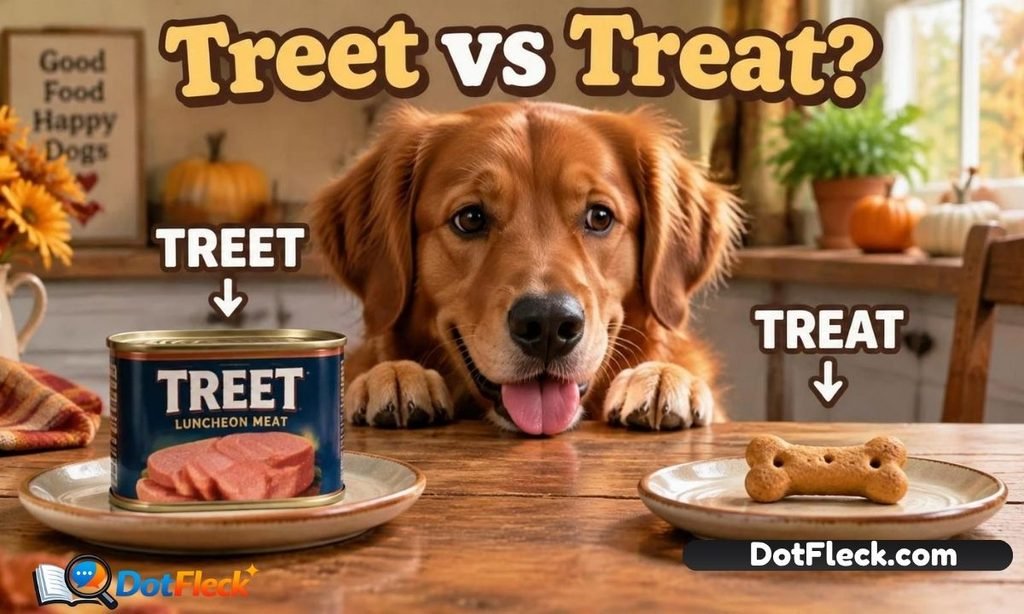
You may see “treet” in jokes, captions, or playful posts online. Writers sometimes use it on purpose to sound cute or silly, especially when talking about pets, snacks, or desserts. This is a style choice, not a correct spelling.
There is no single official “treet” meme that defines the word. If you are writing for school, work, or publication, use “treat.” Save the playful spelling for casual chats where everyone knows you are joking.
British English vs American English Spelling
Good news: there is no regional split here. American English and British English both spell the word treat. The same goes for related forms like treated, treating, and treats.
Some words do change between regions, such as color and colour. “Treat” is not one of them. You can use it confidently in the United States, the United Kingdom, Canada, and Australia.
Which Spelling Should You Use?
Use “treat” every time. It is the only spelling accepted in standard writing, including essays, emails, résumés, and websites.
Here is a quick comparison:
| Feature | Treat | Treet |
| Standard English word | Yes | No |
| Found in major dictionaries | Yes | No (as a regular word) |
| Part of speech | Verb and noun | None |
| Safe for school and work | Yes | No |
| Used in American and British English | Yes | Not as a standard word |
“Treet” can appear as a brand name or proper name in some places. A brand name is a special case, and it does not make “treet” a correct spelling of the everyday word.
Common Mistakes with Treet or Treat
Most errors come from typing quickly or spelling by sound. Here are correct and incorrect examples side by side:
- ❌ She gave her dog a treet. → ✅ She gave her dog a treat.
- ❌ The doctor will treet the infection. → ✅ The doctor will treat the infection.
- ❌ Please treet others kindly. → ✅ Please treat others kindly.
- ❌ Ice cream is my favorite treets. → ✅ Ice cream is my favorite treat.
- ❌ They treeted us to dinner. → ✅ They treated us to dinner.
Notice that the mistake carries into other word forms. If you write “treeted” or “treeting,” the root is wrong too.
Treet or Treat in Everyday Examples
Seeing the word in real sentences helps it stick. Here are natural examples of “treat” in everyday English:
- Let’s treat ourselves to pizza tonight. (verb: to give yourself a pleasure)
- The nurse will treat your sprained ankle. (verb: to give medical care)
- Please treat the new student with respect. (verb: to behave toward someone)
- A warm cookie is a perfect after-school treat. (noun: something enjoyable)
- My aunt treated us to movie tickets. (verb: to pay for someone)
- We treat the wood with oil to protect it. (verb: to apply a substance)
- Kids go door to door for a Halloween treat. (noun: candy or a small gift)
- The company will treat your data carefully. (verb: to handle something)
Treet or Treat – Usage Comparison
“Treat” works in two main roles. As a verb, it means to act toward, handle, or care for something. As a noun, it means something special or enjoyable, or an act of paying for someone else.
“Treet” has no role in standard grammar. It is not a noun, verb, or adjective in regular English dictionaries. That makes the comparison simple. Every correct sentence needs “treat,” and every sentence with “treet” needs fixing.
Why Do People Confuse Treet and Treat?
The main reason is sound. “Treat” is pronounced /triːt/, with a long “ee” sound. Many English words with that same sound are spelled with “ee,” such as street, sheet, and feet. Writers see the pattern and apply it to “treat.”
Spelling by ear also plays a part. English has several ways to write the long “ee” sound, including “ee,” “ea,” “ie,” and “e_e.” Because the options are many, mistakes are natural. Fast typing and autocorrect gaps make them more likely.
Is “Treet” Ever Correct in English?
In standard English, no. “Treet” is not an accepted spelling of the common word “treat.” You will not find it as a regular entry in leading American dictionaries.
There are a few exceptions that do not change this rule. “Treet” can appear as a brand name, a company name, or a surname in some places. In those cases, it is a proper noun, so writers should copy the spelling used by that brand or person exactly. For ordinary writing, stick with “treat.”
Treet vs Treat Synonym
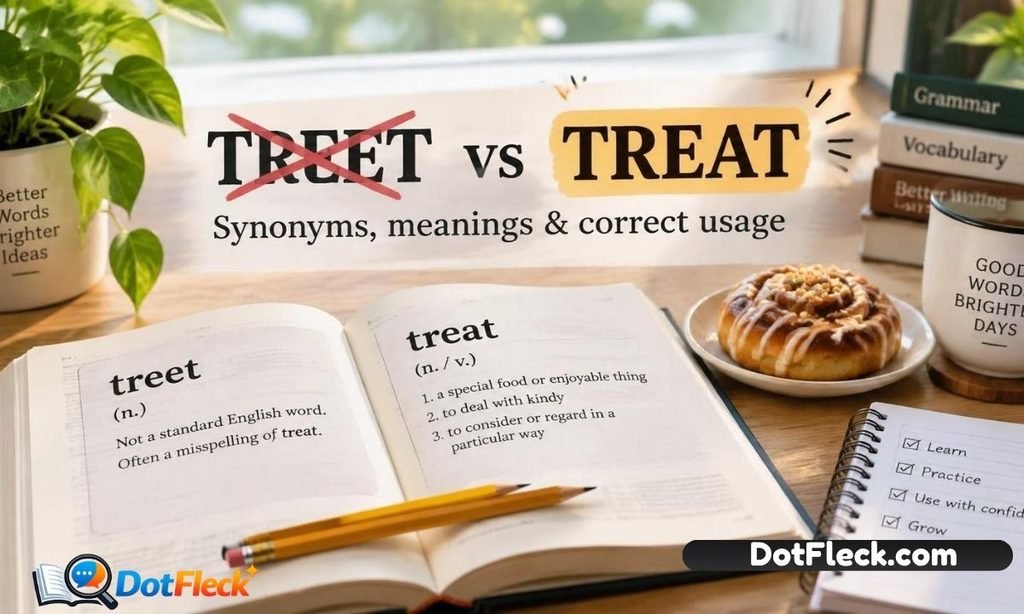
Since “treet” is not a real word, it has no synonyms. “Treat” does, and the right one depends on the meaning.
When “treat” is a verb:
- Handle (handle the situation carefully)
- Care for (care for a patient)
- Deal with (deal with a problem)
- Behave toward (act kindly toward others)
When “treat” is a noun:
- Delight
- Indulgence
- Goodie
- Special gift
Choosing a synonym can help you avoid repeating the same word. Just make sure the meaning still fits the sentence.
Tips to Remember the Correct Spelling (Treat vs Treet)
A few simple tricks can lock in the right spelling:
- Think “eat.” The word “treat” contains the word eat. Many treats are something you eat, so the memory link is easy.
- Match the family. Treat rhymes with heat, seat, beat, and meat. All use “ea.”
- Remember the “ea” pair. The “e” and “a” sit together, like two friends sharing a snack.
- Say it slowly. Break it into t-r-e-a-t when you write it by hand.
Related Spelling Confusions in English
Many commonly confused English words involve the same “ee” and “ea” sounds. Here are a few that trip people up:
| Word Pair | Quick Tip |
| Meat vs. Meet | Meat is food; meet means to encounter |
| Seat vs. Seet | Seat is correct (to sit on) |
| Beat vs. Beet | Beat means to hit; beet is a vegetable |
| Heal vs. Heel | Heal means to recover; heel is part of the foot |
| Cheat vs. Cheet | Cheat is correct (to act dishonestly) |
Each pair shows how English spells the same sound in different ways. Checking the meaning first usually points you to the right form.
Understanding the Treet vs Treat Confusion
The “treet vs treat” confusion is a classic case of sound versus spelling. Learners hear one clear sound but see more than one way to write it. English borrowed words from French, Latin, and Old English, so its spelling patterns do not always follow the sound.
This does not mean you are a weak speller. It means English is tricky. Once you learn the pattern for the word, the mistake fades quickly.
Why Treat Is the Correct Spelling
“Treat” is correct because it follows the spelling it has had since it entered English from French. Dictionaries record it as the only standard form. Style guides and schools teach it that way as well.
Its “ea” spelling also fits a common English pattern. Many everyday words use “ea” for the long “ee” sound, including read, speak, clean, and dream. Spelling “treat” with “ea” matches that group.
The Role of Pronunciation in Spelling Errors
Pronunciation drives many spelling errors. In American English, “treat” sounds like /triːt/. If you say it aloud, you hear “treet.” That is why the wrong spelling feels logical.
The fix is to separate the sound from the spelling. Say the word, then picture the letters. Pair the sound with a known word like “eat” or “heat” to build a reliable link in your memory.
How to Use Treat in a Sentence Correctly
First decide whether you need a verb or a noun. If you mean to handle, care for, or pay for something, use the verb. If you mean a special pleasure, use the noun.
Watch the verb endings:
- Treat: I treat my friends kindly.
- Treats: She treats her plants with care.
- Treated: He treated the wound.
- Treating: They are treating the water.
For the noun, use “treat” for one and “treats” for more than one. For example, The bakery sells sweet treats. Notice that “treets” is also incorrect.
Common Situations Where Mistakes Happen
Mistakes often show up in fast, informal writing. Text messages, social media posts, and quick notes are common places. People also slip when writing about food, pets, and holidays, because “treat” appears so often in those topics.
Students may also miswrite it in timed essays. Proofreading helps. Reading your text aloud or running a spellcheck can catch the error before anyone else sees it.
Tips to Remember the Correct Spelling
Here is a short checklist you can use anytime:
- Check that the word has the letters e and a side by side.
- Compare it to heat or eat.
- Use your spellcheck tool, but read the final text yourself.
- Write a few practice sentences with different forms like treats and treated.
A little practice goes a long way. After a few uses, the right spelling feels natural.
Why Spelling Accuracy Matters in Writing
Correct spelling builds trust. A misspelled word can distract readers, even when your ideas are strong. In school, work, and online content, clean spelling shows care and professionalism.
It also helps people understand you. Search engines, translation tools, and text readers all work better with standard spelling. Writing “treat” correctly keeps your message clear for every reader.
FAQs
Is treat means food?
Not always. “Treat” can mean a small, enjoyable food or snack, but it also means a special pleasure or an act of paying for someone. As a verb, it means to handle or care for something.
Is it treats or treets?
The correct form is treats. It is the plural noun (dog treats) and the third-person verb (she treats). “Treets” is not a standard English word.
What does your treat mean?
“Your treat” usually means you are paying or providing something enjoyable. If a friend says “My treat,” they will pay. “Your treat” means the other person is paying.
How do you spell treets?
The correct spelling is treats. Use “ea” in the middle and an “s” at the end for the plural noun or the verb form. “Treets” is a common misspelling.
Is Treet a word?
“Treet” is not a standard English word. It can show up as a brand name or proper name, but the everyday word is always spelled “treat.”
Is treat a noun or a verb?
It is both. As a verb, it means to handle, care for, or pay for something. As a noun, it means a special pleasure or something enjoyable, like a snack.
Final Thoughts
The answer to “treet vs. treat” is simple. Treat is the correct spelling, and “treet” is a misspelling. The word works as a verb and a noun, and it is spelled the same in American and British English.
Remember the link to eat and heat, and the “ea” pattern becomes easy to recall. Check your spelling, practice with real sentences, and you will write “treat” correctly every time.

Ethan Whitmore is an English language writer who enjoys making grammar, word meanings, and modern slang simple and easy to understand. His content focuses on clear explanations, practical examples, and everyday English usage.