
Have you ever typed “The receipts are totaling $200” and then stopped to wonder whether that word needs a second L? You are not alone. Many writers ask totaling or totalling when they see both spellings in print, and spell checkers do not always flag either one. Both forms look right at first glance, which makes the confusion easy to understand.
This article explains the difference between totaling and totalling in plain terms. You will learn which spelling is correct in American and British English, how each form is built, and when to use each version. Clear examples, common mistakes, and a few memory tricks will help you choose the right spelling in emails, reports, and school assignments.
What Is the Main Difference Between Totaling or Totalling?
The main difference is regional. Totaling (one L) is the standard American English spelling, while totalling (two Ls) is the standard British English spelling. The meaning, pronunciation, and grammar are the same in both versions.
Think of it like color and colour. Both spellings are correct, but each belongs to a different style of English. The key is to choose one and stay consistent within the same document.
What Does Totaling Mean?

Totaling is the present participle of the verb “total,” used in US English. It means adding numbers or amounts together to reach a sum, or reaching a certain sum when added up. A typical example is “The expenses are totaling $1,200 this month.”
In totaling meaning and definition terms, it can also describe the act itself, as in “Totaling the receipts took an hour.” In both cases, it points to a final sum.
What Does Totalling Mean?
Totalling has the same meaning as totaling. It is the present participle of “total” in British English, and it also describes adding up amounts or reaching a sum. In the totalling meaning and definition, nothing changes except the spelling.
For example, a UK writer might say, “The repair costs are totalling £450.” An American writer would write the same sentence with one L and a dollar sign.
Is Totaling Correct?
Yes, totaling is correct in American English. Major US dictionaries list it as the standard spelling, and US style guides follow that rule. If your readers are in the United States, this is the form to use.
The word is also widely understood elsewhere. However, in formal British writing, it may look like an American spelling.
Is Totalling Correct?
Yes, totalling is also correct. It is the standard spelling in the United Kingdom and in most countries that follow British conventions. So if someone asks, “Is totalling a correct word?” the answer is yes, as long as the context fits.
In a US document, though, totalling is usually treated as a spelling error or an inconsistency. Match the spelling to your audience.
Which Spelling Should You Use?
Choose the spelling that matches your audience and your style guide. Use totaling for American readers and totalling for British readers. This simple rule answers the question of totaling or totalling which is correct in most situations.
Here is a quick guide:
- United States: totaling, totaled
- United Kingdom: totalling, totalled
- Canada: usually totalling, totalled
- Australia and New Zealand: usually totalling, totalled
If you write for an international audience, pick one version and use it throughout. Consistency matters more than which version you choose.
Why Does Totalling Have Two L’s?
British English follows a spelling rule that doubles the final consonant when a suffix like “-ing” or “-ed” is added to a word ending in a single vowel plus L. That is why travel becomes travelling, label becomes labelling, and total becomes totalling. The rule applies even when the last syllable is not stressed.
This is the reason many readers ask, “Why does totalling have two Ls?” The short answer is that British spelling prefers the doubled L as a general pattern.
Why Does Totaling Have One L?
American English simplifies this pattern. In US spelling, the final consonant is usually doubled only when the stress falls on the last syllable, as in “compel” and “compelling.” In “total,” the stress falls on the first syllable (TO-tal), so the L stays single.
That is why Americans write traveling, labeling, and totaling. It is a tidy rule: unstressed ending, single L.
Are Totaling or Totalling the Same Word?
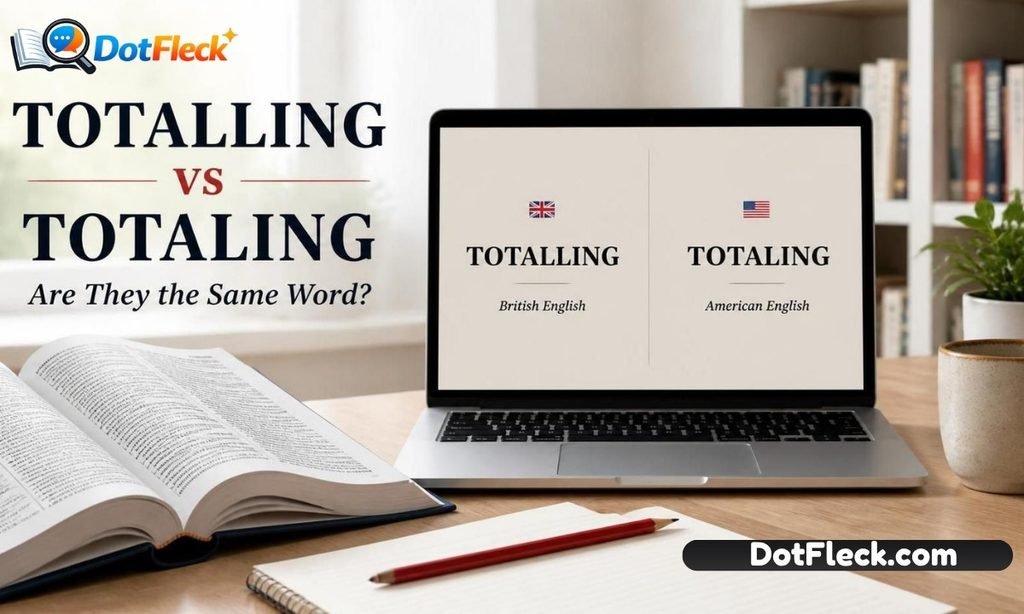
Yes, they are the same word with two accepted spellings. They share the same meaning, the same pronunciation, and the same grammar. Only the spelling differs by region.
You can treat the pair like other transatlantic variants, such as modeling and modelling. Neither one is a different word or a different tense.
How Do You Pronounce Totaling or Totalling?
Both words are pronounced the same way: TOH-tuh-ling. The stress falls on the first syllable, and the second syllable is short and soft. The extra L in the British spelling does not change the sound.
Because the pronunciation is identical, you cannot tell the spelling from speech. You have to rely on the rules of the English variety you are writing in.
What Is the Grammar of Totaling or Totalling?
Both forms come from the verb “total.” Totaling and totalling are present participles, and they can also work as gerunds, which are verb forms that act like nouns. Examples include “The invoices are totaling $900” and “Totaling the column is easy.”
The base verb forms are total, totals, totaled (US) or totalled (UK), and totaling (US) or totalling (UK). Remember that “total” is also a noun and an adjective.
What Does Totaling a Car Mean?
In American English, “totaling a car” means damaging it so badly that repairs cost more than the car is worth. An insurance company then declares it a “total loss.” For example, “He totaled his car in the accident.”
The informal verb comes from the idea of a total loss. In the UK, people more often say a car was “written off,” although “totalled” is also used in casual speech.
Is It “Costs Totaling” or “Costs Totalling”?
It depends on your regional spelling. In American English, write “costs totaling $5,000.” In British English, write “costs totalling £5,000.” The phrase works as a participial phrase that describes the costs.
You can also avoid the issue by rewording. For instance, “The costs came to $5,000” or “The total cost was $5,000” works in every region.
Is It “Totaling Up” or “Totalling Up”?
The same regional rule applies. American writers use “totaling up,” and British writers use “totalling up.” The phrasal verb “total up” means to add everything together, as in “She is totaling up the day’s sales.”
In British English, you may also hear “tot up,” which is an informal way to say add up. It is not a spelling variant of total up, just a different expression. For example, “Let’s tot up the bill.”
Is “Totalling” Wrong in American English?
It is not wrong in the sense of being a nonsense word, but it is not standard in the US. American dictionaries list it as a variant spelling. Most American editors would change it to “totaling.”
If you are writing for a US school, company, or publication, use one L. Using two Ls may look like a typo or a British spelling.
Is “Totaling” Wrong in British English?
In British English, totaling is considered an American spelling. It is not a serious error, but UK style guides and teachers prefer totalling. It may be marked as inconsistent in formal British writing.
If you write for a UK audience, use two Ls. If your document follows American spelling, keep it as totaling throughout.
What Are Examples of Totaling in American English?
Here are clear examples of totaling in US English:
- The three invoices are totaling $2,450.
- She spent the afternoon totaling the receipts.
- Donations totaling $10,000 arrived last week.
- He is totaling up his expenses for taxes.
Each sentence uses one L, which matches the US rule. These totaling vs totalling examples show the American form in everyday settings.
What Are Examples of Totalling in British English?
Here are matching examples of totalling in UK English:
- The three invoices are totalling £2,450.
- She spent the afternoon totalling the receipts.
- Donations totalling £10,000 arrived last week.
- He is totalling up his expenses for his tax return.
These sentences have the same meaning as the US examples. Only the spelling and the currency sign change.
What Are the Past Tense Forms?
The past tense follows the same regional pattern. American English uses totaled, and British English uses totalled. Both forms also serve as the past participle.
- US: The bill totaled $75. The clerk had totaled the sale.
- UK: The bill totalled £75. The clerk had totalled the sale.
So when people ask about totaling past tense and present participle, the answer is totaled and totaling in the US, and totalled and totalling in the UK.
What Is the Noun Form of Totaling or Totalling?
The standard noun is simply “total.” For example, “The total was $300” or “The grand total is higher than expected.” This is the same in both American and British English.
Totaling and totalling can act as nouns only in the gerund sense, meaning the act of adding. For instance, “The totaling of the votes took hours.” In most cases, “total” or “the total amount” sounds more natural.
What Is the Adjective Form of Total?
The adjective form is also “total.” Examples include “a total loss,” “the total cost,” and “total attendance.” It does not change in British or American English.
Do not turn totaling or totalling into an adjective in front of a noun. Write “the total cost,” not “the totaling cost.” The participle works after a noun, as in “costs totaling $50.”
How Can You Remember Totaling or Totalling?
A simple memory trick can help. Think “US = unstressed, single L.” American spelling keeps one L because the stress falls on the first syllable of “total.” You can also remember that the British spelling has the extra L, just like travelling and labelling.
Another tip is to link the spelling to a familiar pair. If you write “traveling” in the US, write “totaling.” If you write “travelling” in the UK, write “totalling.”
What Are Common Mistakes With Totaling or Totalling?
Most errors come from mixing regional rules or using the word in the wrong role. These common spelling mistakes in English are easy to avoid once you know them. Here are the five most frequent ones.
1. Mixing American and British spelling 📋
Writers sometimes use totaling in one paragraph and totalling in the next. Choose one version and keep it for the whole document. Also check related words, such as traveled or travelled, for consistency.
2. Using totaling as a noun 📋
Writing “The totaling was $50” is incorrect when you mean the sum. Use “total” instead: “The total was $50.” Keep totaling for the action or the participle.
3. Using totalling as an adjective 📋
Phrases like “the totalling amount” are not standard. Use “the total amount.” The adjective is always “total.”
4. Using totalling in a US document 📋
A British spelling in an American report may look like a mistake. Switch to totaling and totaled to match US style. This also applies to emails sent to American clients.
5. Using totaling in a UK document 📋
An American spelling in a British document may look inconsistent. Use totalling and totalled for UK readers. Set your word processor to English (UK) to catch it automatically.
How Do You Use Totaling in a Sentence?
Use totaling when a sum is described or calculated in American English. It often follows a noun, such as “payments totaling $400,” or follows a form of “be,” as in “We are totaling the orders.”
Here are more totaling in a sentence examples:
- The company reported losses totaling $3 million.
- I am totaling the scores before the final round.
- Totaling the bills took longer than expected.
How Do You Use Totalling in a Sentence?
Use totalling in the same ways for British English. It often follows a noun, such as “payments totalling £400,” or follows a form of “be,” as in “We are totalling the orders.”
Here are more totalling in a sentence examples:
- The company reported losses totalling £3 million.
- I am totalling the scores before the final round.
- Totalling the bills took longer than expected.
What Words Are Related to Totaling or Totalling?
Several words share the idea of adding or reaching a sum. Common ones include sum, tally, subtotal, grand total, aggregate, and summation. Verbs such as add up, calculate, and tally also fit.
Some of these words have their own spelling patterns. For example, “tallying” and “tallied” do not change between American and British English, which makes them a safe option for global writing.
What Is the Difference Between Totaling and Adding?
Adding is the general act of combining numbers, while totaling focuses on reaching a final sum. You can add two numbers without calling the result a total. Totaling suggests you are collecting several amounts into one figure.
For example, “She added 5 and 7” is natural, while “She is totaling the monthly bills” fits a list of amounts. Adding is more general, and totaling is more specific.
What Is the Difference Between Totaling and Amounting To?
Totaling can describe both the action and the result, while “amounting to” describes only the result. You can say “He is totaling the invoices,” but you cannot say “He is amounting to the invoices.”
When describing a result, the two are close in meaning. “Donations totaling $500” and “donations amounting to $500” say nearly the same thing. “Amounting to” can sound a little more formal.
Can Totaling or Totalling Be Used for People?
You can use them for groups of people, but not usually for one person. For example, “Attendees totaling 300 arrived early” is correct in US English. In British English, write “attendees totalling 300.”
Using the word for a single person is unusual. You would not say a person is totaling unless you mean the person is adding up numbers.
Can Totaling or Totalling Be Used for Money?
Yes, money is the most common use. Examples include “fees totaling $120” in American English and “fees totalling £120” in British English. They work well for bills, expenses, donations, and budgets.
For clear financial writing, give the number right after the word. This avoids confusion and keeps the sentence short.
Can Totaling or Totalling Be Used for Time?
Yes, they can describe time that adds up. For example, “Meetings totaling six hours filled the week” in US English, or “meetings totalling six hours” in UK English. The same pattern works for hours, days, or minutes.
This use is common in reports and schedules. Keep the unit clear so the reader understands what is being added.
Can Totaling or Totalling Be Used for Scores?
Yes, they work well for points and scores. For instance, “Three rounds totaling 215 points” is correct in American English, and “three rounds totalling 215 points” is correct in British English.
You can also use them for goals, runs, or any countable result in sports. The spelling rule stays the same.
FAQs
How do you spell “totalling” in the UK?
In the UK, the spelling is totalling with two Ls. The past tense is totalled, also with two Ls.
Does totaling have one L or two?
In American English, totaling has one L. The two-L spelling, totalling, is the British version of the same word.
How to use totaling?
Use totaling as a present participle or gerund in US English, such as “payments totaling $200” or “totaling the receipts.”
What does totalling mean?
Totalling means adding amounts together or reaching a sum. It is the British spelling of totaling and has the same meaning.
Is totaling or totalling used in Canada?
Canadian English usually follows the British pattern, so totalling and totalled are common, though American spellings also appear.
Conclusion
So, which is right: totaling or totalling? Both are correct, and the choice depends on where your readers live. Use totaling and totaled for American audiences, and use totalling and totalled for British audiences. The meaning, pronunciation, and grammar stay the same, so only the spelling changes.
Remember a few key points. The noun and adjective form is “total,” while totaling and totalling work as the present participle or gerund. Avoid mixing spellings in one document, and match your word processor settings to your audience. With these simple rules, you can write with confidence in any setting.

Ethan Whitmore is an English language writer who enjoys making grammar, word meanings, and modern slang simple and easy to understand. His content focuses on clear explanations, practical examples, and everyday English usage.