
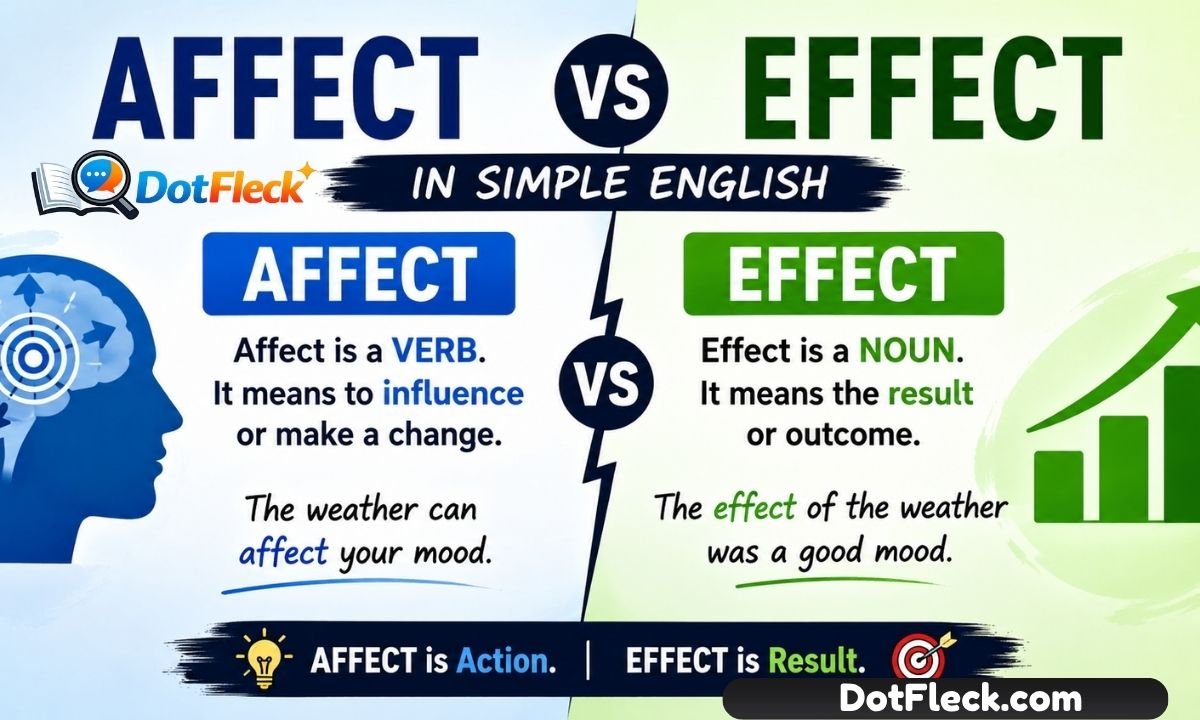
Affect vs Effect in Simple English confuses even careful writers because the two words sound almost the same and share a common root. The short answer: affect is usually a verb that means “to influence something,” while effect is usually a noun that means “the result of a change.”
This mix-up happens because English borrowed both words from Latin roots that overlap in meaning. Once you see the pattern, though, the confusion clears up fast, and you will never second-guess yourself again.
Quick Answer Affect vs Effect
Affect means to influence or change something (a verb). Effect means the result of that change (a noun). Example: “The rain affected the game, and the effect was a delay.” Remember this simple rule: Affect = Action, Effect = End result.
Which Is Correct: Affect vs Effect in Simple English?

Both words are correct, but they serve different jobs in a sentence. You use affect when you describe an action that changes something. You use effect when you name the result of that action. Choosing correctly depends on whether your sentence needs a verb or a noun.
Read Now : Hoodie vs Hoody
Difference Between Both Words Affect vs Effect
The core difference in Affect vs Effect in Simple English comes down to grammar function. Affect drives the action in a sentence, while effect names the outcome. Once you spot this pattern, picking the right word becomes automatic.
| Word | Meaning | Usage | Example | Correct Situation |
| Affect | To influence or change something | Verb (most common use) | “Stress can affect your sleep.” | Use when describing an action happening to something |
| Effect | A result or outcome | Noun (most common use) | “Lack of sleep is one effect of stress.” | Use when naming the outcome of an action |
Definitions Affect vs Effect
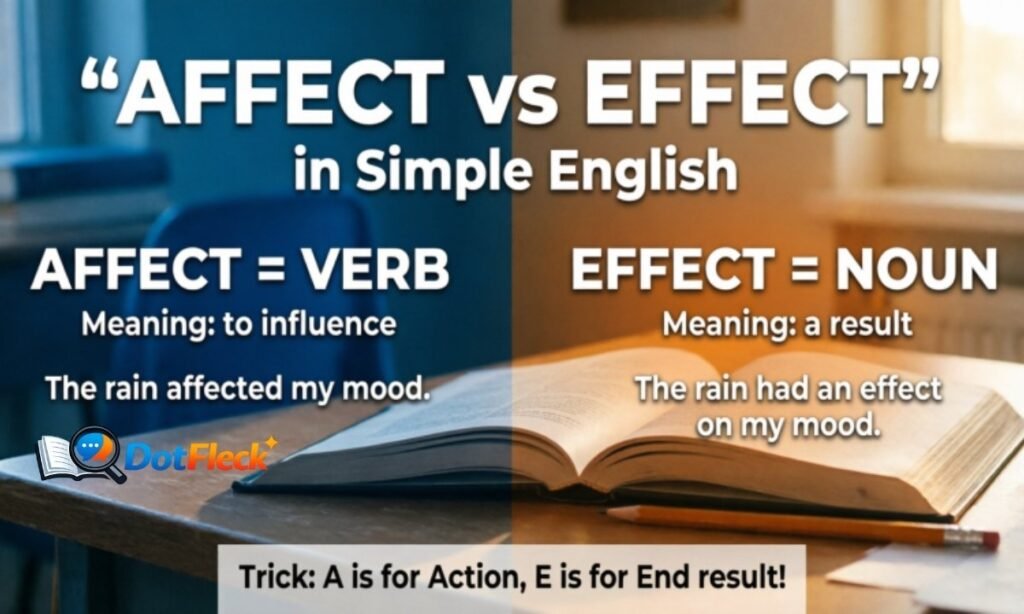
Affect is a verb that means to have an influence on someone or something. When one thing affects another, it causes a change in it.
Effect is a noun that means the result, outcome, or consequence of an action or event. An effect is what happens after something else has taken place.
Read Also : Annual vs Anual
When to Use Affect
Use affect when you want to show that one thing is changing or influencing another. It almost always works as a verb in everyday writing.
- The loud music did not affect her focus at all.
- Heavy traffic can affect how long your commute takes.
- A good night’s sleep affects your mood the next day.
- The new policy will affect how teachers grade assignments.
- Cold weather affects the battery life of most phones.
When to Use Effect
Use effect when you want to name the result of an action or change. It almost always works as a noun.
- The effect of the storm was a citywide power outage.
- Regular exercise has a positive effect on mental health.
- The medicine had an immediate effect on her headache.
- One effect of the new law was lower energy bills.
- The teacher explained the effect of pollution on rivers.
Side-by-Side Comparison Affect vs Effect
| Feature | Affect | Effect |
| Part of speech | Verb (99% of the time) | Noun (99% of the time) |
| Core meaning | To influence or change | The result of a change |
| Common phrase | “affects the outcome” | “the effect was…” |
| Rare alternate use | Noun in psychology (emotional state) | Verb meaning “to bring about” (formal) |
| Easy test | Ask: “Is this an action?” | Ask: “Is this a thing or result?” |
| Sentence position | Usually before a noun (affects sales) | Usually after “the” or “an” (the effect) |
Common Mistakes Affect vs Effect
Learners often swap these words because they sound alike when spoken quickly. This small sound difference makes the grammar rule easy to forget in casual writing.
- Writing “The effect changed my plans” instead of “The affect changed my plans” — reversed usage confuses the verb and noun roles.
- Using “side affects” instead of “side effects” when talking about medicine, since effect is the correct noun here.
- Saying “It didn’t effect me” instead of “It didn’t affect me,” mixing up the action with the result.
- Forgetting that effect can rarely act as a verb (meaning “to cause”), which adds to the confusion.
Easy Trick to Remember Affect vs Effect

Think of the phrase “A is for Action, E is for End result.” Affect starts with A, just like Action. Effect starts with E, just like End result.
If your sentence describes something happening, choose affect. If your sentence names what happened afterward, choose the effect.
Read Now: Brief vs Debrief
Real-Life Examples Affect vs Effect
- Sunlight can affect how quickly plants grow.
- The effect of the new schedule was fewer late arrivals.
- Her kind words affected him more than he expected.
- Scientists studied the effect of caffeine on sleep patterns.
- Loud noises affect a baby’s ability to nap.
- The effect of the discount was a rise in sales.
- Poor lighting can affect your reading speed.
- One surprising effect of the diet was better focus.
- The coach’s advice affected the team’s confidence.
- The long-term effect of the drought worried farmers.
Common Questions Affect vs Effect
Is effect correct in this sentence?
Yes, if you are naming a result, effect is correct. If you are describing an action, affect is the right choice instead.
Can I use affect instead of effect?
No, they are not interchangeable. Affect is a verb showing influence, while effect is a noun showing outcome, so swapping them changes the sentence’s meaning.
Why do people confuse them?
People confuse these words mainly because of pronunciation. Affect and effect sound nearly identical in fast speech, so writers often guess based on sound rather than grammar rule.
Confusion : Everyday vs Every Day
Similar Grammar Confusions
- Then vs Than
- Its vs It’s
- Their vs There vs They’re
- Complement vs Compliment
- Farther vs Further
Frequently Asked Questions
What is the simplest way to remember affect vs effect?
Remember that affect is an action (both start with A), and effect is the end result (both start with E). This small memory trick works for almost every everyday sentence you write.
Is affect ever used as a noun?
Yes, but rarely. In psychology, affect can describe a person’s visible emotional state, as in “the patient showed flat affect.” This use is uncommon outside clinical writing.
Is effect ever used as a verb?
Yes, though it’s formal and less common. “To effect change” means to cause change to happen. Most everyday writing does not need this rare verb form.
Does British English use affect and effect differently?
No, American and British English follow the same basic rule. Affect is typically a verb, and effect is typically a noun, in both writing styles worldwide.
How can I check my sentences quickly before publishing?
Ask yourself if the word describes an action or a result. If it’s an action, use affect. If it’s a result or outcome, use the effect. This quick test works almost every time.
Key Takeaways
- Affect is usually a verb meaning to influence or change something.
- Effect is usually a noun meaning the result of a change.
- Use the trick “A is for Action, E is for End result” to choose correctly.
- Side effects, not side affects, is the correct medical term.
- Affect and effect have rare alternate uses, but these are uncommon in daily writing.
- Reading your sentence aloud and asking “action or result?” solves most mix-ups instantly.
Conclusion
Mastering Affect vs Effect in Simple English comes down to one simple grammar habit: check whether your sentence needs an action word or a result word. Affect drives the change, and effect names what happens because of it.
With the tricks and examples in this guide, you can confidently choose the right word every time you write. Practice spotting the difference in your daily reading, and this once-tricky pair will soon feel completely natural.

Ethan Whitmore is an English language writer who enjoys making grammar, word meanings, and modern slang simple and easy to understand. His content focuses on clear explanations, practical examples, and everyday English usage.