

You typed “anual” into a search bar, Google didn’t blink, and now you’re wondering if you just invented a new word. Relax. Annual is the correct spelling, and anual is simply a common misspelling that sneaks in because English loves to drop letters when we’re not looking.
This guide clears up the confusion in plain terms and shows you exactly how, when, and why to use “annual” correctly.
Annual vs Anual: The Quick Answer
Annual is the only correct spelling in standard English. “Anual” is not a recognized word in any major English dictionary, including Merriam Webster, Oxford, or Cambridge.
The mix up usually happens because Spanish, Portuguese, and a few other Romance languages spell the word “anual” with one N. English speakers who are bilingual, or who simply type fast, often carry that single N habit into English by mistake.
So if you remember one thing from this article, remember this: two N’s, every single time.
What Does “Annual” Actually Mean?
“Annual” is an adjective that describes something happening once every year. It can also work as a noun, referring to a yearly publication or a plant that completes its life cycle in one growing season.
Here’s the simple breakdown:
- As an adjective: an annual checkup, an annual report, an annual salary
- As a noun: the school annual (yearbook), a garden annual (a plant that lives one season)
Both uses point back to the same core idea: something tied to a single year, repeating or completing on that cycle.
Read More : Brief vs Debrief
Why Do People Write “Anual” Instead?
Three reasons explain almost every case of this typo.
First, language crossover. Spanish speakers writing in English often carry over the single N spelling because that’s correct in their native language.
Second, simple typing speed. Double letters are easy to skip when your fingers move faster than your brain proofreads.
Third, phonetic guessing. The word sounds like “AN yoo uhl,” and nothing about the pronunciation hints that there are two N’s hiding in there.
None of these reasons make “anual” acceptable in English writing, but they do explain why the mistake is so common.
Where Did the Word “Annual” Come From?
“Annual” traces back to the Latin word annualis, built from annus, meaning “year.” Latin scholars and early church writers used annus constantly when describing yearly cycles, feasts, and obligations.
This is where the historical and biblical connection comes in. Ancient religious texts, including early Latin translations of scripture, frequently referenced yearly events such as annual sacrifices, annual feasts like Passover, and annual tithes. The concept of a recurring yearly duty is thousands of years old, even if the exact English word came later.
By the 14th century, “annual” had entered English through Old French annuel, keeping the double N structure that Latin had already established. So that second N isn’t random. It’s a direct inheritance from a word that has survived translation after translation for centuries.
Annual vs Anual: A Quick Comparison Table
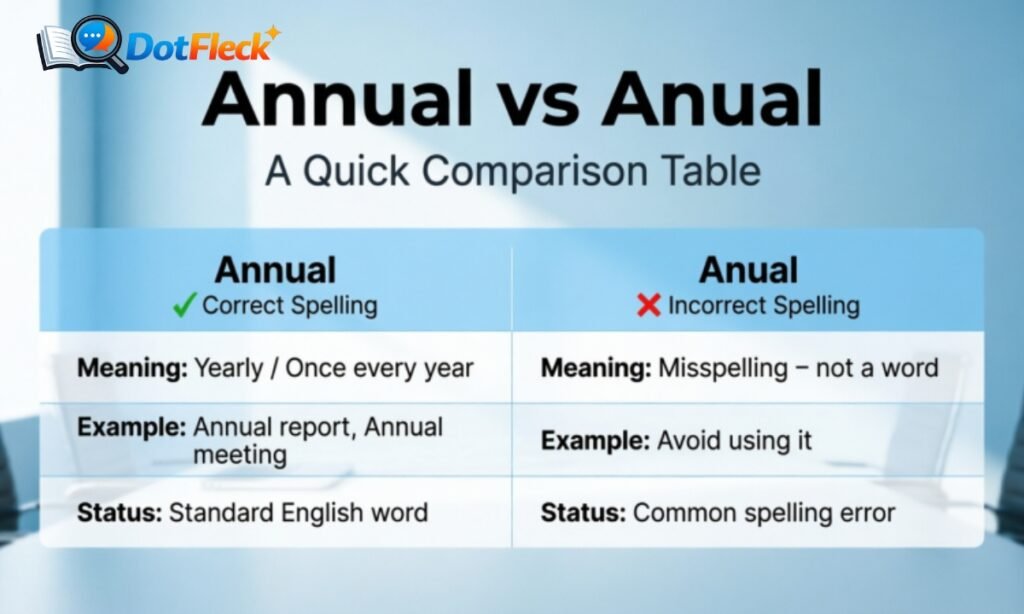
| Feature | Annual | Anual |
| Correct spelling | Yes | No |
| Found in English dictionaries | Yes | No |
| Origin | Latin “annualis” | Misspelling of “annual” |
| Common in | English | Sometimes mistaken from Spanish influence |
| Used in formal writing | Yes | Never |
This table alone answers the core question, but keep reading for the practical side of using the word correctly.
How to Use “Annual” Correctly in a Sentence
Using “annual” correctly is easier once you see it in action. It almost always sits right before a noun, describing something that happens every year.
- The company holds its annual shareholder meeting in March.
- Her annual income increased after the promotion.
- We renew our gym membership on an annual basis.
- The museum hosts an annual art festival every spring.
Notice the pattern. “Annual” describes the noun that follows it, and that noun almost always involves a recurring yearly event, payment, or report.
Real Life Examples of “Annual” in Use
Seeing the word in everyday, real world contexts makes it stick better than any dictionary definition.
- Finance: “Your annual percentage rate (APR) determines how much interest you pay each year.”
- Health: “Doctors recommend an annual physical exam to catch problems early.”
- Business: “The annual report showed a 12 percent increase in revenue.”
- Nature: “Sunflowers are annual plants, meaning they grow, bloom, and die within one year.”
- Education: “Students eagerly signed the class annual on the last day of school.”
Each example ties directly back to that one year cycle, which is the heartbeat of the word’s meaning.
Common Mistakes People Make With “Annual”
Beyond the “anual” typo, a few other mistakes trip people up regularly.
- Anual instead of annual (the most frequent error by far)
- Anually instead of annually (dropping the second N in the adverb form too)
- Bi annual confusion, where people assume it means twice as rare instead of twice a year
- Mixing up annual with annul, which means to cancel or void something legally
That last one causes real confusion because “annul” and “annual” look nearly identical but mean completely different things. An annual meeting happens every year. An annulment cancels a marriage.
Annual vs Anual: Which Is Correct?
Annual is the correct spelling. Anual is a common misspelling, often carried over from Spanish or Portuguese, where “anual” (one N) is actually correct.
“Annual” comes from the Latin word annualis, based on annus (year), and it means something that happens once a year, like an annual checkup, an annual report, or an annual salary.
So whenever you’re writing in English: two N’s, every time. “Anual” simply isn’t a recognized English word.
Related Words You Might Confuse With Annual

A few close cousins of “annual” also cause mix ups, so it’s worth clearing them up while we’re here.
- Annually: the adverb form, meaning “every year” (example: “Taxes are filed annually.”)
- Biannual: happening twice a year
- Biennial: happening every two years
- Perennial: lasting or recurring for many years, often used for plants
These words all share that Latin root tied to time and years, but each one describes a different frequency. Mixing them up changes the entire meaning of a sentence, especially in contracts, medical instructions, or gardening guides.
Click Here To Read : Everyday vs Every Day
Which One Should You Use?
Always use annual. There is no context, formal or casual, business or personal, where “anual” is the accepted spelling in English.
If you’re writing in Spanish, Portuguese, or another language where “anual” is correct, that’s a different story entirely. But for English content, emails, reports, or resumes, “annual” with two N’s is the only safe choice.
Quick Tricks to Remember the Correct Spelling
A few memory tricks make this stick for good.
- Picture two candles on a birthday cake, one for each “N,” since both represent the yearly celebration.
- Remember that “annual” contains the word “annu,” which mirrors “anniversary,” another word about years that also uses double letters.
- Read it out loud slowly: “AN, NUAL.” Hearing the pause helps your brain register both N’s.
Once one of these tricks clicks for you, the misspelling tends to disappear from your writing permanently.
FAQs About Annual vs Anual
Is “anual” ever correct in English?
No. “Anual” is not listed in any major English dictionary and is considered a spelling error whenever it appears in English text. It is only correct in languages such as Spanish and Portuguese.
What is the difference between annual and annually?
“Annual” is an adjective describing something yearly, such as an annual event. “Annually” is the adverb form, describing how often something happens, as in “The conference is held annually.”
Does “annual” always mean once a year?
Almost always, yes. “Annual” refers to something happening or completing once per year. If something happens twice a year, the correct word is “biannual,” not “annual.”
Final Thoughts
The confusion between annual and anual comes down to one missing letter, but that single N carries centuries of history behind it, all the way back to Latin and early references to yearly cycles and traditions.
Once you remember that “annual” always keeps its double N, the mistake tends to vanish from your writing for good. Keep it simple, keep both N’s, and your annual reports, checkups, and celebrations will always be spelled right.

Ethan Whitmore is an English language writer who enjoys making grammar, word meanings, and modern slang simple and easy to understand. His content focuses on clear explanations, practical examples, and everyday English usage.