
If you’ve ever paused mid-sentence wondering whether to type “Your vs You’re,” you’re not alone. These two words sound identical when spoken, which is exactly why they get swapped so often in writing.
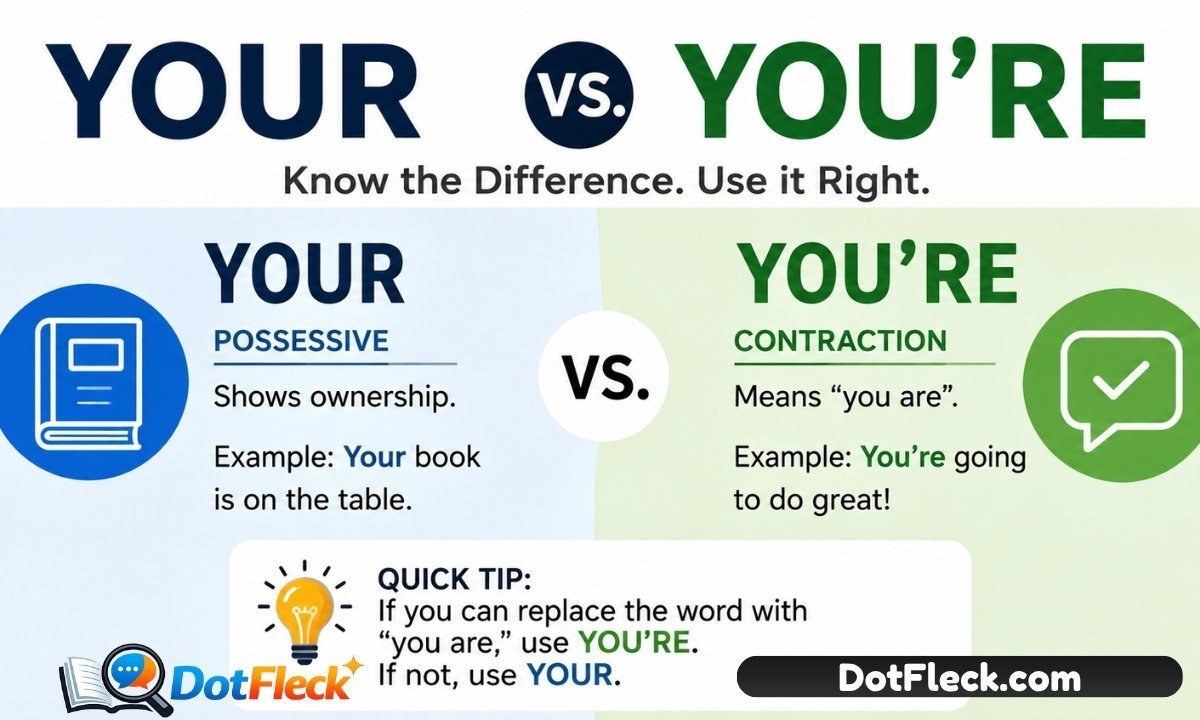
Here’s the quick answer: “your” shows possession (it means something belongs to you), while “you’re” is a contraction of “you are.” If you can replace the word with “you are” and the sentence still makes sense, you need “you’re.” If not, use “your.”
What Does “Your” Mean?

“Your” is a possessive adjective. It tells the reader that something belongs to or is associated with the person being addressed.
- Your car is parked outside.
- I love your new haircut.
- Is this your phone?
Notice that “your” always comes before a noun. It’s describing ownership, not stating an action or condition.
Read Also : Than vs Then
What Does “You’re” Mean?

“You’re” is a contraction, formed by combining “you” and “are” with an apostrophe replacing the missing letter “a.” It’s used whenever you’re describing a state, action, or condition that applies to the person you’re talking to.
- You’re doing a great job.
- I think you’re right about this.
- You’re going to love this restaurant.
Because “you’re” is simply a shortened version of “you are,” the two are always interchangeable in formal and informal writing alike.
Read Grammar : Compliment vs Complement
Why Do People Mix Up Your vs You’re?
The confusion comes down to pronunciation. Both words sound exactly the same when spoken aloud, so when we write quickly in a text, an email, or a social media comment our brains often default to muscle memory rather than logic. Autocorrect doesn’t always catch the error either, since both spellings are valid English words. The mistake isn’t about intelligence; it’s a spelling and grammar slip that even skilled writers make when typing fast.
The Difference Between Your vs You’re at a Glance
| Term | Part of Speech | Meaning | Typical Use | Example |
| Your | Possessive adjective | Belonging to you | Before a noun | “Your bag is on the table.” |
| You’re | Contraction | “You are” | Before a verb, adjective, or gerund | “You’re going to be late.” |
The One-Second Test to Get It Right Every Time
Before you hit send, try this simple substitution trick:
- Replace the word in question with “you are.”
- If the sentence still makes sense, use “you’re.”
- If the sentence sounds wrong or awkward, use “your.”
For example: “Your/You’re late for the meeting.” Try “You are late for the meeting” that works, so the correct word is “you’re late for the meeting.”
Now try: “I found your/you’re keys.” Testing “I found you are keys” makes no sense, so the correct choice is “your keys.”
Read Also : Barrel or Barrell
Real-Life Examples in Different Contexts “Your vs You’re”
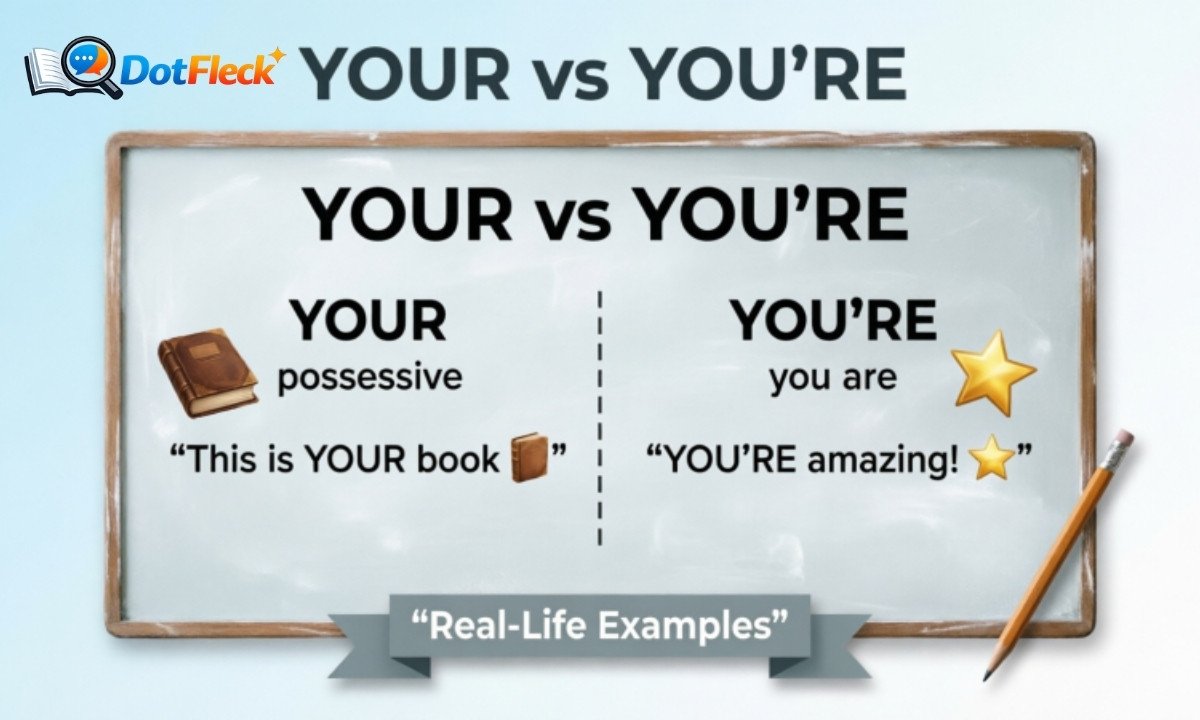
Seeing “your” and “you’re” used correctly across different situations makes the rule easier to remember.
Text message “Your vs You’re”
Correct: “Hey, you’re going to love the new coffee shop.” Incorrect: “Hey, your going to love the new coffee shop.” This is wrong because the sentence means “you are going to love,” which requires the contraction.
Workplace email “Your vs You’re”
Correct: “Please review your report before the meeting.” Incorrect: “Please review you’re report before the meeting.” Here, “report” is a noun being described as belonging to the reader, so “your” is correct.
Academic writing “Your vs You’re”
Correct: “Your thesis statement needs more supporting evidence.” Incorrect: “You’re thesis statement needs more supporting evidence.” “Thesis statement” is a noun showing possession, so “your” fits.
Social media caption “Your vs You’re”
Correct: “You’re amazing, and your energy is contagious.” This sentence actually uses both words correctly in one line: “you’re” describes a state (you are amazing), and “your” shows possession (energy belonging to you).
Common Mistakes and How to Avoid Them “Your vs You’re”
The most frequent error is using “your” when the sentence actually needs “you are.” Writers often see this in casual messages: “Your so funny” instead of the correct “You’re so funny.” Since “so funny” is a description, not a noun being possessed, the sentence calls for the contraction.
The reverse mistake also happens, though less often: writing “you’re” before a noun, as in “you’re car” instead of “your car.” Since “car” is a noun that belongs to someone, “your” is the correct choice.
A simple way to remember the difference: “your” owns something, “you’re” is short for two words. If you’re ever unsure, run the “you are” substitution test before finishing your sentence.
Your vs You’re: Formal and Informal Usage
Both words are appropriate in formal and informal writing; this isn’t a formality issue, it’s a spelling and grammar issue. Business reports, academic essays, casual texts, and social posts all use “your” and “you’re” the same way.
The only difference is that contractions like “you’re” tend to appear more often in conversational or informal writing, while some very formal academic styles may lean toward spelling things out more deliberately. Even so, “you’re” remains grammatically correct in professional communication.
Other Words That Cause the Same Confusion
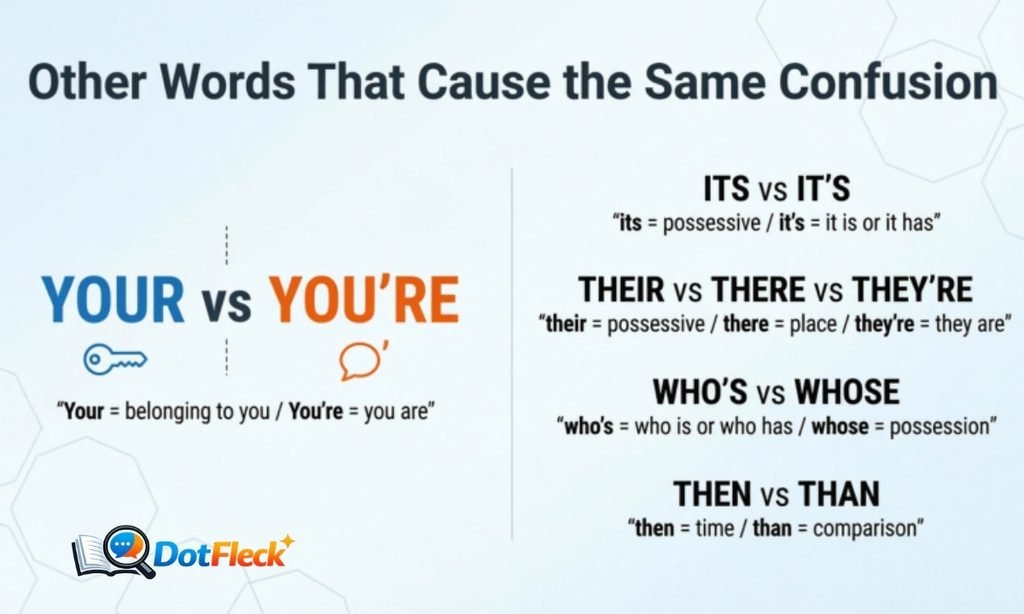
If “your” and “you’re” trip you up, you might also run into similar mix-ups with other possessive-versus-contraction pairs:
- its (possessive) vs. it’s (it is)
- their (possessive) vs. they’re (they are)
- whose (possessive) vs. who’s (who is)
The same substitution trick works for all of these: try replacing the word with the two-word phrase it might represent, and see if the sentence still makes sense.
Frequently Asked Questions
Is “your” or “you’re” correct for “you’re welcome”?
“You’re welcome” is correct because it means “you are welcome.” Writing “your welcome” is a common mistake, since “welcome” here is describing a state, not something being possessed.
How can I remember the difference between your and you’re?
Think of the apostrophe in “you’re” as a placeholder for the missing letter “a” from “are.” If you can say “you are” in place of the word, it’s “you’re.” If the word is followed by a noun showing ownership, it’s “your.”
Is “you’re” always correct when talking to someone?
Not always. “You’re” only works when it means “you are.” If you’re describing something that belongs to the person you’re addressing, such as their idea, home, or opinion, you need “your” instead.
Does autocorrect fix your and you’re automatically?
No. Since both “your” and “you’re” are correctly spelled words, autocorrect typically won’t flag the error unless grammar checking is turned on. It’s worth double-checking manually, especially in professional messages.
Final Takeaway
The difference between “your” and “you’re” comes down to one simple test: if you can substitute “you are” and the sentence still makes sense, use “you’re.” If the word is followed by a noun and shows possession, use “your.”
Once this rule clicks, the mix-up becomes much easier to catch even when you’re typing fast.

Ethan Whitmore is an English language writer who enjoys making grammar, word meanings, and modern slang simple and easy to understand. His content focuses on clear explanations, practical examples, and everyday English usage.