

If you’ve ever paused mid-sentence wondering whether you need there, their, or they’re, you’re not alone. These three words sound identical when spoken, which is exactly why they get swapped so often in writing.
Here’s the quick answer: there points to a place, their shows ownership, and they’re is short for “they are.” Once you see how each one works, the confusion disappears for good.
What’s the Difference Between There, Their, and They’re?
Each word does a completely different job in a sentence, even though they sound the same.
- There is a location word. It tells you where something is, or it introduces a sentence about something existing.
- Their is a possessive word. It shows that something belongs to a group of people (or, in modern usage, a single person of unspecified gender).
- They’re is a contraction. It squeezes “they are” into one word.
They’re called homophones, words that sound alike but have different spellings and meanings. English has plenty of these pairs, but this particular trio causes more mix-ups than almost any other, mostly because spellcheck tools don’t always catch the error. All three words are spelled correctly on their own; the mistake is picking the wrong one for the sentence.
When to Use “There”
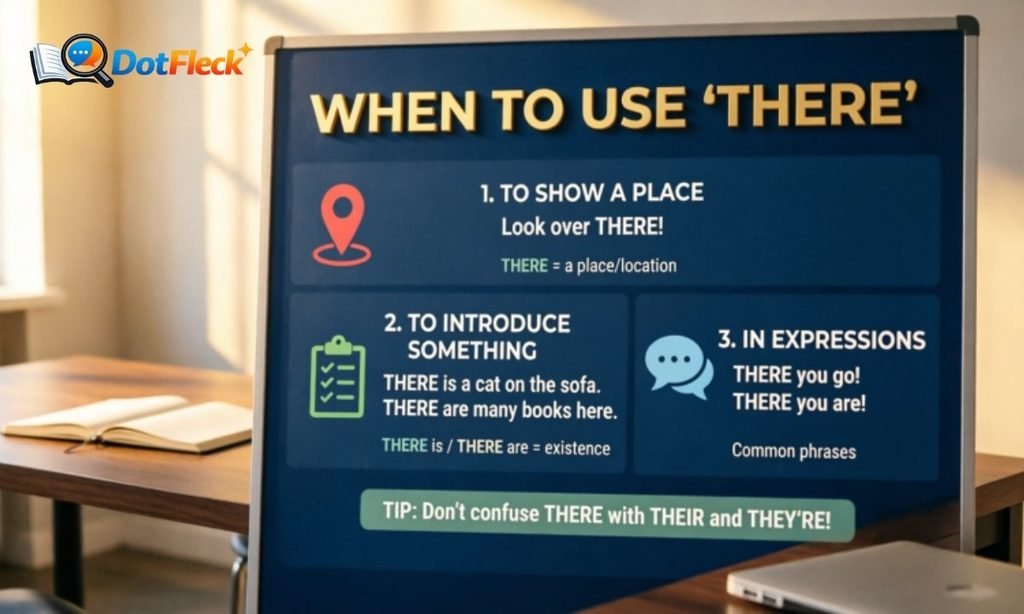
Use there when you’re talking about a location, a direction, or the existence of something. Think of the word here hiding inside there both describe a place.
Correct: “The keys are over there, on the counter.” “There is no easy way to solve this problem.”
Incorrect: “Their is no easy way to solve this problem.”
That second sentence fails because their can’t stand alone at the start of a sentence to announce that something exists. Only there can do that job.
There also works as a filler subject in sentences like “There are three reasons to leave early.” In this pattern, there doesn’t point to a physical spot at all; it simply opens the sentence and lets the real subject (“three reasons”) follow.
When to Use “Their”

Use their when you need to show that something belongs to more than one person, or to a person whose gender you don’t want to specify.
Correct: “The students left their laptops in the classroom.” “Someone forgot their umbrella at the front desk.”
Incorrect: “The students left there laptops in the classroom.”
Here, the laptops belong to the students, so the sentence needs a possessive word. There is no ownership meaning, which makes it the wrong choice.
You’ll also see their used with a singular subject, as in “Someone forgot their umbrella.” This is called the singular they, and major style guides, including the Associated Press and Merriam-Webster, now accept it as standard when a person’s gender is unknown or unspecified.
When to Use “They’re”
Use they’re only when you can replace it with “they are” and the sentence still makes sense. This is the fastest way to check your work.
Correct: “They’re planning a trip to Chicago next month.” (Test: “They are planning a trip to Chicago next month.” ✔️)
Incorrect: “There planning a trip to Chicago next month.”
Run the same substitution test on this incorrect example, and it falls apart immediately: “There are planning a trip” doesn’t make sense, which confirms that they’re was the word needed.
Why People Mix These Words Up
The confusion isn’t really about grammar, it’s about sound. In spoken English, there, their, and they’re are pronounced almost identically, so the brain doesn’t get a spelling cue while writing quickly. Text messages, social media captions, and first drafts are the most common places for these slips because we tend to write at the speed we talk.
Autocorrect makes things worse, not better. Spellcheck only flags words that are misspelled, and all three of these words are spelled correctly; they’re just used in the wrong spot. That’s why proofreading by eye (or reading your sentence out loud) catches mistakes that software misses.
Quick Comparison Table
| Word | Part of Speech | Meaning | Typical Use | Example |
| There | Adverb / pronoun | Refers to a place or introduces existence | Location or “there is/are” statements | “Put the box over there.” |
| Their | Possessive adjective | Shows ownership | Before a noun to show who owns it | “Their dog barks all night.” |
| They’re | Contraction | Short for “they are” | Anywhere “they are” fits naturally | “They’re late for the meeting.” |
Common Mistakes and How to Avoid Them
Mistake 1: Using “there” instead of “their” for possession. “There house is beautiful” should be “Their house is beautiful.” Ask yourself: does something belong to someone here? If yes, you need their.
Mistake 2: Using “their” instead of “they’re” before a verb. “Their going to the concert” should be “They’re going to the concert.” Run the substitution test: if “they are” fits, use they’re.
Mistake 3: Using “they’re” to describe a location. “They’re car is parked outside” should be “Their car is parked outside.” A contraction can’t show ownership, so it never belongs directly in front of a noun like car or house.
A simple way to remember all three:
- There has here inside it think location.
- Their has heir inside it think inheritance and ownership.
- They’re has an apostrophe think of it as a shortcut for two words, they are.
Real-Life Examples in Context
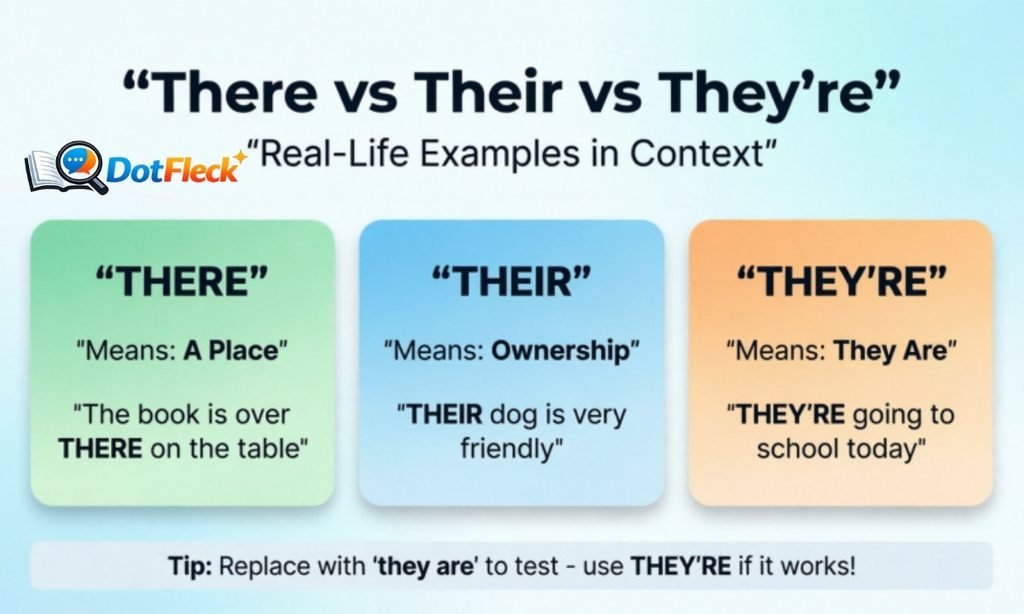
Text message: “Running late, meet you there in 10 mins.”
Workplace email: “Please remind the vendors to submit their invoices by Friday.”
Academic writing: “They’re conducting a follow-up study to confirm their initial findings.”
Social media caption: “There’s nothing like a sunset over the lake. 🌅”
Notice how each sentence uses only one of the three words, and swapping any of them would immediately sound wrong if you read the sentence aloud slowly.
There’s vs. Theirs: A Related Mix-Up
Two related forms cause similar trouble. There’s is a contraction of “there is” (“There’s a spider on the wall”). Theirs is a possessive pronoun that replaces a noun entirely, similar to ours or yours (“That car is theirs”).
Neither of these takes an apostrophe before the s in the possessive form, a detail that trips up even experienced writers, since theirs never uses an apostrophe.
Practical Guidance for Everyday Writing
Before hitting send on an email, text, or post, try this two-second check:
- If the word shows ownership, use their.
- If the word can be replaced with “they are,” use they’re.
- If neither test applies, and you’re describing a place or introducing a statement, use there.
This quick mental test works faster than memorizing definitions, especially when you’re writing under time pressure.
Frequently Asked Questions
Is “their” or “there” correct in “over there”?
There is correct. “Over there” always refers to a location, and location is exactly what there is built for.
Can “their” be used for one person?
Yes. Their is commonly used as a gender-neutral singular pronoun, as in “Every employee should bring their badge.” This usage is accepted in modern American English, including by the Associated Press Stylebook.
What is the easiest way to remember the difference between “they’re” and “their”?
Say the sentence out loud and try substituting “they are.” If it still makes sense, they’re correct. If the sentence is about ownership instead, you need their.
Is “they’re” ever used before a noun?
No. They’re is always short for “they are,” and “they are” can’t sit directly in front of a noun like house or car. If a noun follows, the word you need is almost always their.
The Bottom Line
Getting there, their, and they’re right comes down to one habit: pause for half a second and ask what job the word is doing. Is it pointing to a place? Showing ownership? Standing in for “they are”?
Once you identify the job, the correct spelling follows automatically. With a little practice, this becomes second nature, and these three words stop being a source of second-guessing in your writing.

Ethan Whitmore is an English language writer who enjoys making grammar, word meanings, and modern slang simple and easy to understand. His content focuses on clear explanations, practical examples, and everyday English usage.