
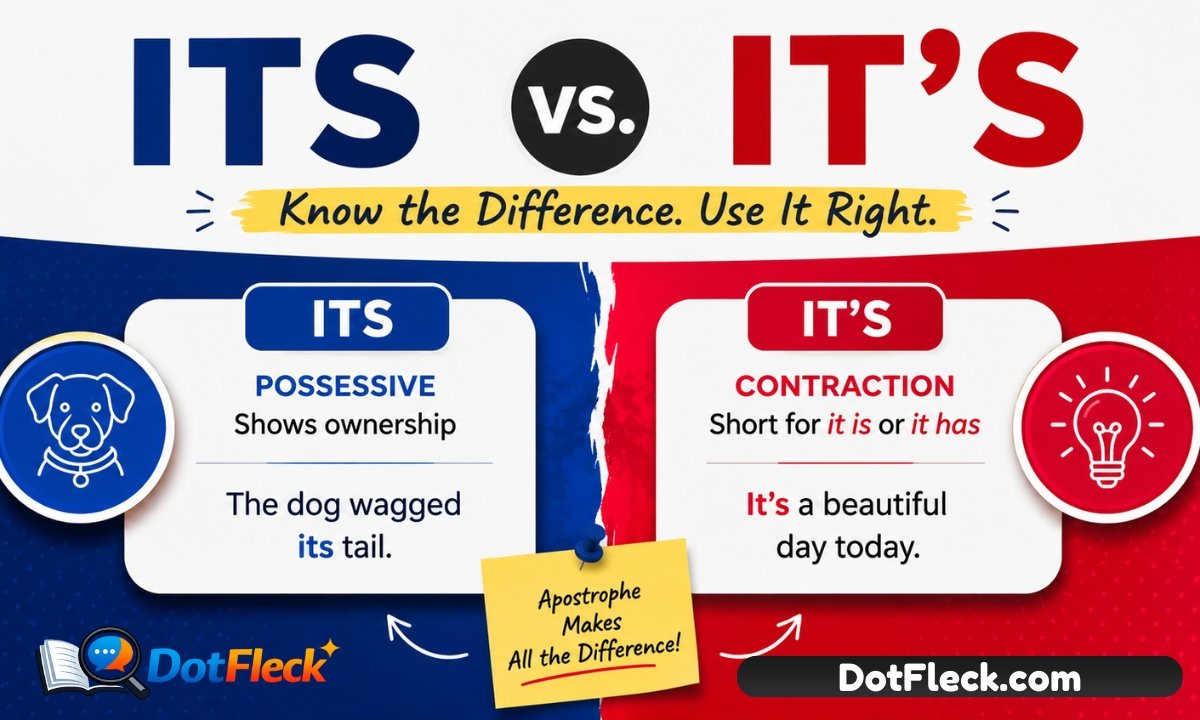
If you’ve ever paused mid-sentence wondering whether you need an apostrophe, you’re not alone. “Its” shows possession (something belongs to it), while “it’s” is a contraction meaning “Its vs. It’s”
The confusion happens because apostrophes usually signal ownership, but “its” breaks that pattern on purpose. Once you know the trick to tell them apart, you’ll never second-guess yourself again.
What Does “Its” Mean?
“Its” is a possessive pronoun. It shows that something belongs to or is associated with a thing, animal, or abstract idea. Just like “his,” “her,” or “their,” it never takes an apostrophe.
- The dog wagged its tail.
- The company changed its logo.
- The storm lost its strength overnight.
Notice that “its” works the same way “his” does. You wouldn’t write “hi’s,” and you shouldn’t write “it’s” when you mean possession.
Read Now : Your vs You’re
What Does “It’s” Mean?
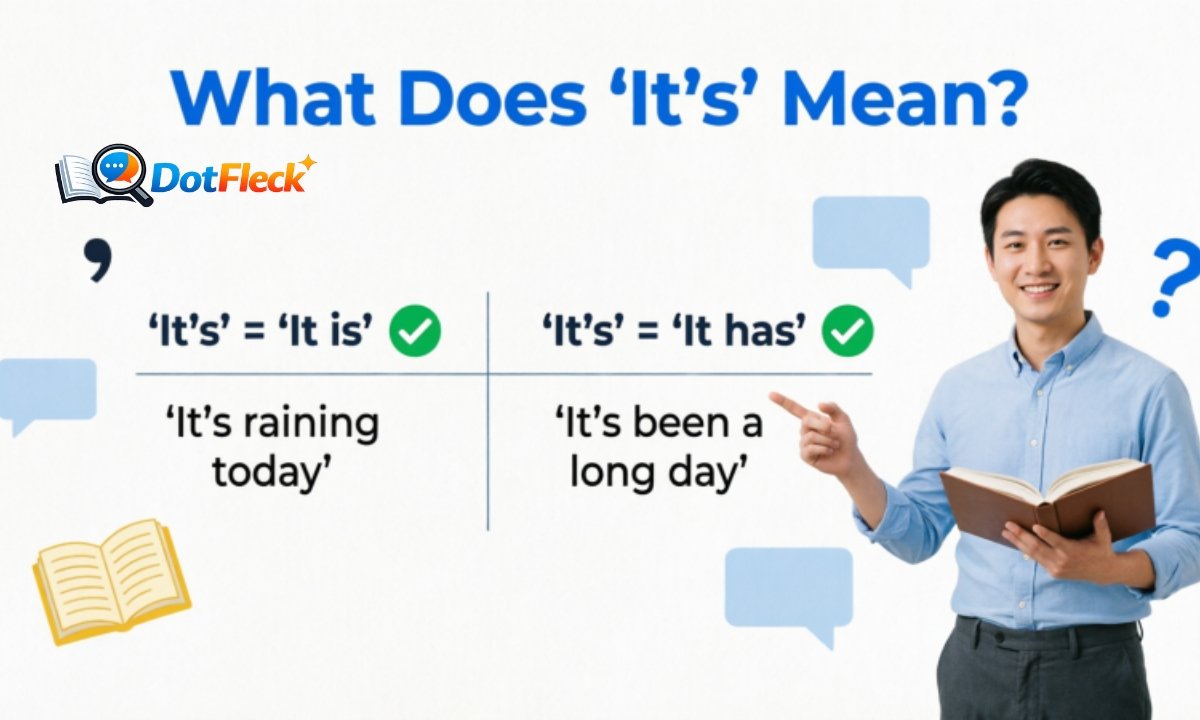
“It’s” is a contraction, a shortened form of two words squeezed together with an apostrophe standing in for missing letters. It always means either “it is” or “it has.”
- It’s raining again. (It is raining again.)
- It’s been a long week. (It has been a long week.)
- It’s your turn to choose. (It is your turn to choose.)
The apostrophe here isn’t showing ownership at all. It’s simply replacing the letter that got dropped, just like in “don’t” (do not) or “she’s” (she is).
Read Also : Than vs Then
Why This Mistake Happens So Often
English usually adds an apostrophe plus “s” to show possession, as in “Sarah’s car” or “the dog’s bowl.” So it feels natural to assume “its” should follow the same pattern. But possessive pronouns like its, his, hers, ours, yours, and theirs are the exception. None of them use an apostrophe, even though they all show ownership.
This is really the whole mystery solved: its behaves like his, not like Sarah’s.
Its vs. It’s: Quick Comparison Table
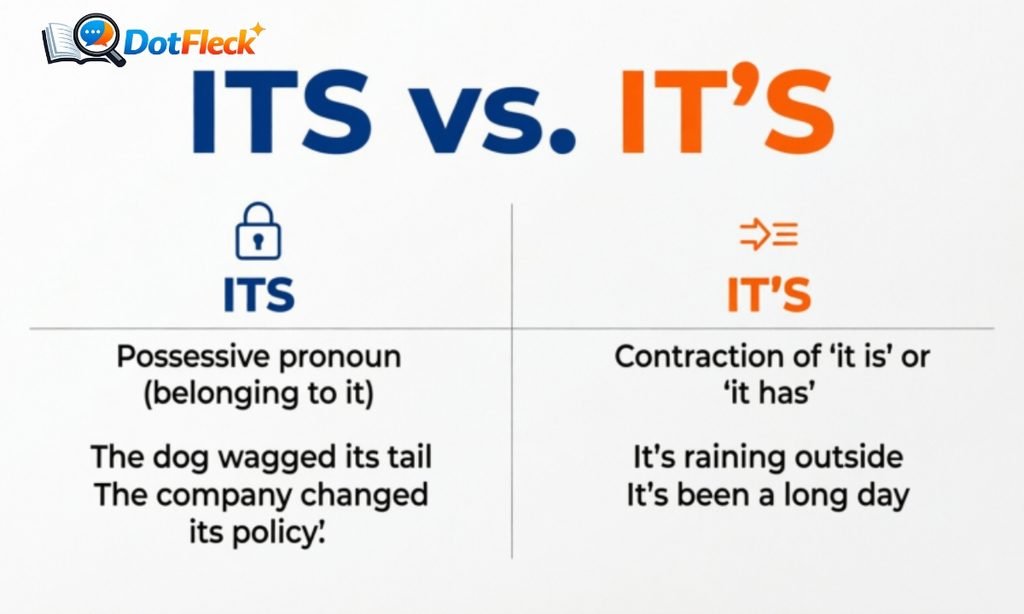
| Term | Correct Use | Meaning | Typical Use | Example |
| Its | Possessive pronoun | Shows ownership or belonging | Describing what something has | The cat licked its paw. |
| It’s | Contraction | Short for “it is” or “it has” | Replacing “it is” or “it has” | It’s getting late. |
The Simple Test to Get It Right Every Time
Here’s the fastest way to check your sentence: replace the word with “it is” or “it has.” If the sentence still makes sense, use it’s. If it sounds wrong, use its.
- Take your sentence: “The bird built ___ nest.”
- Try the substitution: “The bird built it is nest.” That’s nonsense.
- Since the substitution fails, the correct word is its.
Try it again with: “___ almost time to leave.” Substitution: “It is almost time to leave.” That works, so it’s is correct.
This one-step test works in nearly every situation, from text messages to formal reports.
Read Now : Compliment vs Complement
Real-Life Examples in Context “Its vs. It’s”
Seeing both words used naturally makes the rule easier to remember.
Everyday conversation “Its vs. It’s”
- Correct: “The restaurant closed its doors early.”
- Correct: “It’s freezing outside today.”
Workplace communication “Its vs. It’s”
- Correct: “The team updated its quarterly goals.”
- Correct: “It’s important to submit the report by Friday.”
Text messages “Its vs. It’s”
- Correct: “It’s on the counter, grab it before you go.”
- Correct: “The app finally fixed its login bug.”
Academic writing “Its vs. It’s”
- Correct: “The study revised its methodology in the second phase.”
- Correct: “It’s unclear whether the results are statistically significant.”
Common Mistakes and How to Avoid Them “Its vs. It’s”
Incorrect: “The company announced it’s new product line.” Correct: “The company announced its new product line.” Why it’s wrong: The sentence is describing something belonging to the company, not saying “it is new product line.”
Incorrect: “Its been a great year for the business.” Correct: “It’s been a great year for the business.” Why it’s wrong: This means “it has been,” which requires the apostrophe.
Incorrect: “The dog wagged it’s tail happily.” Correct: “The dog wagged its tail happily.” Why it’s wrong: The tail belongs to the dog, so no apostrophe is needed.
A simple way to remember it: if you can swap in “it is” or “it has” and the sentence still makes sense, keep the apostrophe. If not, drop it.
Formal Writing vs. Casual Writing
Both its and it’s are grammatically standard in American English, but context matters. It’s is common in conversational writing, emails, and casual text, since it mirrors natural speech. In more formal writing, such as academic papers or official reports, some writers spell out “it is” or “it has” completely instead of using the contraction.
Its is appropriate in both formal and informal writing, since it functions as a straightforward possessive pronoun with no casual connotation.
Related Word Forms Worth Knowing “Its vs. It’s”
Understanding how its and it’s fit into the bigger picture of pronouns can reinforce the rule.
- Possessive pronouns never use apostrophes: its, his, hers, yours, ours, theirs.
- Contractions always use apostrophes to replace missing letters: it’s, don’t, can’t, she’s, they’re.
- If you’re ever unsure whether a word is possessive or a contraction, ask whether it’s replacing two words squeezed into one. If yes, it needs the apostrophe.
Frequently Asked Questions
Is “its” or “it’s” correct in a sentence like “The car lost ___ value”?
Its is correct here because the sentence describes something belonging to the car. Testing it with “it is” produces “the car lost it is value,” which doesn’t make sense.
Can “it’s” ever be used to show possession?
No. It’s only means “it is” or “it has.” It never shows ownership, no matter how the sentence is phrased. For possession, always use its.
What is the easiest way to remember the difference between its and it’s?
Think of its like his. Neither uses an apostrophe, even though both show possession. Use it’s only when you can substitute “it is” or “it has” without changing the sentence’s meaning.
Is this rule different in British English?
No. The its vs. it’s rule is identical in both American and British English. The confusion and the correct usage are the same on both sides of the Atlantic.
Final Takeaway
The difference comes down to one simple test: if you can replace the word with “it is” or “it has,” use it’s. If you’re showing ownership, use its, with no apostrophe.
Keep that substitution trick in mind, and this common mix-up becomes an easy fix rather than a guessing game.

Ethan Whitmore is an English language writer who enjoys making grammar, word meanings, and modern slang simple and easy to understand. His content focuses on clear explanations, practical examples, and everyday English usage.