
Loose vs. Lose
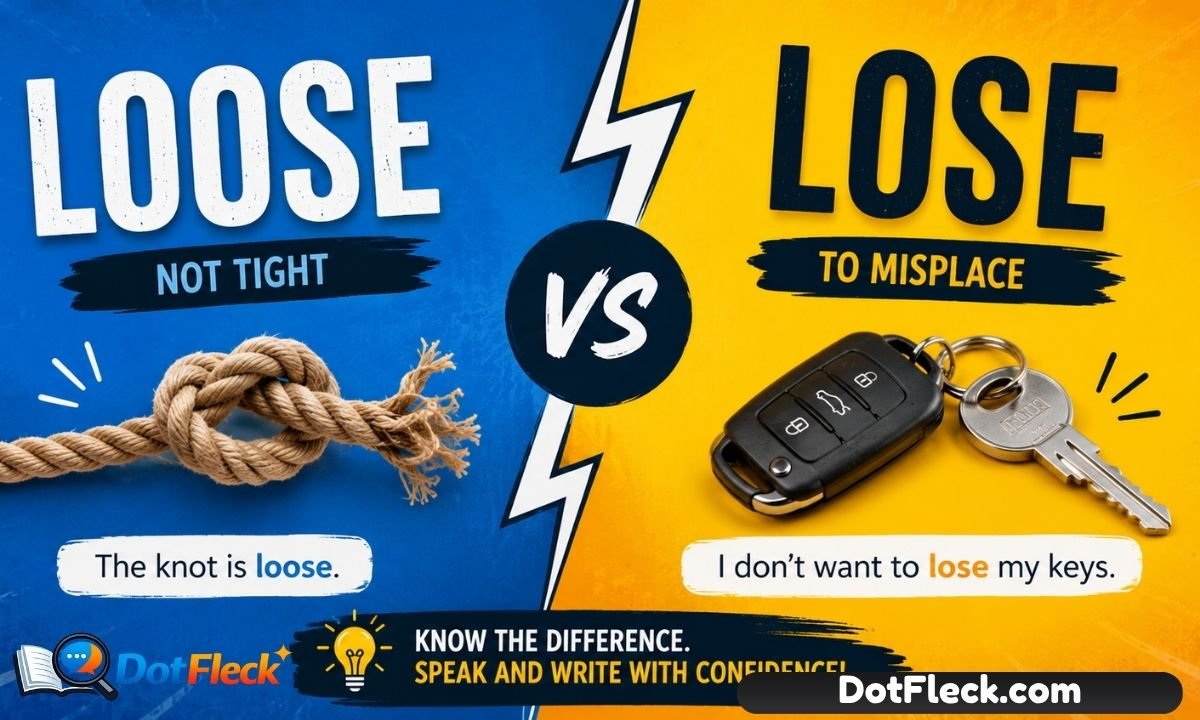
If you’ve ever typed “I don’t want to loose my keys” and then paused, wondering if that extra O belongs there, you’re not alone. Lose (one O) is a verb meaning to misplace something or fail to win.
Loose (two O’s) is an adjective meaning not tight. The mix-up happens because the words look almost identical and differ by just one letter, even though they don’t sound alike or work the same way in a sentence.
The Quick Answer: Which One Do You Need?
Before diving into the details, here’s the short version:
- Use lose when you’re talking about an action misplacing something, failing to win, or losing weight, time, or interest.
- Use loose when you’re describing something a shirt that isn’t tight, a screw that isn’t tightened, or rules that aren’t strict.
If you can replace the word with “misplace” or “fail to win,” you need lose. If you can replace it with “not tight” or “not fastened,” you need loose.
What “Lose” Means

Lose is a verb. It’s pronounced with a “z” sound, like “looz,” which trips people up because the spelling doesn’t hint at that pronunciation at all. It has a few related meanings, all centered on the idea of no longer having something.
- To fail to win: The team expects to lose tonight’s game.
- To misplace something: I always lose my phone charger.
- To be deprived of something: He didn’t want to lose his job.
- To stop having a feeling or quality: Try not to lose your patience.
Because lose is always a verb, it changes form depending on the tense: lose, loses, losing, lost. Notice that “lost” drops the pattern entirely, which is one more reason this word family causes confusion.
What “Loose” Means
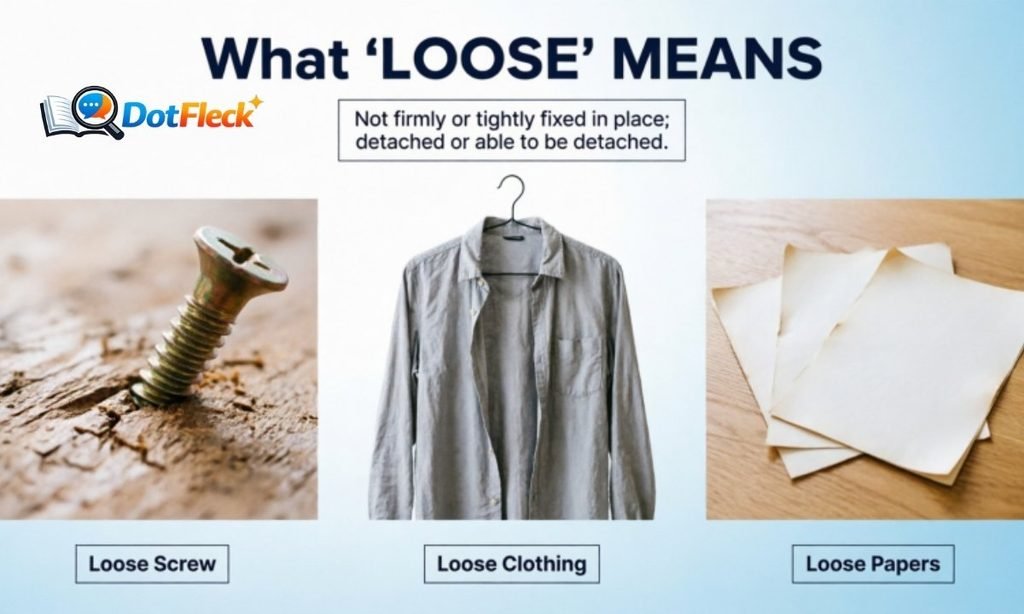
Loose is most commonly an adjective. It rhymes with “goose,” and it describes something that isn’t tight, isn’t fastened, or isn’t restrained.
- Not tight: These jeans feel loose around the waist.
- Not firmly attached: The dog got loose from its leash.
- Not strict or exact: That’s a loose translation of the original text.
- Free from confinement: The horses ran loose in the field.
Loose can also work as a verb, though this use is far less common. When it functions as a verb, it means to release or set free, as in the archer loosed an arrow. You’ll mostly see this in older or more formal writing, so for everyday purposes, think of loose as a describing word, not an action word.
Read Also : POV Meaning in Slang
Why People Mix Up Loose vs. Lose
The confusion isn’t really about meaning. Almost no one thinks “not tight” and “fail to win” are the same idea. The problem is spelling. English speakers are used to a doubled vowel making a word “longer” or “softer” sounding, so it feels natural to double the O in lose. But English spelling doesn’t always follow logic, and in this case, the single-O word is the verb, while the double-O word is the adjective the opposite of what many people expect.
Autocorrect doesn’t always catch the error either, since both words are spelled correctly on their own. The mistake is a word choice error, not a spelling error, which means spell-check tools often miss it completely.
Loose vs. Lose at a Glance
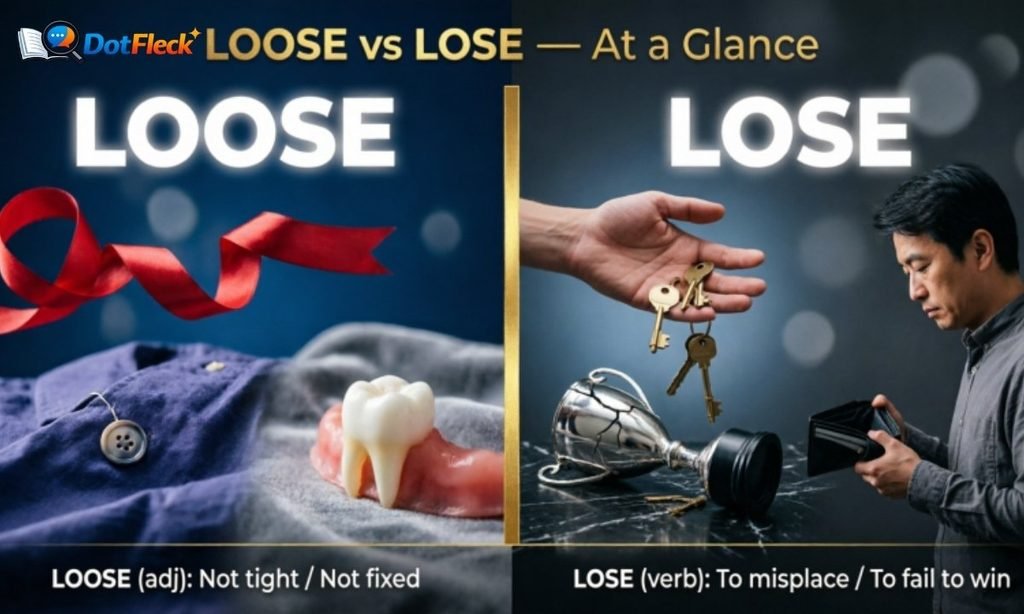
| Word | Part of Speech | Meaning | Example |
| Lose | Verb | To misplace, fail to win, or stop having | Don’t lose your ticket. |
| Loose | Adjective (rarely a verb) | Not tight, not fastened, or not strict | The button on my shirt is loose. |
A Simple Trick to Remember the Difference “Loose vs. Lose”
Here’s a memory trick that works for almost everyone: think of the extra O in loose as room to move around. A loose shirt has extra room. A loose knot has room to slip free. That spare O visually represents the slack or looseness the word describes.
For lose, picture the word itself losing a letter. It went from “loose” to “lose” by dropping an O, just like you might lose an item. The verb literally lost something, which is fitting, since that’s exactly what it means.
If mnemonics aren’t your style, try this instead: lose rhymes with choose, and both are verbs. Loose rhymes with goose and moose, and none of those are actions. Matching the rhyme to the part of speech can make the choice automatic.
Correct and Incorrect Examples “Loose vs. Lose”
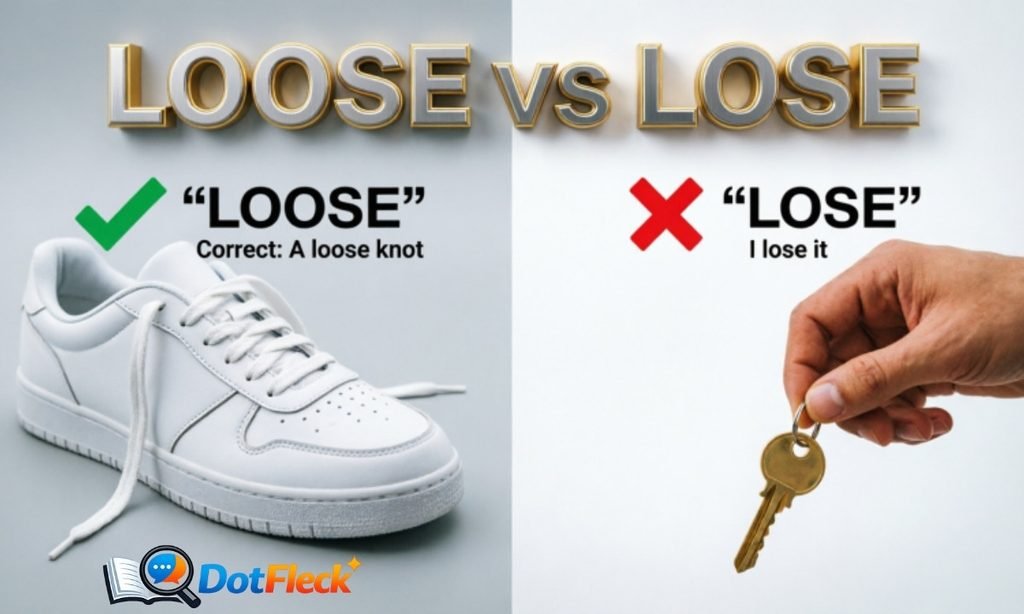
Correct: “I hope I don’t lose this game.”
Incorrect: “I hope I don’t loose this game.” Loose describes a physical state, not an action, so it can’t replace lose here.
Correct: “The dog’s collar is too loose.”
Incorrect: “The dog’s collar is too lose.” Lose is a verb, so it can’t describe a noun like “collar” the way an adjective can.
Correct: “She’s trying to lose ten pounds before summer.”
Incorrect: “She’s trying to loose ten pounds before summer.” Weight loss is an action, which calls for the verb lose.
Correct: “He wore a loose-fitting jacket to the interview.”
Incorrect: “He wore a lose-fitting jacket to the interview.” A jacket’s fit is a description, which needs the adjective loose.
Common Mistakes to Watch For “Loose vs. Lose”
The single most frequent error is writing loose when the sentence calls for the verb lose, especially in casual writing like texts, social media posts, and quick emails. This happens because “loose” simply looks more familiar or “complete” to many writers.
A less common but still real mistake is writing lose where loose belongs, usually when someone is typing quickly and drops a letter by habit. Reading your sentence back and asking “am I describing an action or a description?” will catch almost every instance of this error.
One more mix-up worth mentioning: some writers confuse loose with loosen. Loosen is the verb form that means to make something less tight, as in loosen your grip. Loose itself, as noted earlier, is rarely used as a verb in modern English, so if you need a verb related to tightness, loosen is usually the safer choice.
Practical Tips for Everyday Writing “Loose vs. Lose”
- Ask what job the word is doing. If it’s showing an action, you want lose. If it’s describing a noun, you want loose.
- Say the sentence out loud. Lose rhymes with “shoes.” Loose rhymes with “goose.” Trust your ear once you know the pattern.
- Check for a nearby noun. Adjectives like loose sit right next to the noun they describe: loose thread, loose change, loose ends.
- Watch for verb tenses. If the sentence needs past tense, you’re looking at “lost,” not “loosed” another sign you’re dealing with the verb lose.
Related Words Worth Knowing “Loose vs. Lose”
- Losing the present participle of lose, as in she hates losing.
- Lost the past tense and past participle of lose, as in I lost my wallet.
- Loosely the adverb form of loose, as in the plan is loosely organized.
- Loosen the verb form related to loose, as in loosen the screw.
Knowing these related forms helps you catch mistakes before you make them, since each one follows the same core distinction between the action word and the description word.
FAQs “Loose vs. Lose”
Is “loose” ever correct as a verb?
Yes, but rarely. In older or more formal English, loose can mean to release or set free, as in the soldiers loosed a volley of arrows. In modern everyday writing, though, loose almost always functions as an adjective, and lose is the word you want for any action related to misplacing or failing to win.
What is the difference between “lose” and “loose” in one sentence?
Lose is a verb meaning to misplace something or fail to win, while loose is an adjective meaning not tight or not fastened. For example: If you keep the knot loose, the rope might lose its grip.
How do I remember which spelling is correct?
Think of the extra O in loose as extra space or slack, which matches its meaning of “not tight.” For lose, remember that the word has literally lost a letter compared to loose, just as the verb describes losing something.
Is “loose” or “lose” used in British English differently than American English?
No. Both American and British English use lose as the verb and loose as the adjective in the same way. This isn’t a regional spelling difference like “color” versus “colour” the distinction is about grammar and meaning, not dialect.
The Bottom Line “Loose vs. Lose”
Lose is the action word you lose games, keys, weight, and patience. Loose is the description word pants, screws, and rules can all be loose.
Once you connect the extra O in loose to the idea of extra room or slack, the two words become easy to tell apart, even under the pressure of a fast-typed text or email.

Ethan Whitmore is an English language writer who enjoys making grammar, word meanings, and modern slang simple and easy to understand. His content focuses on clear explanations, practical examples, and everyday English usage.