
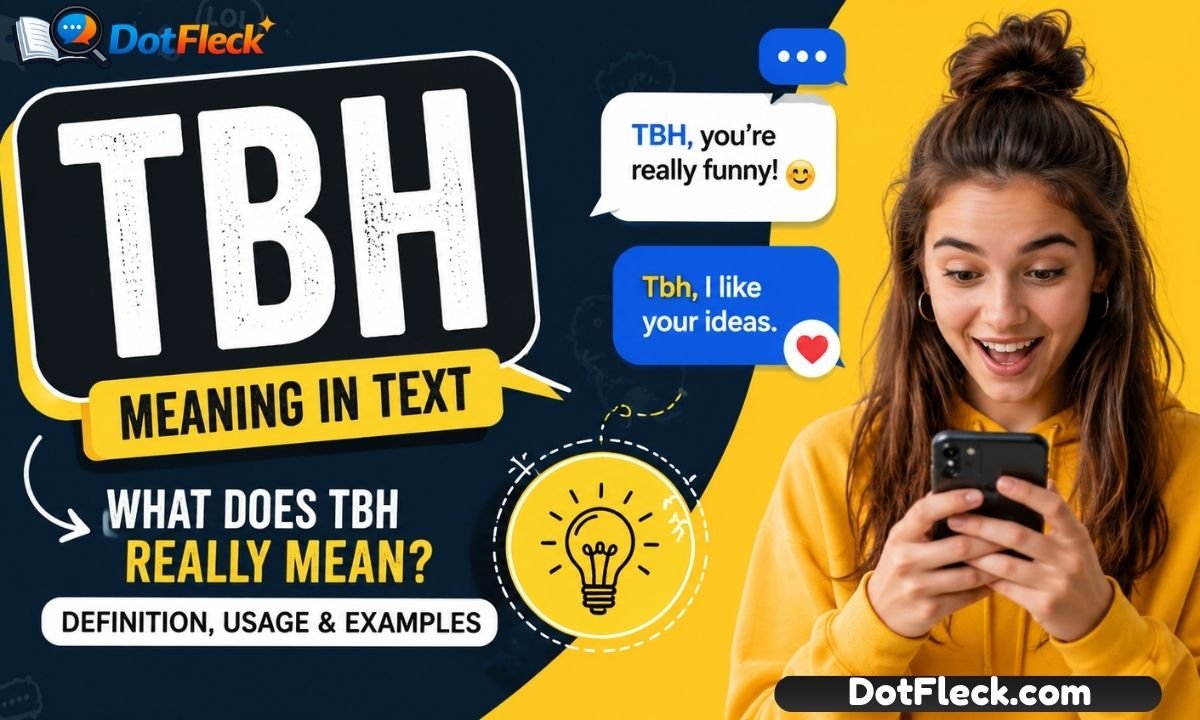
TBH stands for “to be honest.” People drop it into texts, comments, and captions right before they say something candid, whether that’s a real opinion, a small confession, or a compliment they weren’t planning to give out loud.
The TBH meaning in text has stayed pretty consistent for years, but how it gets used has shifted a lot depending on who’s sending it and where.
Quick Answer
TBH = “to be honest.” It signals that what comes next is a genuine opinion, not just small talk. You’ll see it used the same way whether it comes from a friend, a stranger’s comment, or an Instagram sticker, though the tone behind it can change a lot.
What TBH Actually Means When You’re Texting
At its core, TBH is a heads-up. It tells the other person that what follows is sincere, even if it’s blunt or a little awkward to say.
Someone might text “tbh I forgot we had plans today” or “tbh that outfit was on fire.” Same three letters, two totally different moods. The word itself doesn’t carry emotion. The sentence after it does.
This is actually the biggest thing people get wrong about texting abbreviations like this one. TBH isn’t a tone on its own. It’s more like a verbal nudge that says “pay attention, this part is real.”
When a Girl Texts TBH
When TBH shows up in a text from a girl, it’s often used to soften something that might otherwise sound harsh, or to add weight to a compliment. “Tbh I think you’d look better in the blue one” reads as gentle honesty, not criticism.
It also shows up a lot in group chats before someone shares an unpopular opinion. It works almost like a disclaimer: I’m about to say something you didn’t ask for, but I mean it kindly.
When a Guy Texts TBH

From a guy, TBH tends to lean more direct. It often comes before a straightforward take, a compliment someone wasn’t fishing for, or an admission that took a second to type out.
Something like “tbh I really missed hanging out” carries more emotional weight than it would without the TBH in front of it. It signals that the sentiment is real, not just something said out of habit.
Neither usage is a hard rule. Texting habits vary person to person more than they vary by gender, but these are the general patterns people notice.
Does TBH Have a Medical Meaning?
Not in any standard or widely recognized sense. TBH is not an official medical abbreviation you’d find in clinical charting or textbooks. If you’ve seen it used in a health-related context, it was almost certainly still “to be honest,” just written by a nurse, patient, or caregiver in an informal note or message.
Some niche internal systems reuse common acronyms for unrelated purposes, so it’s not impossible to stumble on a rare exception. But for the vast majority of readers searching this, the medical angle isn’t relevant. The texting meaning is the one that applies.
What TBH Means on Instagram
On Instagram, TBH picked up a specific cultural moment around 2015 to 2017. Users would post a photo and caption it “like for a tbh,” inviting followers to comment on it, and the poster would reply with an honest, often flattering, one-line opinion about that person.
That exact trend has faded, but the underlying idea stuck around. Instagram later leaned into it with features like the Honesty Box sticker on Stories, and separate apps like NGL borrowed the same concept of anonymous, unfiltered feedback.
Today, TBH on Instagram is more often just a caption starter than a full trend. “Tbh this might be my favorite trip ever” reads the same way it would in a text.
Where TBH Came From
TBH isn’t new. It’s been floating around internet forums, instant messaging, and early texting since at least the 2000s, well before smartphones made texting the default way people talked.
It grew alongside a whole family of similar shorthand like NGL (not gonna lie), IMO (in my opinion), and TBF (to be fair). All of them exist for the same reason: typing out a full honest disclaimer takes time, and three or four letters gets the same point across faster.
TBH in Real Conversations

Here’s where the meaning actually clicks, because context does most of the work.
A friend group chat, deciding on dinner: “Tbh I’m kind of over pizza this week.”
A comment on a friend’s photo: “Tbh you glow differently lately.”
A slightly awkward admission between coworkers: “Tbh I didn’t finish reading the whole email.”
A text after an argument: “Tbh I’ve been thinking about what you said.”
Notice how none of these need extra punctuation or emojis to land. The TBH is doing the emotional setup on its own.
When to Use TBH (and When to Avoid It)
TBH works well when:
- You’re about to share a genuine opinion someone didn’t necessarily ask for
- You want to soften bad news without burying it
- You’re giving a compliment that feels a little vulnerable to say
It’s worth skipping in a few situations:
- Formal texts to a boss, teacher, or client, where it can read as too casual
- Serious conversations where the abbreviation might feel dismissive of something heavy
- Messages where you’re not actually being more honest than usual, since using it as filler makes it lose meaning
Common Mistakes People Make With TBH
The most common slip is using TBH before something that isn’t actually an honest confession, just a regular statement. “Tbh I’m going to the store” doesn’t need the disclaimer, since there’s nothing to be honest about.
Another mistake, and one that’s newer, is people mixing up TBH with NGL. They’re close cousins but not identical. NGL usually admits something slightly embarrassing or reluctant, like “ngl I forgot your birthday.” TBH is broader and can introduce almost any sincere statement, positive or negative.
A smaller but real issue is tone loss in text. Because TBH can precede either a compliment or a criticism, some people read it with anxiety before they even finish the sentence. If you’re texting someone who tends to worry, it can help to lead with warmth before dropping a TBH-flagged opinion.
Words and Phrases Similar to TBH
A few terms overlap with TBH but carry slightly different shades of meaning:
- NGL (not gonna lie): admits something a bit reluctantly
- IMO / IMHO: frames a statement as opinion rather than fact
- TBF (to be fair): adds balance or a counterpoint
- Honestly / candidly: the spelled-out, more formal cousins of TBH
None of these are exact substitutes. Swapping TBH for IMO in a sentence, for example, shifts it from “this is my honest truth” to “this is just how I see it,” which is a smaller claim.
Frequently Asked Questions
What does TBH mean from a girl on Snapchat?
It means the same thing as anywhere else, “to be honest,” though on Snapchat it often shows up in quick reactions to snaps or streaks. It’s usually used to give a fast, sincere reaction without typing out a full sentence.
Is TBH the same as NGL?
They’re similar but not interchangeable. TBH introduces an honest opinion in general, while NGL usually admits something the person feels a little sheepish or reluctant about. Context usually makes the difference clear.
Can TBH be used sarcastically?
Yes, though it’s less common. If the sentence after it clearly contradicts reality, like “tbh I loved waiting two hours in line,” the TBH signals sarcasm instead of sincerity. The tone from the rest of the message gives it away.
Does TBH always mean something negative is coming?
No. People often assume TBH signals bad news, but it’s just as likely to introduce a compliment or a positive confession. The abbreviation itself is neutral; only the sentence after it carries the actual tone.
Is it rude to text someone “tbh” before criticism?
Not inherently, but pairing it with something harsh can feel blunt if there’s no softness around it. Adding a warm opener or explaining your intent usually keeps it from landing wrong.
What’s the origin of TBH as slang?
It traces back to early internet and messaging culture in the 2000s, long before it became an Instagram caption trend around 2015 to 2017. It has simply carried forward as one of the more durable texting abbreviations.
Final Thought
TBH has stuck around because it does something useful: it flags sincerity in a format, texting, where tone is easy to lose. Whether it shows up from a girl softening an opinion, a guy admitting something real, or a caption on Instagram, the core meaning barely changes.
What changes is the honesty behind it, and that part is still up to the person typing it.

Ethan Whitmore is an English language writer who enjoys making grammar, word meanings, and modern slang simple and easy to understand. His content focuses on clear explanations, practical examples, and everyday English usage.