
You are writing a recipe card, a menu, or a product label, and you stop mid-sentence. Should it be “homemade” or “home made”? Both look natural on the page, which is why so many writers second-guess themselves. Only one of them is standard in most American writing.
This guide on Homemade vs. Home Made explains which spelling is correct, when the two-word version can still appear, and where the hyphen fits in. You will also find clear examples, style guide notes, comparisons with similar terms, and short exercises. By the end, you should be able to pick the right form quickly and avoid the most common mistakes.
Quick Answer
Homemade is the correct spelling in American English. It is one word, it has no hyphen, and it works as an adjective meaning “made at home” or “made by hand rather than bought.”
“Home made” as two separate words is not a standard spelling of the adjective. It only appears when “home” and “made” belong to different parts of a sentence, such as “a home made of stone.” In British English, you may also see the hyphenated form “home-made.”
Homemade vs. Home Made vs. Home-Made: Comparison at a Glance
The table below shows how each form is usually treated, so you can see the differences side by side.
| Form | Standard? | Where you see it | Example |
| homemade | Yes | US writing, and increasingly UK writing | She served homemade soup. |
| home-made | Yes (mainly UK) | British publications and dictionaries | He baked a home-made loaf. |
| home made | Only in special cases | Phrases where “made” describes “home” | A home made from recycled wood |
If you are writing for a US audience, choose “homemade” every time you mean something made at home.
What Does “Homemade” Mean?
Homemade meaning is simple: something prepared or produced at home instead of in a factory, store, or professional kitchen. Most people connect it with food, but it can describe crafts, cleaning products, gifts, and even tools.
The word often suggests care, simplicity, or a personal touch. It can also hint at a less polished result, as in “a homemade costume.” Context decides whether the tone is warm or slightly critical.
Word Origin: Where “Homemade” Comes From
“Homemade” is a compound word built from “home” and “made.” It combines a noun and a past participle to describe where something was produced. English has many compounds like this, such as “handmade,” “sun-dried,” and “store-bought.”
Over time, the hyphenated “home-made” often settled into a single word. Many compounds follow this path: first two words, then a hyphenated form, then one closed word. American usage completed that shift for “homemade” earlier than British usage did.
How to Pronounce “Homemade”
“Homemade” is pronounced roughly as HOHM-MAYD. Both parts carry some stress, though the first part is slightly stronger in everyday speech. The pronunciation is the same whether you spell it as one word or with a hyphen.
Syllable Breakdown
“Homemade” has two syllables:
- home (/hoʊm/), rhymes with “dome”
- made (/meɪd/), rhymes with “paid”
Parts of Speech and Related Word Forms
“Homemade” is almost always an adjective. It usually comes before a noun (“homemade jam”) but can also follow a linking verb (“The jam is homemade”). It does not change form for comparison in normal use, so “more homemade” sounds unusual.
Related forms include “homemaker,” “home-cooked,” and “housemade.” You may also see “homemade” used as a predicate adjective in short answers, such as “Is it store-bought? No, it’s homemade.”
Do You Need a Hyphen? Home-Made vs. Homemade
In American English, you do not need a hyphen. Major American dictionaries list “homemade” as one word. A hyphen is mostly a British habit, and even there, the closed form is common.
Check your audience before you decide. If readers are in the United States, use “homemade.” If you are writing for a UK publication that follows Oxford-style spelling, “home-made” may be preferred.
What AP, Chicago, and MLA Style Say
Major style guides lean on standard dictionaries for compounds like this one. The Associated Press Stylebook uses “homemade,” and Chicago and MLA both defer to Merriam-Webster for US spelling, which lists “homemade” as one word.
If your school, employer, or publisher has its own style sheet, follow it. Otherwise, “homemade” is the safe choice.
UK vs. US Usage
American writers overwhelmingly use “homemade.” British writers use both “home-made” and “homemade,” and the hyphenated form still appears in many UK dictionaries and newspapers. Neither form is wrong in the UK, but consistency matters within a single document.
Homemade in a Sentence: Examples
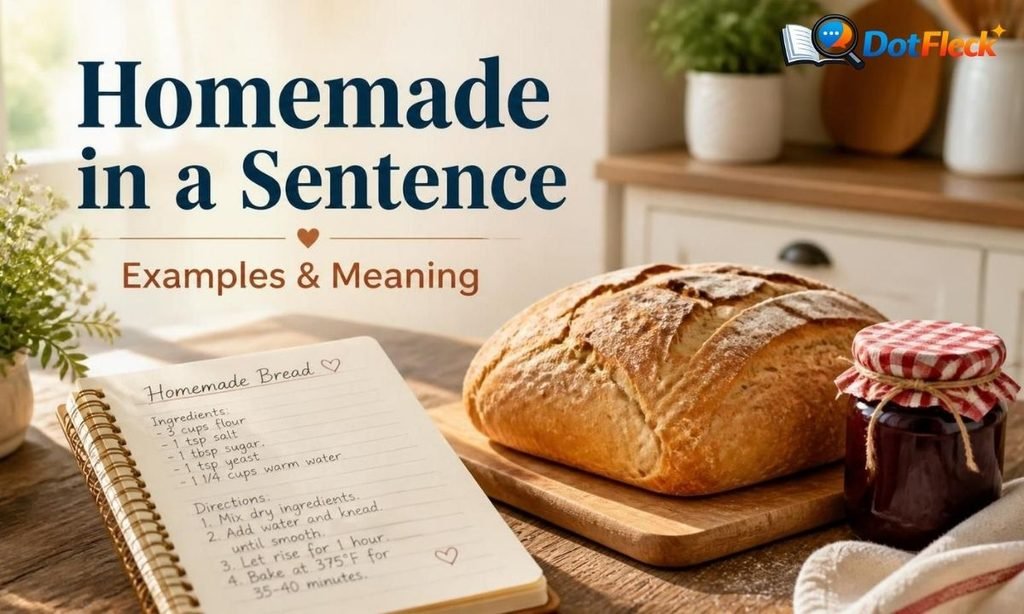
Seeing the word in context makes the rule easier to remember. Here are correct examples:
- My grandmother’s homemade pie won the county fair.
- We gave our neighbors homemade candles for the holidays.
- The kids built a homemade rocket out of cardboard.
- Is the salad dressing homemade or from a bottle?
- Homemade cleaning spray is cheap and easy to mix.
Here is a case where “home made” is correct as two words:
- They live in a home made entirely of reclaimed brick.
Common Misspellings of “Homemade”
The most frequent errors are small and easy to miss. Watch for these:
- home made (two words, used as an adjective)
- home-made (hyphenated in US writing)
- homemaid (wrong ending)
- homeade (missing letter)
Spell checkers may not flag “home made,” because both words are real. That is why it helps to know the rule rather than rely on software.
Common Mistakes to Avoid With “Homemade”
The biggest grammar mistake is splitting the adjective into two words before a noun, as in “home made cookies.” Another is mixing forms in one document, such as “homemade soup” in one paragraph and “home-made bread” in the next.
Writers also confuse “homemade” with “handmade” or assume it only applies to food. Choose the word that matches what you actually mean, and stay consistent.
Homemade vs. Handmade: What’s the Difference?
“Homemade” tells you where something was made: at home. “Handmade” tells you how it was made: by hand rather than by machine. A scarf knitted by hand in a workshop is handmade but not homemade, while a cake mixed with a stand mixer in your kitchen is homemade but not handmade.
The two words can overlap, but they are not interchangeable.
Homemade vs. Handmade Comparison Table
| Feature | Homemade | Handmade |
| Focus | Place (made at home) | Method (made by hand) |
| Common uses | Food, crafts, DIY items | Jewelry, pottery, textiles |
| Machines allowed? | Yes | Usually no |
| Example | Homemade lemonade | Handmade leather wallet |
Homemade vs. Home-Cooked: What’s the Difference?
“Home-cooked” applies only to food that was cooked at home. “Homemade” is broader because it can describe anything made at home, including non-food items. A home-cooked meal is a type of homemade item, but a homemade birdhouse is not home-cooked.
Use “home-cooked” when you want to stress the cooking itself, as in “a home-cooked dinner.” Use “homemade” when the focus is on the product, such as “homemade bread.”
Homemade vs. Store-Bought: What’s the Difference?
“Store-bought” describes items purchased ready-made, while “homemade” describes items made by the person using or serving them. The two terms are often used as opposites, especially in recipes and product reviews.
This contrast helps readers understand quality, cost, and effort. Homemade items often cost less and offer more control over ingredients, while store-bought items save time.
Homemade vs. Store-Bought Comparison Table
| Feature | Homemade | Store-Bought |
| Source | Made at home | Purchased ready-made |
| Time needed | More | Less |
| Ingredient control | High | Limited |
| Example | Homemade granola | Store-bought granola |
Synonyms and Related Terms for “Homemade”
Depending on your meaning, you can use several alternatives:
- home-cooked
- from scratch
- DIY
- handcrafted
- do-it-yourself
- self-made
Not all of these mean exactly the same thing, so match the word to your context. “From scratch” works best for recipes, while “DIY” suits projects and crafts.
Homemade vs. Housemade (Restaurant Menus)
“Housemade” often appears on restaurant menus. It means the restaurant prepared the item itself instead of buying it from a supplier, as in “housemade pasta” or “housemade pickles.”
Use “homemade” for items made in a home kitchen and “housemade” for items made by a restaurant or business. The difference is small, but it helps menus sound accurate.
Beyond the Kitchen: Figurative and Extended Uses of “Homemade”
“Homemade” is not limited to food and crafts. It can describe amateur or improvised work, such as a homemade video, a homemade website, or a homemade explanation. In these cases, the word may suggest something personal and unpolished.
The tone depends on context. “A homemade film” can sound charming or can suggest low quality, so consider how your readers will take it.
Memory Trick to Remember the Spelling
Think of “homemade” as one cozy unit, like a house with no gap in the middle. If the word describes a noun in one smooth idea, such as homemade bread, keep it together.
You can also use this quick test: if you can replace it with “made at home” and the meaning still works, write “homemade” as one word.
Practice: Home Made vs. Homemade Exercises
Try these short exercises. Answers appear at the end of each section.
Choose the Correct Form
Pick the correct option for each sentence.
- She brought (homemade / home made) cookies to the party.
- The recipe calls for (homemade / home-made) stock.
- They live in a (homemade / home made) of logs.
Answers: 1. homemade. 2. homemade (or home-made in UK writing). 3. home made (here, “made of logs” describes the home).
Multiple Choice Challenge
Which sentence is correct in American English?
- A. We love home made pizza.
- B. We love homemade pizza.
- C. We love home-made pizza.
Answer: B.
Spot and Fix the Mistake
Fix the error in this sentence: “My brother sells home made soap online.”
Answer: “My brother sells homemade soap online.”
Sentence Building
Write one sentence using “homemade” before a noun and one using it after “is.”
Sample answers: “I made homemade jam.” “The jam is homemade.”
Frequently Asked Questions
Is home made one word or two?
In most cases, it is one word: “homemade.” Use two words only when “home” is a noun and “made” describes it.
Which is correct: “homemade” or “home made”?
“Homemade” is correct for the adjective meaning made at home. “Home made” is only correct in special phrases like “a home made of brick.”
Is there a hyphen in homemade?
In American English, no. “Homemade” is written as one closed word. British writing may use “home-made,” but both forms appear.
What is the correct spelling of “homemade”?
The correct spelling is h-o-m-e-m-a-d-e, written as one word with no hyphen or space.
Is homemade a compound word?
Yes. It combines “home” and “made” into a single adjective. Many similar compounds, like “handmade,” follow the same pattern.
Is “home-made” correct in British English?
Yes. British dictionaries often list “home-made,” though “homemade” is also widely used and accepted.
Final Thoughts
The Homemade vs. Home Made question has a simple answer for most writers. “Homemade” is one word, it needs no hyphen in American English, and it describes things made at home. “Home-made” is a UK variant, and “home made” belongs only in special phrases where the two words play different roles.
When in doubt, use the “made at home” test and stay consistent throughout your writing. Choosing “homemade” for food, crafts, and everyday projects will keep your spelling correct and your meaning clear. A quick check of your audience and style guide is all you need to finish with confidence.

Ethan Whitmore is an English language writer who enjoys making grammar, word meanings, and modern slang simple and easy to understand. His content focuses on clear explanations, practical examples, and everyday English usage.