
You typed “lieing,” stared at it for three seconds, and something felt off. That gut feeling was right. Lying is the correct spelling, not “lieing.” The confusion is common because English spelling rules rarely play fair, and this word breaks the pattern you’d normally expect.
Here’s the simple rule that fixes it for good.
Lieing vs Lying: The Quick Answer
“Lying” is always correct. “Lieing” is always wrong.
There is no situation, formal or casual, where “lieing” is an accepted spelling. Not in dictionaries, not in style guides, not in casual texting.
The word comes from the verb “lie,” and when you add “-ing,” the letter e at the end gets dropped and swapped for a y. That single swap is the entire secret behind this mix-up.
What Does “Lying” Actually Mean?
“Lying” is the present participle of two different verbs, which is honestly part of why people get tripped up.
- Lie (to tell an untruth): She is lying about where she was last night.
- Lie (to rest in a horizontal position): The cat is lying on the warm windowsill.
Both meanings use the exact same spelling, “lying.” Only the context tells you which one is meant.
Why Isn’t It Spelled “Lieing”? (The Spelling Rule Explained)
This is the part most articles skip, and it’s the part that actually helps you remember the rule long term.
English has a quiet little rule for verbs that end in ie: when you add “-ing,” the ie flips to y before the ing is attached.
So the transformation looks like this:
lie → drop the e → li → flip the ie order isn’t quite it either, so let’s be exact: lie → remove the final e → add y → lie becomes ly → add ing → lying
In plain terms: take “lie,” delete the e, replace it with y, then tack on ing. You get lying, never “lieing.”
This isn’t a random exception. It’s a consistent spelling pattern that applies to a small family of English verbs, which we’ll look at shortly.
The History Behind This Confusing Word
“Lie” has roots stretching back to Old English “leogan,” meaning to speak falsely, and it shows up in some of the oldest surviving English texts, including early biblical translations where truth telling and lying are treated as opposite moral forces.
The spelling rule that turns ie into y before ing didn’t exist yet in Old English. It developed later, during Middle English, as scribes tried to avoid awkward letter clusters like “ieing,” which is clunky to write and even clunkier to read.
So the y swap wasn’t invented to confuse students centuries later. It was invented to make handwriting and reading smoother, and it accidentally became one of the most misspelled patterns in modern English.
Lieing vs Lying: Quick Comparison Table
| Feature | Lying | Lieing |
| Correct spelling | Yes | No |
| Found in dictionaries | Yes | No |
| Used in formal writing | Yes | Never |
| Grammar rule followed | ie → y before ing | Breaks the rule |
| Example sentence | He kept lying about the deadline. | Not valid in any context |
Real-Life Examples of “Lying” in a Sentence
Seeing the word in action makes the spelling stick faster than any rule ever will.
- “I know you’re lying, your left eyebrow always gives it away.”
- The witness admitted to lying under oath during the trial.
- My dog spends most afternoons lying in the exact spot the sun hits the floor.
- Politicians accused of lying about campaign spending rarely recover their approval ratings quickly.
- “Stop lying to yourself about how much sleep you actually need.”
Notice how “lying” fits both the dishonesty meaning and the resting position meaning without changing spelling at all.
| Read More Articles |
| HBU Meaning in Text: Shocking Meaning Revealed 2026 |
| Keep vs Kept: Easy Past Tense Rules Explained |
| FOMO Meaning: The Powerful Truth Behind This Popular Slang |
Common Mistakes People Make With This Word
Even confident writers slip up here, usually for one of these reasons:
- Autocorrect assumptions: Some people assume dropping the e and just adding “ing” is enough, giving you “lieing,” which spellcheck will flag every time.
- Confusing it with “die”: “Die” becomes “dying,” which follows the same ie to y rule, yet people still second guess themselves.
- Mixing it up with “lay”: This leads straight into our next section, because it’s genuinely one of the most common grammar mix-ups in English.
- Overcorrecting: A few writers try so hard to avoid “lieing” that they accidentally write “lying” with a double y or extra letter under pressure.
Lying vs Lieing vs Laying: Don’t Mix These Up
This is the mistake competitors barely touch, and it’s arguably more useful than the spelling issue itself.
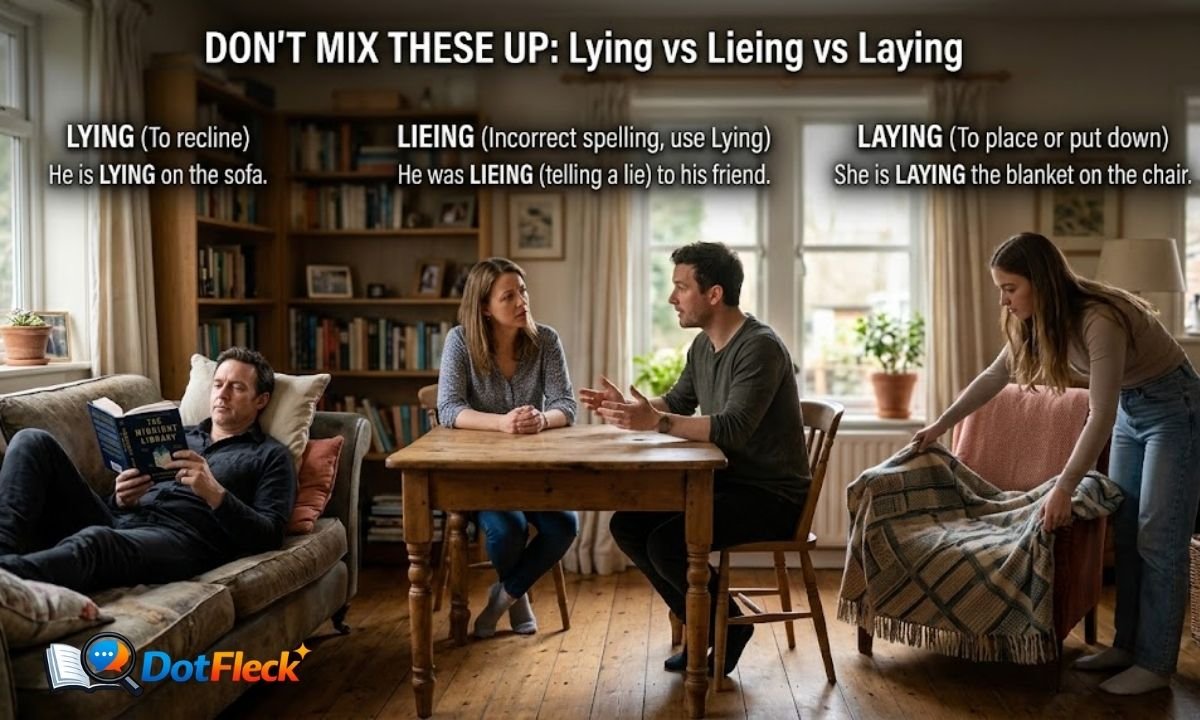
Lying means resting or telling an untruth, and it needs no object. “She is lying down” works fine on its own.
Laying comes from “lay,” which means to place something down, and it needs an object. “She is laying the blanket on the bed” requires that blanket to complete the sentence.
Quick test: if you can’t finish the sentence with “what,” you probably need lying. If you can answer “what is being placed,” you need laying.
Which One Should You Use?
Use lying anytime you’re writing about:
- Someone telling an untruth
- A person, animal, or object resting horizontally
- Any present tense form of the verb “lie”
There is no scenario, professional email, school essay, text message, or novel, where “lieing” is the right call. If you’re ever unsure, picture the rule: drop the e, add y, then ing.
Simple Trick to Never Misspell It Again
Here’s a memory trick that actually works better than repeating the rule in your head.
Think of the phrase “lie becomes ly before ing joins the party.” The silly rhythm of it sticks because your brain remembers rhythm better than raw rules.
Or try this: any time you see “ieing” in a word you’re typing, stop. That letter combination almost never appears correctly in English. It’s a built in red flag.
Frequently Asked Questions
Is “lieing” ever correct in any dialect of English?
No. American English, British English, and every major style guide treat “lieing” as a misspelling. There is no regional or dialectal exception where it becomes acceptable.
Why does “lie” change to “ly” instead of just adding “ing”?
English avoids stacking two vowels like ie directly before ing because it creates an awkward, hard to read letter cluster. Swapping ie for y keeps the spelling smoother and easier to pronounce visually.
What other words follow this same ie to y rule?
“Die” becomes “dying,” “tie” becomes “tying,” and “vie” becomes “vying.” Any short verb ending in ie typically follows this exact same pattern when you add ing.
Final Thoughts
“Lieing” isn’t a stylistic choice or a regional quirk, it’s simply a spelling error, and now you know exactly why. The rule is small but reliable: drop the e, add y, then attach ing, and you’ll land on lying every single time.
Next time your fingers want to type “lieing,” picture that rhyme, laugh a little at English for making something so simple feel so tricky, and move on with confidence.

Ethan Whitmore is an English language writer who enjoys making grammar, word meanings, and modern slang simple and easy to understand. His content focuses on clear explanations, practical examples, and everyday English usage.