
Have you ever typed a word, stared at it, and wondered if it looked wrong? Many writers pause over Shiny vs. Shiney when they want to describe a polished floor, a bright coin, or a freshly washed car. One version looks natural, but the other keeps showing up in captions, product listings, and text messages.
This article settles the question quickly and then goes a little further. You will learn the correct spelling, why the extra “e” does not belong, and how the word works in a sentence. You will also find a comparison table, simple spelling rules, real examples, and a short quiz to check what you have learned in everyday American English.
Comparison Overview
The correct spelling is shiny. The form “shiney” is a common spelling mistake, and standard dictionaries do not list it as a word. If you are unsure which one to write, choose “shiny” every time.
The confusion comes from the base word “shine.” Because “shine” ends in an “e,” many writers keep that letter when they add the ending “-y.” English usually removes it, so the result is “shiny,” not “shiney.”
Definition of Shiny
“Shiny” is an adjective. It describes something that has a bright, smooth surface that reflects light. The shiny adjective meaning is close to “glossy,” “polished,” or “gleaming.”
A shiny object does not have to give off its own light. A new penny, a waxed car, and a clean window are all shiny because light bounces off them. The word can also describe things that are new or attractive, as in “a shiny new phone.”
Definition of Shiney
“Shiney” has no standard definition in English. If you are asking is shiney a real word, the honest answer is that it is not a recognized spelling of any common English word. It is simply a misspelling of “shiny.”
You may still see “shiney” in other places. It appears as a given name or surname for some people, and it sometimes shows up in brand names, usernames, or casual social media posts. In those cases it is a proper noun or a creative choice, not the adjective you use to describe a bright surface.
Main Differences Between Shiny and Shiney
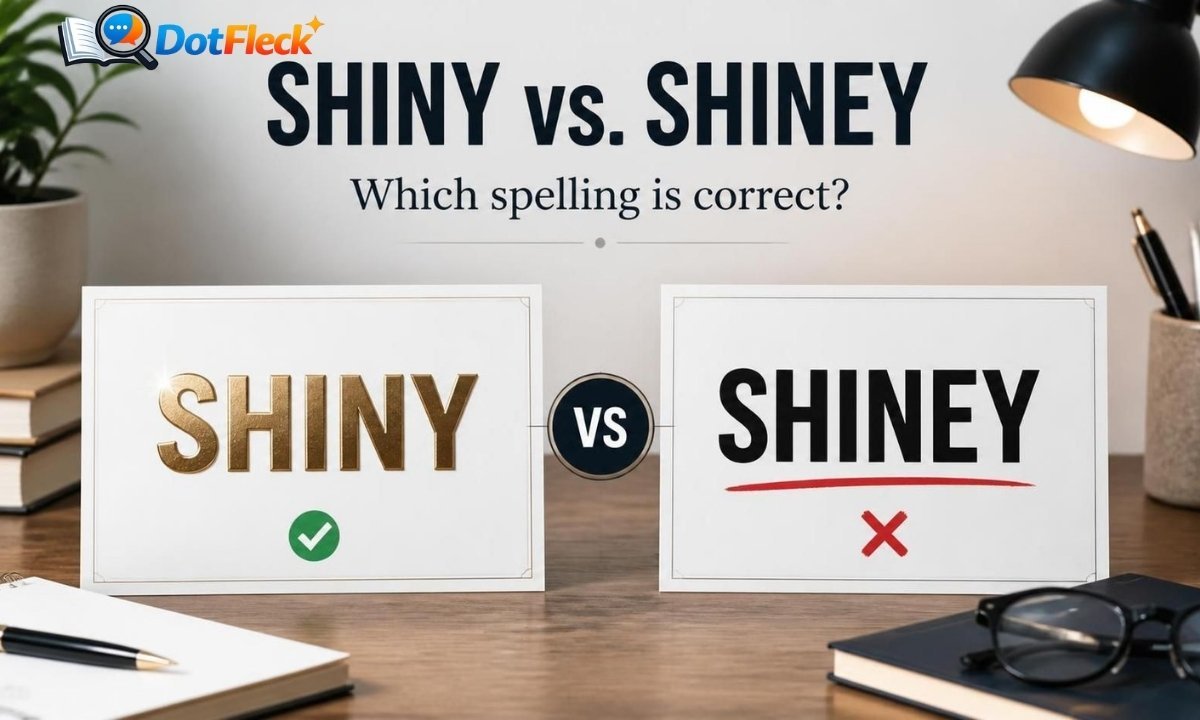
The main difference is simple. “Shiny” is correct, and “shiney” is not. There is no difference in meaning to learn, because only one of them is a standard word.
Here are the key points to keep in mind:
- “Shiny” is a standard adjective found in every major dictionary.
- “Shiney” is a common spelling mistake caused by keeping the silent “e” from “shine.”
- Both spellings sound the same when spoken, which is why the error is easy to make.
- Spell checkers will flag “shiney” in most writing programs.
Pronunciation and Etymology of Shiny
Both spellings are pronounced the same way: SHY-nee. The first syllable rhymes with “my,” and the second syllable sounds like “knee.” Because the sound does not change, you cannot tell which spelling someone means just by listening.
The word has a long history. “Shine” comes from an Old English verb meaning to give off light, and “shiny” was formed by adding the common adjective ending “-y.” That ending turns a verb or noun into a word that describes a quality, in the same way “rain” becomes “rainy” and “sun” becomes “sunny.”
Comparison Table
| Feature | Shiny | Shiney |
| Correct spelling | Yes | No |
| Part of speech | Adjective | None (misspelling) |
| Found in dictionaries | Yes | No |
| Pronunciation | SHY-nee | SHY-nee |
| Meaning | Bright, glossy, reflecting light | No standard meaning |
| Used in US English | Yes | No |
| Used in UK English | Yes | No |
| Comparative form | Shinier | Not applicable |
| Superlative form | Shiniest | Not applicable |
Grammar Guide
Understanding the rule behind the spelling makes it easier to remember. This section covers how the word is used, the mistakes learners make, and a few simple tricks.
How Each Term Is Used in Sentences
“Shiny” works like any other adjective. It can come before a noun or after a linking verb such as “is,” “looks,” or “feels.” Here are some examples of shiny in a sentence:
- The shiny bike stood outside the store.
- After the rain, the pavement looked shiny.
- She polished the table until it was shiny.
“Shiney” should not be used in these sentences. If you need to write a name that includes the letters “shiney,” keep the spelling exactly as the person or brand uses it.
Common Mistakes Learners Make
The most frequent mistake is adding an “e” before the “y.” Writers do this because they remember that “shine” ends in “e” and assume the letter should stay. This habit is understandable, but it does not match the spelling pattern.
Another mistake is mixing up “shiny” and “shining.” The two words are related but not identical. “Shining” describes something that is giving off or reflecting light right now, while “shiny” describes a surface that has a bright finish. Compare “the shining sun” with “the shiny coin.”
People also forget the forms for comparing. The shiny comparative and superlative forms are “shinier” and “shiniest.” The “y” changes to “i” before the endings, and no extra “e” appears anywhere.
Simple Rules to Remember
The key idea is a spelling pattern. Many English words that drop silent e before y follow the same rule. When a word ends in a silent “e,” you usually remove the “e” before adding “-y.”
- shine becomes shiny
- bone becomes bony
- stone becomes stony
- noise becomes noisy
- smoke becomes smoky
- shade becomes shady
- wave becomes wavy
A small group of words keeps the “e,” such as “pricey,” “dicey,” and “cagey.” These words keep it to preserve a soft “c” or “g” sound. “Shine” has no such sound to protect, so the “e” goes away.
Quick Tips for Writing and Speaking
When writing, say the word slowly and picture the rule: drop the “e,” add the “y.” You can also remember that “shiny” is shorter than “shiney,” and the shorter spelling is the right one.
When speaking, you do not need to worry, because the two spellings sound identical. The real test happens on the page. If a text, email, or product description matters, take a moment to check this word before you hit send.
| Also Read Below Grammar Posts |
| Pursue or Persue? Discover the Correct Spelling |
| Performed vs Preformed: Discover the Key Difference |
When to Use Each One
Use “shiny” whenever you want to describe a bright, glossy, or reflective surface. It fits everyday writing, school papers, business emails, and product descriptions. It also works for things that are new and eye-catching, such as a shiny new car or a shiny trophy.
Use “shiney” only when you are copying a real proper name that is spelled that way. That includes a person’s name, a username, or a brand that has chosen this spelling on purpose. In these cases you are preserving a name, not choosing a word.
When NOT to Use Each One
Do not use “shiny” for things that are dull, matte, or not reflective. A rough wooden board or a cloth with no gloss is not shiny. If you want to describe something that produces its own light, “shining,” “glowing,” or “bright” may fit better.
Do not use “shiney” as a regular adjective. It will look like an error to teachers, editors, and readers, and it can make otherwise careful writing look rushed. If you see it in a draft, change it to “shiny.”
Shiny vs Shiney in UK and US English
This is one of those spelling questions where the two main varieties of English agree. Whether you follow shiny or shiney in American English or British English, the answer is the same. “Shiny” is correct in both, and “shiney” is not accepted in either.
Many British and American spelling differences involve endings like “-or” and “-our” or “-ize” and “-ise.” This word is not one of them. You do not need to adjust your spelling based on your audience.
Which One to Use (Decision Guide)
A quick decision guide can help you choose in a few seconds. Ask yourself these questions:
- Are you describing something bright, glossy, or reflective? Use “shiny.”
- Are you comparing two things? Use “shinier” or “shiniest.”
- Are you copying a person’s name or a brand name that uses “shiney”? Keep the original spelling.
- Are you unsure? Choose “shiny.”
In nearly every situation, the answer is “shiny.” The only exception involves proper names, which follow their own rules.
Real-World Practical Examples
Reading examples in context helps the correct spelling stick. These samples show how the word appears in ordinary writing.
Shiny Examples
- The jeweler held up a shiny silver ring.
- Her shoes were so shiny that she could see her reflection.
- The truck is shinier than it was yesterday because he washed it.
- That is the shiniest apple in the basket.
- The shiny new laptop arrived in a plain box.
Shiney Examples
Because “shiney” is not a standard word, these examples show the mistake and the fix instead:
- Incorrect: The floor looked very shiney. Correct: The floor looked very shiny.
- Incorrect: She wore a shiney jacket. Correct: She wore a shiny jacket.
- Incorrect: This is the shineyest car on the lot. Correct: This is the shiniest car on the lot.
Other Uses of “Shiny” You Might Have Heard
“Shiny” has a few figurative uses beyond describing surfaces. In the phrase “shiny new,” it suggests something that is recently made and attractive, often with the hint that the appeal might fade. A “shiny new plan” may sound exciting, but a careful listener may wonder how well it will work.
The phrase “shiny object syndrome” describes a habit of chasing every new idea instead of finishing the current one. It is an informal expression, not a medical term. In clothing, a “shiny” suit can also mean a fabric worn smooth with age, which is a less flattering use.
In some video games, a “shiny” is a rare alternate-color version of a character or creature. Players use the word as a noun in that setting. These uses are all spelled the same way, with no extra “e.”
Synonyms of Shiny
Several words overlap with “shiny,” but each one has its own shade of meaning. Choosing the right one can make your writing more precise.
- Glossy: smooth and reflective, like a magazine page or fresh paint
- Gleaming: shining brightly, often after cleaning or polishing
- Polished: made smooth and bright by rubbing
- Glistening: shining with a wet or sparkling look
- Sparkling: flashing with small points of light
- Lustrous: having a soft, rich shine, often used for hair or metal
- Burnished: polished by rubbing, often used for metal
- Sleek: smooth and shiny in a stylish way
Self-Assessment (Fill in the Blanks)
Test yourself by choosing the correct word or form for each sentence. Cover the answers below before you start.
- The kitchen counters were clean and very ______ (shiny / shiney).
- This coin is ______ than that one (shinier / shineier).
- The spelling of the adjective that describes a glossy surface is ______.
- When you add “-y” to “bone,” you drop the silent “e” and write ______.
- The ______ new bicycle caught everyone’s attention (shiny / shiney).
- Of all the trophies, this one is the ______ (shiniest / shineyest).
- The word “shine” loses its final “e” when it becomes ______.
- A person’s name spelled “Shiney” should be ______ (kept as written / changed to shiny).
Answers
- shiny
- shinier
- shiny
- bony
- shiny
- shiniest
- shiny
- kept as written
If you got six or more correct, you understand the rule well. If you missed a few, review the section on silent “e” words and try the quiz again.
Final Verdict
The answer to shiny or shiney, which is correct, is clear. “Shiny” is the right spelling, and “shiney” is a mistake that comes from keeping the “e” in “shine.” The rule is easy to remember because many English words drop a silent “e” before adding “-y,” as in “bony,” “stony,” and “noisy.”
With this in mind, you can write with confidence. Use “shiny” for anything bright, glossy, or newly attractive, and use “shinier” and “shiniest” for comparisons. The distinction in Shiny vs. Shiney is small, but getting it right helps your writing look clean and careful.
Summary
- “Shiny” is the correct spelling in both US and UK English.
- “Shiney” is a common misspelling and not a standard word.
- The “e” in “shine” is dropped before adding “-y.”
- The comparative and superlative forms are “shinier” and “shiniest.”
- “Shiny” and “shining” are related but not identical.
- Keep “shiney” only when it is part of a real name or brand.
Frequently Asked Questions
Which is correct, shiney or shiny?
“Shiny” is correct. “Shiney” is a common misspelling that adds an unnecessary “e” from the base word “shine.”
What does “shiney” mean?
“Shiney” has no standard meaning in English. It is a misspelling of “shiny,” though it can appear as a personal name or brand.
How do you spell “shiny” in English?
Spell it S-H-I-N-Y. Drop the silent “e” from “shine” before adding the “-y” ending, just as you do with “bone” and “bony.”
Is shiny the same as glossy?
They are close but not identical. “Shiny” means reflecting light, while “glossy” suggests a smooth, polished finish, like paint or a magazine page.
What are the comparative and superlative forms of shiny?
The comparative is “shinier,” and the superlative is “shiniest.” The “y” changes to “i” before the ending.

Ethan Whitmore is an English language writer who enjoys making grammar, word meanings, and modern slang simple and easy to understand. His content focuses on clear explanations, practical examples, and everyday English usage.