
You are texting a friend about a movie, and you stop mid-sentence. Is it scary or scarey? The word sounds like it could take an extra letter, and the mistake is easy to miss when you are typing fast.
This guide on Scary vs. Scarey gives you the answer right away, then shows why one spelling is standard and the other is not. You will learn what the word means, where it comes from, how its other forms are built, and how it differs from words like creepy and spooky. A short practice quiz at the end helps the rule stick, so you can spell the word correctly every time.
Quick Answer: Is It “Scary” or “Scarey”?
“Scary” is the correct spelling. “Scarey” is a misspelling and does not appear as a standard entry in major American dictionaries. If you are writing an email, an essay, a school paper, or a social media post, use “scary.”
The mistake usually happens because the word comes from “scare,” which ends in an e. Writers sometimes keep that e by habit and add the y, which produces “scarey.” The standard rule is to drop the silent e before the y.
Here is the short version:
- Correct: scary, scarier, scariest, scarily
- Incorrect: scarey, scareyer, scareyest
What Does “Scary” Mean?
“Scary” is an adjective. Its main meaning is “causing fear or alarm.” A scary movie, a scary noise, or a scary thought all share the same idea: something that makes a person feel frightened or uneasy.
In everyday speech, people also use scary in a lighter way. A “scary good” cook is not frightening anyone, but the word signals that something is surprisingly intense or impressive. You will see more of this figurative use later in the article.
There is also an older, less common meaning of “easily frightened.” You might still see it in older writing, but modern American English almost always uses “scary” to describe the thing that causes fear, not the person who feels it. For the person who feels fear, most writers choose “scared” or “afraid.”
Is “Scarey” a Real Word? What Dictionaries Actually Say
No. Standard dictionaries list “scary” as the correct form and do not treat “scarey” as an accepted variant. If you search for scarey meaning and spelling in a reputable dictionary, you will typically be pointed back to “scary” or find no entry at all.
You may still see “scarey” online, in casual posts, or in a quick text message. Seeing a spelling in many places does not make it correct. It usually means that many people make the same slip, which is exactly why this question gets searched so often.
The same applies to word games. “Scary” is accepted in standard Scrabble word lists, while “scarey” is not. If you are playing, stick with the spelling that dictionaries recognize.
Word Origin: Where “Scary” Comes From
“Scary” is built from the verb “scare.” English borrowed “scare” in the Middle Ages from Old Norse, a language spoken by Vikings who settled in parts of Britain. The root carried the sense of frightening or startling someone.
Over time, English speakers added the suffix -y, which turns a word into an adjective meaning “full of” or “having the quality of.” Add -y to “scare,” and you get a word for something that has the quality of causing a scare. The same pattern gives us “shady” from “shade” and “bony” from “bone.”
This is also the answer to a question some readers ask: why is scary spelled with an a and not with another vowel? The a is simply part of the root word “scare.” The only letter that changes is the final e, which drops away when the suffix is added.
The Spelling Rule: Why “Scary” Has No “E”
English has a common rule for adding suffixes. When a word ends in a silent e and the suffix begins with a vowel or the letter y, you usually drop the e before adding the suffix. “Scare” ends in a silent e, and -y acts like a vowel suffix, so the e disappears.
You can see the same pattern in many everyday words:
- shade + y = shady
- ice + y = icy
- bone + y = bony
- noise + y = noisy
- stone + y = stony
Some words do keep the e, and that is part of the confusion. Examples include “dicey,” “cagey,” and “holey.” These are exceptions, and they are far fewer than the words that follow the rule. For “scary,” the pattern is clear: no e.
A simple memory trick helps. Say to yourself: “When I add the y, the e has to go.” If you picture the e leaving the word, you will spell it right.
Word Forms: Scarier, Scariest, Scarily, Scariness
Once you know that “scary” is the base form, the related forms follow standard rules. To make the comparative and superlative, change the final y to i and add -er or -est. This is the same change you see in “happy, happier, happiest.”
Here are the main forms:
- Scary (adjective): The hallway was scary at night.
- Scarier (comparative): The sequel was scarier than the first film.
- Scariest (superlative): That was the scariest ride in the park.
- Scarily (adverb): The lights flickered scarily.
- Scariness (noun): The scariness of the story surprised her.
Notice that none of these forms contains an e between the r and the y or i. If you ever see “scareier” or “scareiest,” you are looking at the same misspelling in a different form.
How to Use “Scary” in a Sentence
“Scary” works like most adjectives. It can come before a noun (“a scary story”) or after a linking verb such as “is,” “seems,” or “feels” (“the story is scary”). It can also be softened or strengthened with words like “very,” “a little,” or “pretty.”
When you use it, think about what is causing the fear. “Scary” describes the source of the feeling. “Scared” describes the person who has the feeling. Mixing them up is a common mistake, so keep that difference in mind.
Example Sentences
Here are clear examples of scary in a sentence:
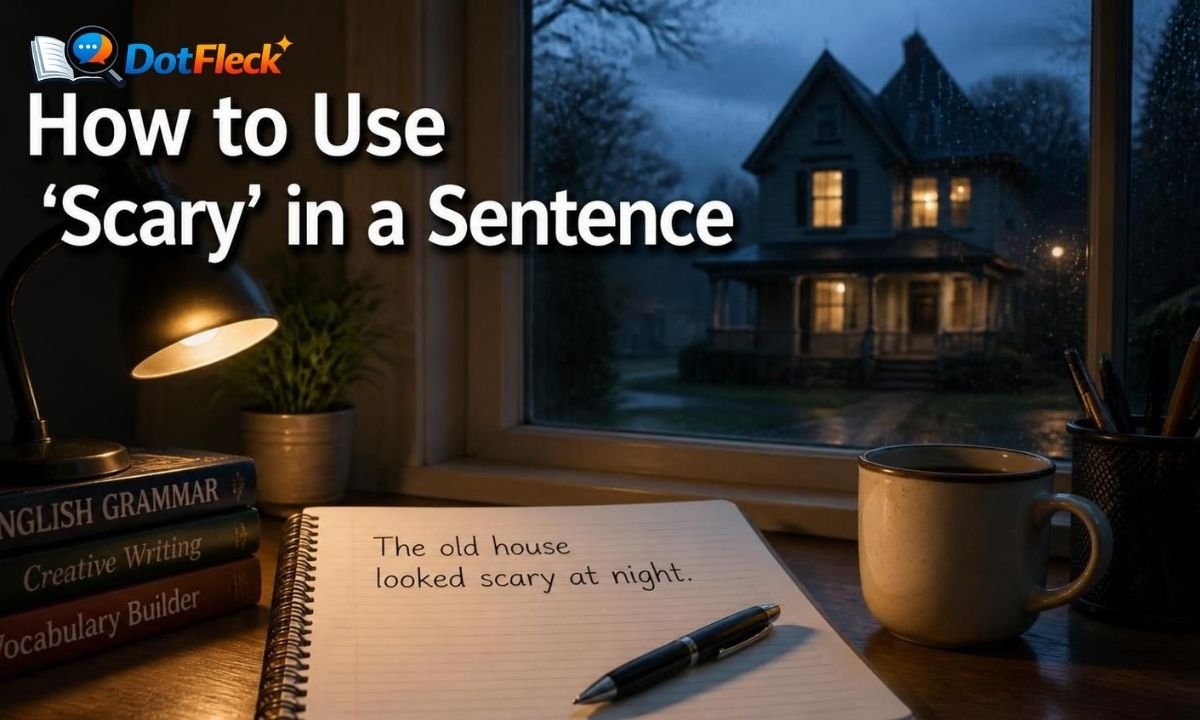
- The old house at the end of the street looked scary after dark.
- She told a scary story around the campfire.
- Driving in heavy fog can be scary for new drivers.
- The test results were scary, but the doctor explained the next steps.
- That was the scariest roller coaster I have ever seen.
Now compare these with the incorrect spelling. A sentence like “The movie was scarey” would be flagged as an error in most spell checkers. This is a good reminder of what scarey in a sentence looks like: it is a typo, not a variant.
Using “Scary” Beyond Fear (Figurative Meaning)
English speakers often stretch “scary” past its plain meaning. Sometimes it means “worrying” or “alarming” without any sense of horror. For example, “It’s scary how fast prices are rising” expresses concern, not fright.
It can also be used for something surprisingly strong or skilled. A “scary smart” student or a “scary accurate” forecast is impressive enough to be a little unsettling. This use is common in conversation and informal writing.
Keep figurative use in mind when you edit. If a sentence is meant to be serious, a word like “alarming” or “concerning” may fit better than “scary.” If it is meant to sound casual and natural, “scary” is usually fine.
Is “Scary” Formal or Informal?
“Scary” is standard English and is not slang. You can use it in school papers, news articles, and professional writing without worry. It is a plain, common word that most readers understand at once.
That said, it is a fairly casual word in tone. In very formal writing, such as a legal document or an academic paper, you may prefer terms like “frightening,” “alarming,” or “disturbing.” These choices sound more measured.
For everyday writing, such as emails, blog posts, and social media, “scary” is a natural choice. This is how to use scary in everyday writing: pick it when you want a clear, direct word that sounds like a real person talking.
Scary vs. Scarry (Another Common Misspelling)
“Scarey” is not the only wrong version of this word. Some writers type “scarry” with a double r, probably because words like “carry” and “marry” have that pattern. This is also incorrect when you mean “causing fear.”
“Scarry” does exist, but only as a proper name. It is a surname, and you may recognize it from the well-known children’s author Richard Scarry. In that case, the spelling is correct because it is part of a name.
Here is how to tell them apart:
- “The cave was scary.” (adjective meaning frightening)
- “Richard Scarry wrote many picture books.” (a person’s name)
Scary vs. Similar Words: Creepy, Spooky, and Frightened
English has many words for fear, and they are not all interchangeable. Choosing the right one makes your writing more precise. The comparisons below cover three that people often mix up with “scary.”
Scary vs. Creepy
“Scary” is broad and covers anything that causes fear, from a car accident to a horror film. “Creepy” is narrower. It describes something that gives you an uneasy, skin-crawling feeling, often because it seems strange or slightly wrong.
A dark alley can be scary. A stranger who stares at you without blinking is creepy. A creepy thing may not be dangerous, but it feels off.
Scary vs. Spooky
“Spooky” usually points to ghosts, haunted places, and eerie atmospheres. It often has a playful or seasonal feel, especially around Halloween. When people discuss scary vs spooky difference, the main point is intensity: spooky is mild and atmospheric, while scary can be fully serious.
A spooky decoration might make children giggle. A scary event, such as a storm that knocks out the power, can cause real worry.
Scary vs. Frightened
This pair is about grammar as much as meaning. “Scary” describes what causes fear, and “frightened” describes how a person feels. They also differ from scary vs frightening, because “frightening” is the closer match to “scary” and is often a bit more formal.
- The noise was scary. (the noise causes fear)
- The child was frightened. (the child feels fear)
- The noise was frightening. (the noise causes fear, in a more formal tone)
Synonyms and Antonyms for “Scary”
If you want variety in your writing, there are many scary synonyms and meaning options to choose from. Each has a slightly different shade of meaning, so match the word to the situation.
Synonyms for “scary”:
- frightening
- alarming
- terrifying
- eerie
- chilling
- creepy
- spooky
- hair-raising
- menacing
Antonyms for “scary”:
- comforting
- calming
- reassuring
- soothing
- harmless
- pleasant
A good tip is to avoid using “scary” over and over in the same piece. Swapping in “chilling” or “alarming” now and then keeps your writing fresh while the meaning stays clear.
Common Mistakes to Avoid
Most errors with this word are small, but they are easy to repeat. Watch for these common spelling mistakes with scary:
- Adding an extra e: writing “scarey” instead of “scary.”
- Doubling the r: writing “scarry” when you mean the adjective.
- Keeping the e in other forms: writing “scareier” or “scareiest.”
- Mixing up “scary” and “scared”: saying “I am scary” when you mean “I am scared.”
- Overusing the word: repeating “scary” when a more exact word would work better.
A quick proofreading habit helps. After you finish a draft, search for “scarey” and “scarry” and replace them with “scary.” It takes a few seconds and catches the slip before anyone else sees it.
Practice: Test Your Understanding of “Scary” vs. “Scarey”
Try these questions on your own, then check the answers in the next section. They cover spelling, word forms, and meaning.
Multiple Choice Questions
- Which spelling is correct? a) scarey b) scary c) scarry
- Choose the correct comparative form: “This hallway is ______ than the last one.” a) scareier b) scarrier c) scarier
- Which word describes the person who feels fear? a) scary b) scared c) scariness
- Which sentence is spelled correctly? a) The storm was scarey. b) The storm was scarry. c) The storm was scary.
- Which word is the best match for something that feels strange and uneasy rather than dangerous? a) creepy b) comforting c) frightened
Fill in the Blanks
Fill each blank with the correct word: scary, scarier, scariest, scarily, scared.
- That was the ______ movie I have ever watched.
- The wind howled ______ through the trees.
- I was too ______ to open the door.
- The second book is even ______ than the first.
- It was a ______ walk home in the dark.
Answers
Multiple Choice Answers
- b) scary. “Scarey” and “scarry” are both misspellings of the adjective.
- c) scarier. Change the y to i and add -er.
- b) scared. “Scared” describes the person who feels fear.
- c) The storm was scary.
- a) creepy. It describes an uneasy feeling, not necessarily danger.
Fill in the Blanks Answers
- scariest
- scarily
- scared
- scarier
- scary
Frequently Asked Questions
Is it scarey or scary?
The correct spelling is “scary.” “Scarey” is a common misspelling because the root word “scare” ends in an e.
What does “scarey” mean?
“Scarey” has no meaning of its own. It is a typo for “scary,” which means causing fear or alarm.
How do you spell “scarry”?
You do not spell it that way. “Scarry” is only a surname, such as Richard Scarry. The adjective is “scary.”
Is “scarey” a valid Scrabble word?
No. Standard Scrabble dictionaries accept “scary” but not “scarey,” so using the extra e would be rejected in play.
Why is “scary” spelled without an e?
English drops a silent e before the suffix -y. Adding -y to “scare” gives “scary,” just like “shade” becomes “shady.”
Can I use “scary” in formal writing?
Yes, it is standard English. In very formal documents, “frightening” or “alarming” may sound more measured.
Final Thoughts
When it comes to Scary vs. Scarey, the answer is simple: “scary” is correct, and “scarey” is a misspelling. The word comes from “scare,” and the silent e drops when the suffix -y is added, just as it does in “shady” and “icy.” The same rule gives you the right forms: scarier, scariest, scarily, and scariness.
Remember that “scary” describes what causes fear, while “scared” describes the person who feels it. Choose “creepy,” “spooky,” or “frightening” when they fit the situation better. With the rule in mind and a quick proofread, you can spell this word correctly in every email, essay, and message you write.

Ethan Whitmore is an English language writer who enjoys making grammar, word meanings, and modern slang simple and easy to understand. His content focuses on clear explanations, practical examples, and everyday English usage.