

Have you ever typed “atleast” in a message and then stopped to wonder if it looked wrong? You are not alone. Spell check does not always flag it, and the two forms look so similar that many people cannot tell which one belongs in an email, a school paper, or a work report. The question of at least or atleast comes up every day, and the answer is simpler than most spelling debates.
This article gives you a clear answer and the reasoning behind it. You will learn what the phrase means, where it comes from, how it works in a sentence, and which common spelling mistakes to avoid. By the end, you will know exactly how to spell it and how to use it with confidence in both casual and formal writing.
Atleast or At Least – Quick Answer
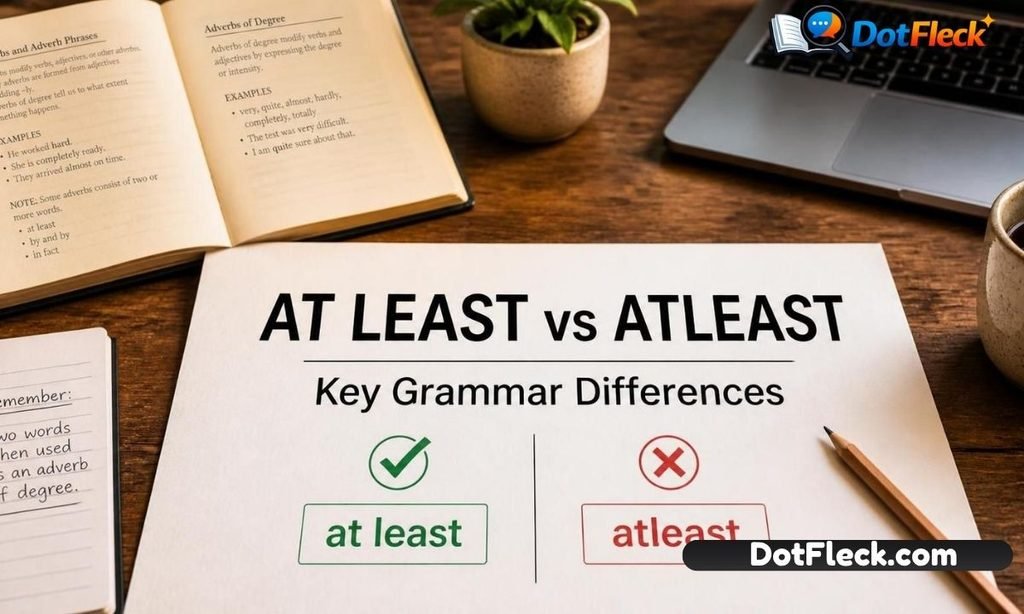
The correct form is at least, written as two separate words. “Atleast” is not a standard English word, and you will not find it in major American dictionaries such as Merriam-Webster or the American Heritage Dictionary. If you see it in print, it is a spelling error.
Here is the short version:
- Correct: at least (two words)
- Incorrect: atleast (one word)
Example: “You should drink at least eight glasses of water a day.” Writing “atleast eight glasses” in that sentence would be marked wrong by any editor or teacher.
The Origin of “At Least”

The phrase “at least” is built from the preposition “at” and the word “least,” which is the superlative form of “little.” Together they point to the smallest amount, degree, or point you can accept. English has used phrases like this for a very long time, and earlier versions often included the word “the,” as in “at the least.”
Over the years, the shorter form took over in everyday speech and writing. Even so, it never became a single word. Because it began as a preposition followed by a superlative, it has always been written as two words, the same way “at most” and “at best” are.
British English vs American English Spelling
Many spelling differences exist between the two main varieties of English. Think of “color” and “colour,” or “center” and “centre.” The phrase at hand is not one of them. Both American and British writers use at least as two words.
This matters because some people assume “atleast” is a regional variant. It is not. No major English-speaking country treats it as an accepted spelling, so you can use the two-word form safely no matter who your readers are.
Which Spelling Should You Use?
Use “at least” every time. There is no situation in standard English where “atleast” is the better choice, whether you are writing an essay, a business email, a blog post, or a text to a friend. Choosing the correct spelling also helps your writing look careful and professional.
If you are unsure while writing quickly, a simple habit helps. Read the phrase aloud as “at” plus “least.” If you can hear two separate words, write two separate words.
Common Mistakes with Atleast or At Least
The most frequent error is joining the two words together. This usually happens when people type fast or rely on autocorrect, and it is more common in texting and social media than in published writing. Other grammar mistakes are less obvious but still worth watching.
Here are mistakes to avoid:
- Writing “atleast” as one word
- Writing “at lest” or “at leat” by dropping a letter
- Confusing “at least” with “at last”
- Using “at least” where “at most” is needed
Example of a mix-up: “At last two people came” is wrong if you mean a minimum of two. The correct sentence is “At least two people came.”
At Least in Everyday Examples
Seeing the phrase in real sentences makes the rule easier to remember. Below are several at least example sentences that show different uses.
- “I need at least ten minutes to finish this.”
- “She is at least as tall as her brother.”
- “At least the weather stayed dry for the picnic.”
- “If you cannot join us, at least send a message.”
- “He has read at least five books this month.”
In the first and last examples, the phrase sets a minimum. In the third and fourth, it offers a small positive point or a smaller request.
At Least – Google Trends & Usage Data
Search tools such as Google Trends can show how often people look up spelling questions like this one. When you compare the two terms yourself, you will likely see that the correct form appears far more often in published writing, while the one-word version shows up mostly in informal typing and as a search for spelling help. Exact numbers change over time, so it is best to check the tool directly for current results.
That pattern supports the same conclusion as the dictionaries. The two-word phrase is the accepted standard in news articles, books, and academic writing, and the joined spelling is a typing habit rather than a real variant.
Memory Trick to Remember the Correct Spelling
A simple trick is to link “at least” with its opposite, “at most.” Nobody writes “atmost” as one word, so there is no reason to join “at least” either. Both phrases follow the same pattern: a small word, then a word that describes an amount.
Another way is to picture a space between the two words as a gap that cannot be filled. Say it to yourself like this: “At least has two parts, and so should my spelling.” Repeating it a few times can make the right form stick.
At Least vs Similar Phrases
Several phrases sound close to “at least” but carry different meanings. Knowing the difference keeps your sentences clear and accurate.
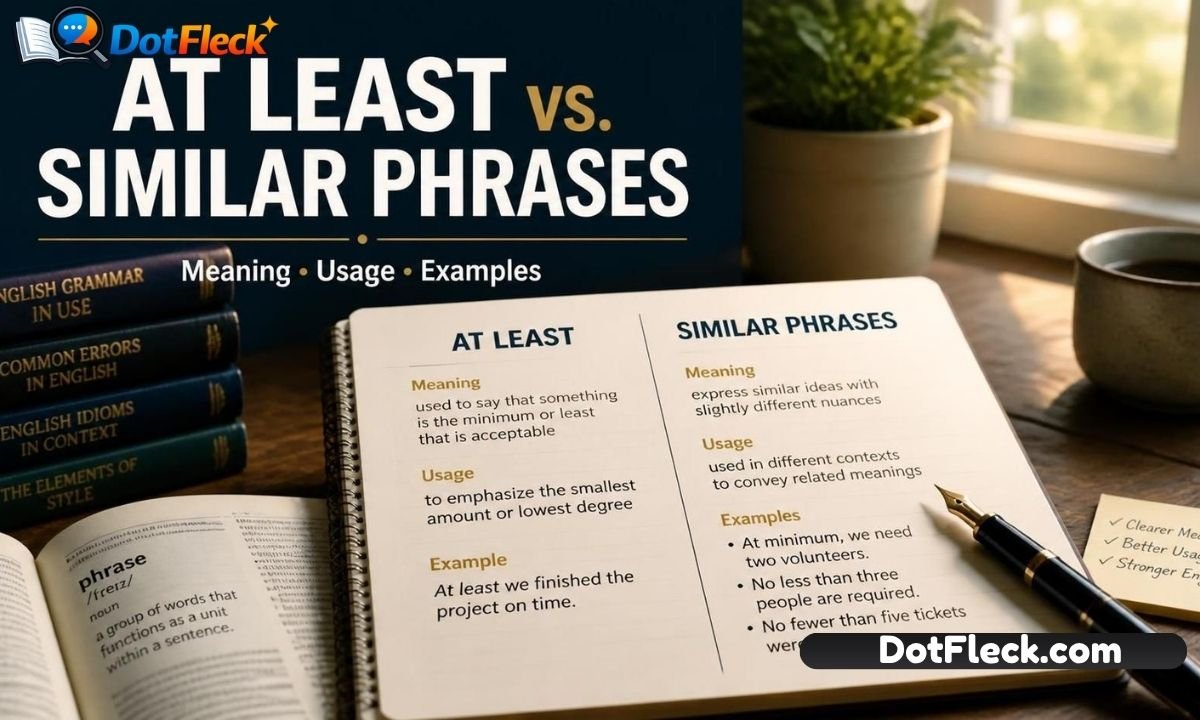
- At least: the minimum or a small positive point
- At most: the maximum
- At best: the most favorable outcome possible
- At last: finally, after a long wait
- At the very least: a stronger version of “at least”
Example: “At last, the package arrived. It took at least a week.”
Understanding Atleast or At Least in Simple Terms
In plain language, “at least” tells the reader that a number or amount is the lowest it could be, and it could be more. If you say “I need at least three hours,” you mean three hours or more. The phrase never means less than the number that follows it.
The second common use is to point out something good in a bad situation. “At least we arrived safely” means that, despite problems, one positive thing remains. Both uses share the same spelling.
Is Atleast Correct or Just a Common Mistake?
“Atleast” is a common mistake, not a correct variant. Dictionaries list “at least” as a phrase under the entry for “least,” and style guides follow that approach. Words like “atleast” have not been accepted into standard English because there is no linguistic reason to merge the two parts.
Some people argue that language changes and that the joined form might become standard someday. That is possible in theory, but for now it would be treated as an error in school, business, and publishing. Writers who want to be understood and respected should stay with the two-word form.
At Least Meaning and Its Role in Sentences
The at least meaning depends on context, but it always involves a lower limit or a small consolation. As a minimum, it comes before a number or quantity. As a comment, it often begins a sentence and is followed by a comma or a short clause.
Grammatically, “at least” works as an adverb phrase. It modifies numbers, adjectives, or whole statements. For example, in “She has at least two cats,” it modifies the number. In “At least he apologized,” it comments on the entire clause.
At Least vs Atleast: Key Grammar Differences
The main difference between at least vs atleast is that one is a real phrase and the other is not. “At least” has a clear structure: preposition plus superlative. “Atleast” has no grammatical structure because it is not a word recognized in standard grammar references.
For writers, this has practical effects:
- Spell checkers may highlight “atleast” with a red line.
- Editors will correct it.
- Teachers and employers may see it as a careless error.
Using “at least” avoids all of these problems.
Common Spelling Mistakes in English Like Atleast
Joining words that should stay apart is a widespread habit in English. Other examples include “alot” for “a lot,” “aswell” for “as well,” “infact” for “in fact,” and “eachother” for “each other.” Each of these is treated as an error in standard writing.
These spelling errors often come from fast typing and from seeing the joined forms online. The fix is the same each time. Check whether the phrase is a compound word in the dictionary, and if it is not, keep the words separate.
At Least Usage in English for Daily Communication
In daily conversation, “at least” is flexible and friendly. People use it to set expectations (“I’ll be there at least by noon”), to soften a request (“Can you at least try?”), or to find comfort (“At least it’s Friday”). It sounds natural in speech, and its pronunciation is simple: “at LEEST,” with the main stress on “least.”
In text messages, many writers shorten or merge words, and “atleast” slips in. Even in casual settings, using the correct form helps your message look clean and easy to read.
English Writing Tips to Avoid Grammar Errors
Good proofreading is the best defense against small errors. Read your draft slowly, and then read it again from the last sentence to the first. This breaks your usual reading pattern and makes spelling slips easier to spot.
A few other habits help:
- Keep a trusted dictionary open while you write.
- Do not rely only on spell check, since it can miss misused phrases.
- Make a short list of words you often get wrong.
- Read your work aloud to catch awkward wording.
Formal vs Informal English: Why “At Least” Matters
In formal writing, such as reports, essays, and cover letters, every spelling choice shapes how readers judge you. A joined “atleast” can distract from your message and weaken your credibility. The correct two-word phrase keeps the focus on your ideas.
In informal writing, readers are more forgiving, but accuracy still helps. Someone who writes “at least” correctly in a text is less likely to be misread and more likely to carry good habits into formal settings. Making the right choice in both cases is easy once you know the rule.
FAQs
What is correct, atleast or at least?
“At least” is correct. It is always written as two words in standard American and British English.
What does “atleast” mean?
“Atleast” has no official meaning because it is not a real word. It is a misspelling of the phrase “at least.”
Is “atleast” a real word?
No. Dictionaries do not list it. Treat it as a spelling error and use the two-word phrase instead.
Which is correct, “atleast” or “at least” in the UK?
“At least” is also correct in the UK. British English uses the same two-word spelling as American English.
Final Thoughts
The answer to at least or atleast is clear: write “at least” as two words every time. It comes from a preposition and a superlative, it has the same spelling in American and British English, and it appears in every major dictionary. “Atleast” is only a typing habit that has spread through texts and social media.
Remember the basics. “At least” means a minimum amount or a small positive point, it works as an adverb phrase, and it should not be mixed up with “at last” or “at most.” If you keep the memory trick in mind and proofread before you publish, you can avoid this mistake in any kind of writing.

Ethan Whitmore is an English language writer who enjoys making grammar, word meanings, and modern slang simple and easy to understand. His content focuses on clear explanations, practical examples, and everyday English usage.