
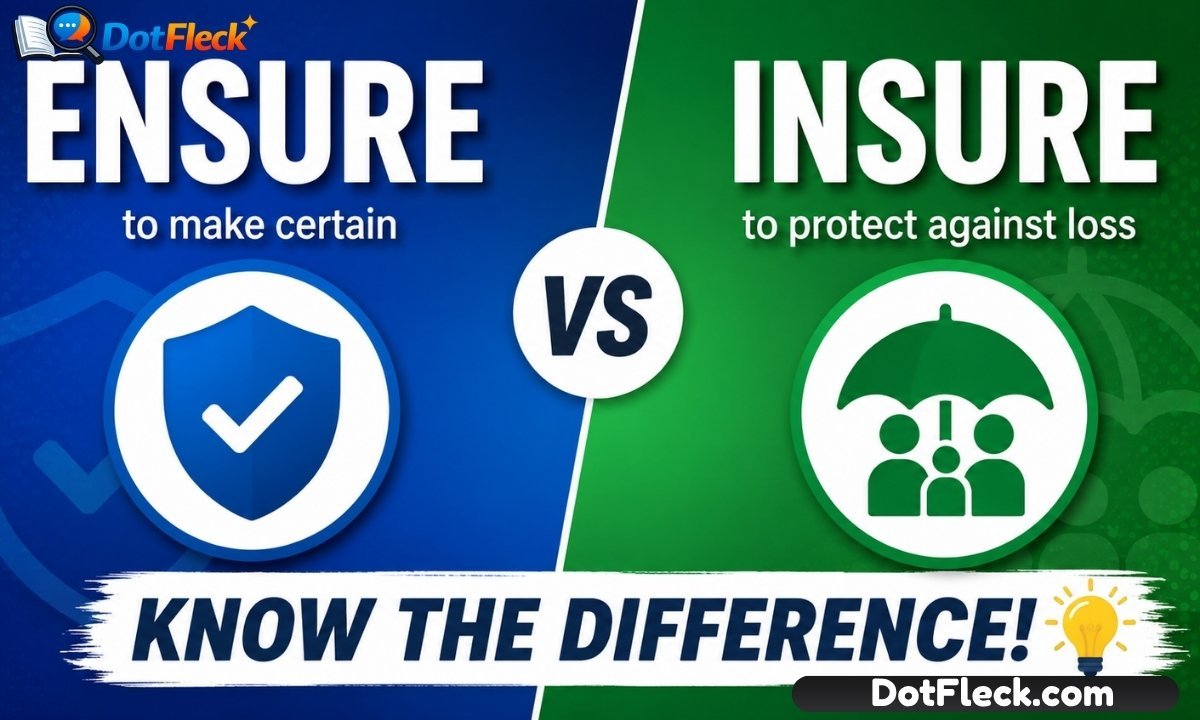
Ensure vs Insure
You want to guarantee something will happen, so you type “insure” and then you pause. Is that right? The confusion is understandable because both words come from the same Latin root and both mean something close to “make certain.”
Here’s the quick answer: use “ensure” when you mean to guarantee an outcome, and use “insure” when you’re talking about an insurance policy. Once you see the pattern, you’ll never second-guess it again.
What Does “Ensure” Mean?
Ensure is a verb that means to make certain something happens or to guarantee a result. When you ensure something, you’re taking action or describing an action that removes doubt about an outcome.
- The manager reviewed the checklist to ensure every step was complete.
- Wearing a seatbelt helps ensure your safety on the road.
- Please ensure that the report is submitted by Friday.
Notice that none of these examples have anything to do with money, policies, or financial protection. “Ensure” is about outcomes, guarantees, and certainty in a general sense.
What Does “Insure” Mean?

Insure is a verb tied specifically to the world of insurance. To insure something means to protect it financially by paying for a policy that covers loss, damage, or risk.
- We insure our car through a local agency.
- You should insure your home against fire and flood damage.
- The jeweler advised her to insure the necklace before shipping it.
If money, a policy, or a claim is involved, “insure” is almost always the word you want.
Why People Mix Up Ensure vs Insure
This mix-up happens for three reasons. First, the words are near-homophones; they sound almost identical when spoken aloud, especially in fast conversation. Second, they share the same Latin ancestor, securus, meaning “safe” or “secure,” so their meanings overlap at the edges.
Third, for centuries “ensure” and “insure” were simply two spellings of the same word, and English didn’t consistently separate their meanings until the 19th century, when “insure” gradually became the standard term for financial coverage. That shared history is exactly why the line between them can still feel blurry today.
There’s also a third word often thrown into the mix: assure. To assure someone is to comfort them or remove their doubt through words, not to guarantee an outcome or provide financial coverage.
- Assure: I assure you the flight will land on time. (giving confidence to a person)
- Ensure: Checking the weather will ensure you’re not caught off guard. (guaranteeing an outcome)
- Insure: You should insure your luggage before a long trip. (buying financial protection)
A simple way to keep all three straight: assure a person, ensure an outcome, insure a possession.
Don’t Miss : Allusion vs Illusion
Ensure vs Insure: Quick Comparison Table
| Term | Correct Use | Meaning | Typical Context | Example |
| Ensure | To make certain something happens | Guarantee, confirm, secure a result | General actions, plans, outcomes | “Double-check the locks to ensure the building is secure.” |
| Insure | To protect financially against loss | Provide or obtain an insurance policy | Insurance, finance, risk coverage | “You need to insure the shipment before it leaves the warehouse.” |
| Assure | To reassure a person | Remove doubt, give confidence | Speaking directly to someone | “I assure you the results will be accurate.” |
The Core Rule for Telling Them Apart “Ensure vs Insure”
Here’s a rule you can apply in seconds: if you can replace the word with “guarantee,” use “ensure.” If you can replace it with “get insurance for,” use “insure.”
- “We need to ensure the data is backed up” → “We need to guarantee the data is backed up.” ✔ ️ Make sense use ensure.
- “We need to insure the equipment” → “We need to get insurance for the equipment.” ✔ ️ Make sure to use insure.
If neither substitution fits naturally, try “reassure” for assure instead.
Correct and Incorrect Examples “Ensure vs Insure”
Correct: “The company updated its policy to ensure all employees receive proper training.”
Incorrect: “The company updated its policy to insure all employees receive proper training.” Why it’s wrong: No financial coverage is involved here; the sentence is about guaranteeing a training outcome, so “ensure” is required.
Correct: “Before the road trip, they decided to insure the rental car against damage.”
Incorrect: “Before the road trip, they decided to ensure the rental car against damage.” Why it’s wrong: “Against damage” signals a financial protection context, which calls for “insure,” not “ensure.”
Correct (text message): “can u ensure the tickets get to me before Friday?”
Correct (workplace email): “Please ensure the client receives the signed contract by end of day.”
Correct (academic writing): “Researchers took steps to ensure the sample size was statistically valid.”
Correct (insurance context): “Homeowners are required to insure their property before closing on a mortgage.”
A Note on American vs. British English “Ensure vs Insure”
In American English, the distinction between “ensure” and “insure” is generally observed the way this article describes: “ensure” for guarantees, “insure” for financial coverage. Some American style guides also allow “insure” as a secondary spelling for “make certain,” especially in older or more formal writing, but “ensure” remains the safer and clearer choice outside financial contexts. In British English, the same core distinction applies, though British writers occasionally use “insure” more loosely. If you’re writing for a US audience, stick with the ensure-for-outcomes, insure-for-policies rule and you’ll always be understood correctly.
Common Mistakes to Avoid “Ensure vs Insure”
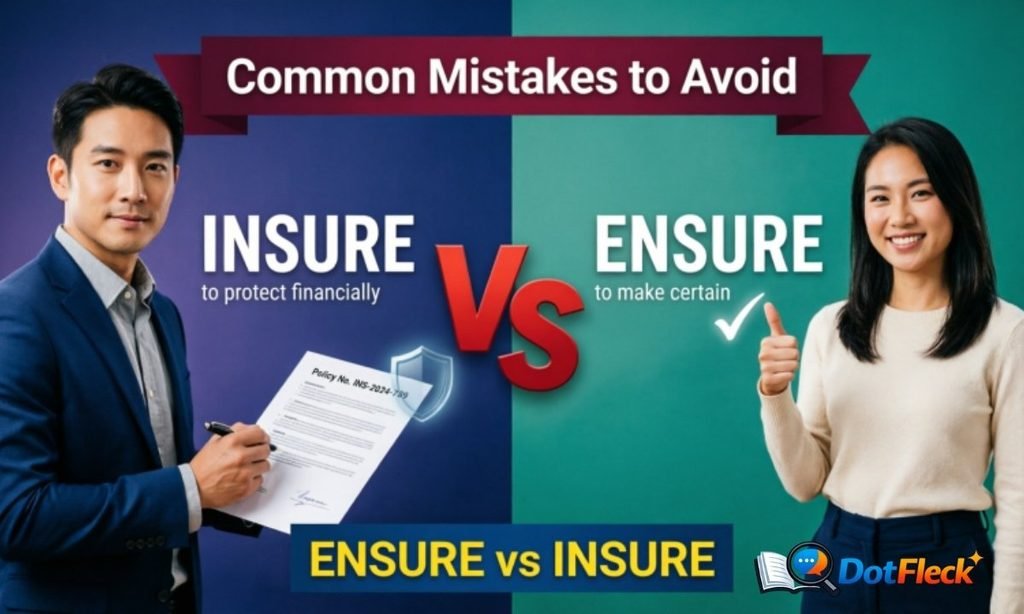
The most frequent error is using “insure” in a sentence that has nothing to do with insurance, simply because the two words look and sound alike. Writers also sometimes reach for “insure” when they actually mean “assure,” especially in spoken English where all three words blend together.
A simple memory trick: “Insure” has “sure” and relates to insurance both start with “in-sur-ance.” If your sentence could appear on an insurance form, use “insure.” If it’s about making a promise or guarantee with no policy involved, use “ensure.”
Another small but common slip is writing “in sure” as two words; this isn’t a word at all and should always be “insure” or “ensure,” never split apart.
Practical Guidance for Writers “Ensure vs Insure”
When you’re proofreading your own writing, pause on every instance of “ensure” or “insure” and ask: Is money or a policy involved? If yes, “insure” is correct. If the sentence is about guaranteeing an action, plan, or result with no financial component, “ensure” is correct. This one question resolves the vast majority of real-world cases, from workplace emails to school essays to formal reports.
For business and legal writing, it’s worth being extra careful, since these documents often mix both concepts in the same paragraph for example, guaranteeing compliance (ensure) while also discussing liability coverage (insure).
Related Terms Worth Knowing “Ensure vs Insure”
- Ensured / Ensuring: past tense and present participle forms “She ensured the doors were locked,” “He is ensuring compliance.”
- Insured / Insuring: past tense and present participle forms “The car is insured,” “They are insuring the shipment.”
- Insurance: the noun form connected to “insure,” referring to the policy or coverage itself.
- Assurance: the noun form connected to “assure,” referring to a promise or, in British English, sometimes a type of life insurance.
FAQs “Ensure vs Insure”
Is “ensure” or “insure” correct when talking about safety?
“Ensure” is correct for general safety guarantees, as in “Wear a helmet to ensure your safety.” Use “insure” only if you’re discussing a safety-related insurance policy, such as liability coverage.
Can “insure” ever mean the same thing as “ensure”?
In some older or more formal American usage, “insure” has occasionally been used to mean “make certain,” overlapping with “ensure.” However, modern American English keeps them separate, and using “ensure” for guarantees and “insure” for financial coverage is the clearest, most widely accepted choice.
What is the difference between “ensure” and “assure”?
“Ensure” guarantees an outcome or fact, while “assure” comforts or reassures a person. For example, “I assure you the package is insured, which will ensure you’re compensated if it’s lost.”
Is “in sure” a real word?
No. “In sure” is not a standard English word or phrase. The correct spellings are always “ensure” or “insure,” written as one word.
Final Takeaway “Ensure vs Insure”
The fastest way to choose correctly is to remember that “ensure” guarantees a result, while “insure” protects something financially.
Whenever a sentence involves a policy, coverage, or a claim, reach for “insure.” Everywhere else plans, promises, safety, outcomes “ensure” is the word that fits. Keep that one distinction in mind, and you’ll use both words with confidence every time.

Ethan Whitmore is an English language writer who enjoys making grammar, word meanings, and modern slang simple and easy to understand. His content focuses on clear explanations, practical examples, and everyday English usage.