
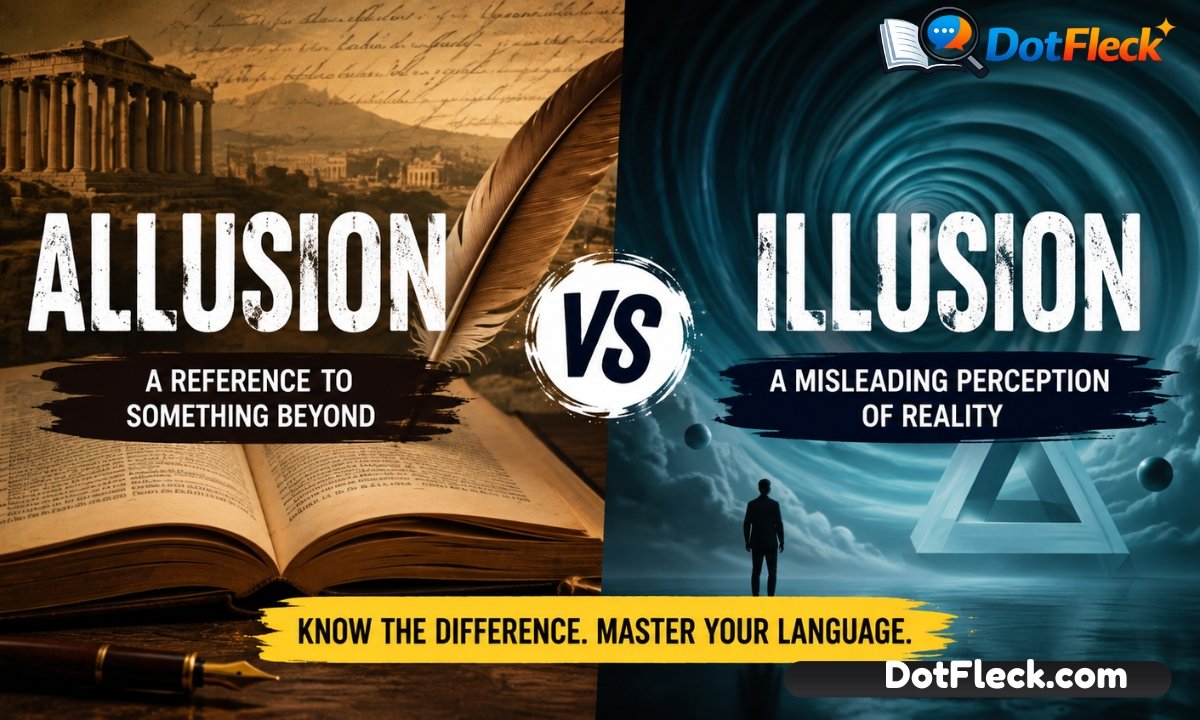
If you’ve ever paused mid-sentence wondering whether you need “allusion” or “illusion,” you’re dealing with two words that look almost identical but mean completely different things. An allusion is an indirect reference to something else, while an illusion is a false impression or a trick played on the senses. They sound alike and share a Latin root, which is exactly why writers swap them so often. Once you see the difference side by side, though, the confusion tends to disappear for good.
The Quick Answer “Allusion vs Illusion”
Allusion = a hint or indirect reference (usually to literature, history, or pop culture). Illusion = something that looks real but isn’t (a visual trick, a false belief, or a deceptive appearance).
If you’re pointing to something without naming it directly, you want “allusion.” If you’re describing something fooling your eyes or your mind, you want “illusion.” Neither word is a misspelling of the other they’re two separate words with two separate jobs.
What Does “Allusion” Mean?
An allusion is a brief, indirect mention of a person, place, event, or work of art that the reader is expected to recognize on their own. Writers use allusions to add depth without spelling everything out, trusting the audience to fill in the connection.
- “He’s got a Midas touch” is an allusion to the Greek myth about King Midas, without ever mentioning the myth by name.
- A political speech that references “a house divided” makes an allusion to Abraham Lincoln’s famous line.
The verb form is allude, as in “the article alludes to a scandal without naming names.” You’ll see “allusion” most often in essays about literature, speeches, journalism, and everyday conversation when someone references a shared cultural touchstone.
Don’t Miss : Maybe vs. May Be
What Does “Illusion” Mean?
An illusion is something that appears to be true or real but actually isn’t. It covers everything from optical tricks to false beliefs.
- A mirage on a hot highway is a classic illusion your eyes perceive water that isn’t there.
- Believing a failing project will magically turn around is an illusion, not a realistic plan.
Illusions can be visual, auditory, or purely mental. Magicians build entire careers on illusions, and psychologists study how the brain gets tricked into seeing patterns or movement that doesn’t exist. The rare verb form, illude, means “to deceive,” but it’s uncommon in everyday writing — you’ll mostly encounter “illusion” as a noun.
Why People Mix These Words Up “Allusion vs Illusion”
“Allusion” and “illusion” trace back to related Latin roots tied to the idea of “playing” alludere means “to hint at,” and illudere means “to mock or trick.” Because the words share that root and differ by only one letter at the start, the eye tends to glide right past the difference, especially when typing quickly or reading a word out loud.
Add in the fact that both words are abstract nouns describing something that isn’t stated outright, and it’s easy to see why spell-check often lets the wrong one slip through — both are real, correctly spelled words, so it never flags the mistake.
Allusion vs Illusion: Quick Comparison
| Term | Part of Speech | Meaning | Typical Use | Example |
| Allusion | Noun | An indirect or implied reference | Literature, speeches, everyday hints | “The title is an allusion to a Shakespeare play.” |
| Illusion | Noun | A false or misleading perception | Magic tricks, optical effects, false beliefs | “The stripes create an illusion of movement.” |
How to Remember the Difference “Allusion vs Illusion
A simple memory trick: illusion starts with the same letter pattern as “eye,” and illusions almost always involve the eyes or the senses being fooled. Allusion, on the other hand, pairs naturally with words like “literary” and “reference” both start with sounds that lean toward language rather than sight.
Another shortcut: if you can replace the word with “reference” or “hint” and the sentence still makes sense, you need allusion. If you can replace it with “trick” or “false impression,” you need an illusion.
Allusion vs Illusion in Real Sentences
Everyday conversation Allusion vs Illusion
- Correct: “That joke was an allusion to the show we watched last week.”
- Incorrect: “That joke was an illusion to the show we watched last week.”
- Why it’s wrong: The joke is referencing the show, not tricking anyone’s senses.
Academic writing Allusion vs Illusion
- Correct: “The poem contains an allusion to Greek mythology in its final stanza.”
- Incorrect: “The poem contains an illusion to Greek mythology in its final stanza.”
- Why it’s wrong: A poem referencing mythology is making a literary connection, not creating a sensory trick.
Workplace communication Allusion vs Illusion
- Correct: “The presentation created the illusion that sales were growing, when they were actually flat.”
- Incorrect: “The presentation created the allusion that sales were growing, when they were actually flat.”
- Why it’s wrong: A misleading impression of growth is an illusion, not a reference.
Text messages Allusion vs Illusion
- Correct: “lol nice illusion, the coffee mug totally looked empty in that pic”
- Incorrect: “lol nice allusion, the coffee mug totally looked empty in that pic”
- Why it’s wrong: A photo trick is an illusion, since it’s fooling the eye, not referencing something else.
Formal writing Allusion vs Illusion
- Correct: “The author’s allusion to the Great Depression frames the entire chapter.”
- Incorrect: “The author’s illusion to the Great Depression frames the entire chapter.”
- Why it’s wrong: Referencing a historical period is an allusion; nothing about it is deceptive or sensory.
Read Also : Everyday vs Daily
Common Mistakes to Avoid
The most frequent error is using “illusion” when the writer actually means a reference — often because “illusion” feels like the more familiar word. Here’s how to sort it out fast:
- Mistake: “The song title is an illusion to her hometown.” Fix: “The song title is an allusion to her hometown.” A title referencing a place is a reference, not a trick.
- Mistake: “The magician’s allusion fooled everyone in the room.” Fix: “The magician’s illusion fooled everyone in the room.” A magic trick deceives the senses — that’s an illusion.
- Mistake: Confusing either word with delusion, a false belief the person genuinely holds as true (as in “delusions of grandeur”). Delusion is about a mistaken belief someone clings to; illusion is about a false perception anyone might briefly experience; allusion is about a reference, not deception at all.
A quick gut-check before hitting publish: ask whether the sentence is pointing to something else (allusion) or misleading the senses or mind (illusion). That question resolves almost every mix-up.
Practical Usage Guidance “Allusion vs Illusion”
When editing your own writing, search for both words and ask what job each one is doing in the sentence. If it’s connecting your text to an outside reference a book, a historical event, a song lyric “allusion” is correct. If it’s describing something that looks true but isn’t, “illusion” is correct.
This distinction matters most in formal and academic writing, where literary allusions are a common topic of analysis, and in marketing or design writing, where “illusion” often describes visual effects. Getting it right signals careful, precise writing, which matters in professional and academic contexts especially.
Related Terms Worth Knowing “Allusion vs Illusion”
- Allude (verb): to make an indirect reference. “She alluded to the conflict without describing it directly.”
- Illude (verb, rare): to deceive or trick. Seldom used in modern writing.
- Delusion (noun): a persistent false belief, distinct from a fleeting sensory illusion.
- Elusion (noun): the act of evading or avoiding something, unrelated in meaning but sometimes confused due to similar spelling.
Both American English and British English treat “allusion” and “illusion” identically — there’s no regional spelling difference to worry about here, unlike some other commonly confused word pairs.
Frequently Asked Questions
Is “allusion” the same as “illusion”?
No. They are different words with different meanings. Allusion is an indirect reference to something else, while illusion is a false or misleading perception. They are not interchangeable, even though they’re pronounced similarly.
What is the difference between allusion and illusion?
An allusion points to something outside the text or conversation, like a reference to a historical event or a literary work. An illusion is something that appears real or true but isn’t, such as an optical trick or a mistaken belief. For example, “a Biblical allusion” references scripture, while “an optical illusion” tricks the eyes.
Which word means “a hint or reference”?
Allusion means a hint or indirect reference. If you’re describing a subtle nod to something else in literature, film, or conversation, “allusion” is the word you want.
Is “illusion” always about tricking the eyes?
Not always. While many illusions are visual, the word also covers auditory illusions, false beliefs, and misleading impressions that have nothing to do with sight, such as believing a struggling business is thriving.
The Bottom Line
Allusion and illusion may look like near-twins on the page, but they do very different work in a sentence. Reach for allusion when you’re pointing to something else without stating it outright, and reach for illusion when you’re describing something that fools the eyes, the ears, or the mind.
Keep that one distinction in mind, and you’ll never send spell-check scrambling again.

Ethan Whitmore is an English language writer who enjoys making grammar, word meanings, and modern slang simple and easy to understand. His content focuses on clear explanations, practical examples, and everyday English usage.