

Many people get confused about curtesy or courtesy because the two words look and sound similar.
If you’re wondering which spelling is correct, the answer depends on the meaning you want to express.
Courtesy is the correct spelling when you mean politeness, good manners, or respectful behavior.
Curtesy is also a real word, but it is an uncommon historical legal term. It is not the standard spelling of courtesy in everyday English.
In this guide, you’ll learn the difference between curtesy and courtesy, their meanings, correct usage, and easy examples to help you avoid spelling mistakes.
Quick Answer: Curtesy or Courtesy?
- Courtesy: The correct and commonly used word for politeness and respectful behavior.
- Curtesy: A rare legal term referring historically to a husband’s interest in certain property of his deceased wife.
- Which should you use? Choose courtesy when talking about manners, respect, or kindness.
Example:
- Correct: Thank you for your courtesy and support.
- Incorrect for this meaning: Thank you for your curtesy and support.
Remember that curtesy is not always a spelling mistake. It has a specialized historical meaning, but it is rarely needed in modern everyday writing.
What Does Courtesy Mean?

Courtesy means polite, respectful, and considerate behavior toward other people. It can also describe a kind action performed out of respect or goodwill.
Courtesy helps people communicate respectfully at work, at school, and in everyday situations.
Examples of Courtesy in Sentences
- She showed great courtesy to everyone at the meeting.
- Please treat your coworkers with courtesy and respect.
- He held the door open as a courtesy to the woman behind him.
- Thank you for your courtesy and understanding.
- Drivers should show courtesy to pedestrians and other road users.
In each example, courtesy refers to good manners, consideration, or a polite action.
Common Synonyms for Courtesy
Depending on the context, you can use these words instead of courtesy:
- Politeness
- Respect
- Kindness
- Consideration
- Good manners
- Thoughtfulness
- Civility
For example, “She treated the visitors with courtesy” can also be written as “She treated the visitors with kindness and respect.”
| Don’t Miss These Posts |
| Piece or Peice (2026): Correct Spelling Explained |
| Barrel or Barrell – The Correct Spelling Explained |
What Does Curtesy Mean?
Curtesy is an old legal term associated with a husband’s historical right to an interest in certain property belonging to his deceased wife.
The term appeared in historical property law, particularly in discussions of inheritance and a surviving husband’s rights.
Unlike courtesy, it does not mean politeness or good manners.
Examples of Curtesy in Sentences
Because curtesy is a specialized historical legal term, it is unlikely to appear in ordinary conversations.
Examples of its use include:
- The legal text discussed a husband’s right of curtesy.
- The historian explained how curtesy operated under older property laws.
- The document described the historical rules governing curtesy and inheritance.
These examples illustrate the term’s legal context rather than everyday English usage.
If you are writing a casual message, school assignment, email, or general article about manners, you almost certainly need courtesy, not curtesy.
Curtesy or Courtesy: Key Differences
The main difference between courtesy and curtesy is their meaning and usage.
| Feature | Courtesy | Curtesy |
|---|---|---|
| Meaning | Politeness and respectful behavior | Historical legal property right |
| Spelling | Standard modern spelling | Specialized historical spelling |
| Everyday usage | Very common | Extremely rare |
| Common context | Conversations, emails, and professional writing | Historical legal documents |
| Example | Please show courtesy to others. | The text discussed curtesy rights. |
Easy rule: Use courtesy for politeness and curtesy only when referring to the historical legal concept.
Why Do People Confuse Curtesy or Courtesy?
There are several reasons people mix up these two words.
1. They Look Almost Identical
Both words contain similar letters, so it is easy to type one when you mean the other.
However, the spelling changes the meaning.
2. They Sound Similar
When spoken quickly, curtesy and courtesy can sound very similar, depending on the speaker’s accent.
This can make the correct spelling difficult to identify by sound alone.
3. People Forget the Correct Letter Pattern
The standard spelling is c-o-u-r-t-e-s-y.
The letters “our” appear in the middle of courtesy.
Remembering this pattern can help you avoid the common spelling error.
4. The Legal Meaning Is Unfamiliar
Most people use courtesy when talking about politeness.
Because the historical legal meaning of curtesy is rarely discussed in everyday life, many writers assume it is simply a misspelling.
Although that assumption is understandable, the word does have a distinct historical meaning.
How to Use Courtesy Correctly
Courtesy works in several everyday situations, including professional communication, social interactions, and public behavior.
1. In Emails and Professional Writing
Use courtesy when expressing appreciation or discussing respectful communication.
Examples:
- Thank you for your courtesy and cooperation.
- We appreciate your courtesy during the meeting.
- Please respond to all customers with courtesy and professionalism.
2. In Everyday Conversations
Courtesy can describe simple actions that make interactions more pleasant.
Examples:
- Please show some courtesy when others are speaking.
- She thanked him for his courtesy.
- A little courtesy can make someone’s day better.
3. In Public Places
Courtesy is important when sharing public spaces with other people.
Examples:
- Passengers should show courtesy to elderly travelers.
- Please use courtesy when speaking to staff.
- Drivers should demonstrate courtesy on the road.
4. In the Expression “As a Courtesy”
The phrase “as a courtesy” means doing something as a polite gesture or out of consideration.
Examples:
- The hotel offered a complimentary drink as a courtesy.
- She called ahead as a courtesy to her guests.
- The company sent a reminder as a courtesy to its customers.
Easy Tricks to Remember the Correct Spelling “Curtesy or Courtesy”
If you frequently confuse curtesy and courtesy, these simple tricks can help.
Trick 1: Remember “our” inside courtesy.
Break the word into parts:
C + OUR + TESY = COURTESY
The word courtesy contains “our,” which can remind you of the correct spelling.
Trick 2: Connect courtesy with good manners.
Whenever you think about politeness, respect, or kindness, use courtesy.
Trick 3: Check the meaning before choosing.
If you are discussing good manners, the correct choice is courtesy.
If you are reading a historical legal document about a husband’s property rights, curtesy may be the intended term.
Trick 4: Read your sentence aloud.
Reading aloud can help you check whether the word fits your intended meaning, although the spelling still needs to be checked separately.
Common Mistakes to Avoid “Curtesy or Courtesy”
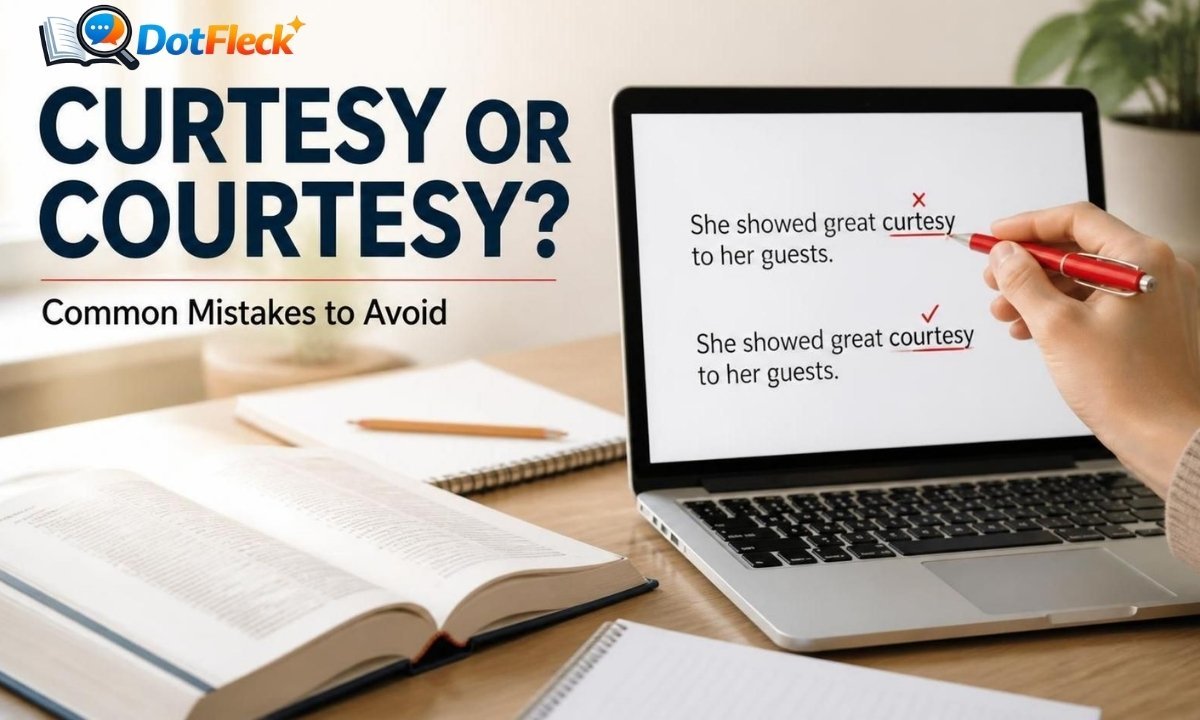
Here are some examples of incorrect and correct usage.
- Incorrect for politeness: Please show some curtesy.
- Correct: Please show some courtesy.
- Incorrect for politeness: Thank you for your curtesy.
- Correct: Thank you for your courtesy.
- Incorrect for politeness: She treated the guests with curtesy.
- Correct: She treated the guests with courtesy.
Remember, curtesy can be correct in its historical legal context. The mistake occurs when you use it to mean politeness.
Practice: Courtesy or Curtesy?
Test your understanding by choosing the correct word for each sentence.
- Please show ______ to your classmates.
- Thank you for your ______ and support.
- The historian studied the old legal rules concerning ______.
- The receptionist greeted the visitors with ______.
- The company offered a free service as a ______.
Answers:
- Courtesy
- Courtesy
- Curtesy
- Courtesy
- Courtesy
If you answered all five correctly, you understand the difference between these two words.
Frequently Asked Questions
1. Is curtesy or courtesy correct?
Both words exist, but they have different meanings. Courtesy is the standard word for politeness and respectful behavior. Curtesy is a rare historical legal term.
2. Is curtesy a real word?
Yes. Curtesy is a real word used in historical legal contexts, particularly concerning a husband’s interest in certain property of his deceased wife. It is not the standard spelling of courtesy.
3. What does courtesy mean in simple words?
Courtesy means being polite, respectful, and considerate toward others. Holding a door open, saying thank you, and listening respectfully are examples of courtesy.
4. Why do people spell courtesy as curtesy?
People often confuse the two spellings because they look similar and may sound alike when spoken. Remembering the letters “our” in courtesy can help prevent this mistake.
5. Can I use courtesy in formal writing?
Yes. Courtesy is appropriate in formal emails, business documents, academic writing, and everyday communication whenever you mean politeness or respectful behavior.
6. What is the difference between courtesy and curtesy?
Courtesy means politeness or considerate behavior. Curtesy refers to a historical legal property right associated with a surviving husband. Their meanings and contexts are different.
7. What is an example of courtesy in a sentence?
“Thank you for your courtesy and understanding” is a correct example. Here, courtesy refers to polite and considerate behavior.
8. What is the easiest way to remember courtesy?
Remember the phrase “courtesy contains our.” The correct spelling is C-O-U-R-T-E-S-Y. Use it whenever you mean politeness or good manners.
Conclusion
When deciding between curtesy or courtesy, focus on the meaning of your sentence.
Courtesy is the correct choice for everyday writing when you mean politeness, kindness, good manners, or respect.
Curtesy is a rare historical legal term associated with certain property rights of a surviving husband.
To remember the difference, keep the letters “our” in mind and connect courtesy with respectful behavior.
With this simple rule, you can choose the right word and avoid a common English spelling mistake.

Ethan Whitmore is an English language writer who enjoys making grammar, word meanings, and modern slang simple and easy to understand. His content focuses on clear explanations, practical examples, and everyday English usage.