
Have you ever wondered whether to write piece or peice?
These two spellings look similar, but only one is correct in standard English.The correct spelling is piece, which means a part, portion, or amount of something.Peice is a common spelling mistake that happens when people mix up the letters i and e.
Whether you are writing an email, completing a school assignment, or posting on social media, knowing the difference between piece and peice can help you avoid spelling errors.
In this guide, you will learn the correct spelling, its meaning, common examples, and an easy memory trick to remember it.
Quick Answer: Piece or Peice?
- Piece: The correct English spelling. It means a part or portion of something.
- Peice: An incorrect spelling of the word piece.
Example: Please give me a piece of chocolate.
Remember to write piece, not peice, whenever you mean a part of something.
What Does Piece Mean?
The word piece is a noun that refers to a part, portion, or individual item from a larger whole.
It can describe food, paper, furniture, artwork, information, and many other things.
Examples of Piece in a Sentence
- I ate a piece of chocolate after dinner.
- She gave me a piece of paper to write on.
- He created a beautiful piece of art.
- Can you share a piece of advice with me?
- I need one more piece of the puzzle.
In each sentence, piece refers to a part, item, or amount.
The word can also appear in expressions such as a piece of cake, which can mean something that is very easy to do.
| Keep Reading These Posts |
| Barrel or Barrell – The Correct Spelling Explained |
| Complement vs Compliment: What’s the Difference? |
What Does Peice Mean?
Peice is a misspelling of piece. It is not the standard spelling used in modern English.
People often type peice because they accidentally reverse the letters i and e.
Here is the correct way to write it:
- Incorrect: I would like a peice of pizza.
- Correct: I would like a piece of pizza.
- Incorrect: She bought a peice of furniture.
- Correct: She bought a piece of furniture.
If you see peice in an email, text message, essay, or online article, it should generally be corrected to piece.
Piece vs. Peice: Key Differences
| Feature | Piece | Peice |
|---|---|---|
| Spelling | Correct | Incorrect |
| Word type | Noun | Misspelling |
| Meaning | A part, portion, or item | No standard English meaning |
| Correct in formal writing? | Yes | No |
| Example | A piece of cake | A peice of cake |
The main difference is the order of the letters. Piece uses ie, while peice incorrectly uses ei.
How to Remember the Correct Spelling
Remembering the spelling of piece is easier when you connect it with a familiar phrase.
1. Think of a Piece of Pie
Both piece and pie contain the letters ie.
Remember this phrase:
A piece of pie.
This simple spelling trick can help you recall the correct letter order whenever you write the word.
2. Look at the Letter Order
Compare the two spellings:
- P-I-E-C-E — correct
- P-E-I-C-E — incorrect
The letters i and e appear in the wrong order in the second spelling.
3. Do Not Depend Only on the Spelling Rule
You may have learned the phrase “i before e, except after c.”
However, English has many exceptions to this rule, so it is not reliable for every word.
For piece, the easiest approach is to memorize the spelling directly: P-I-E-C-E.
Common Examples of Piece in Everyday English
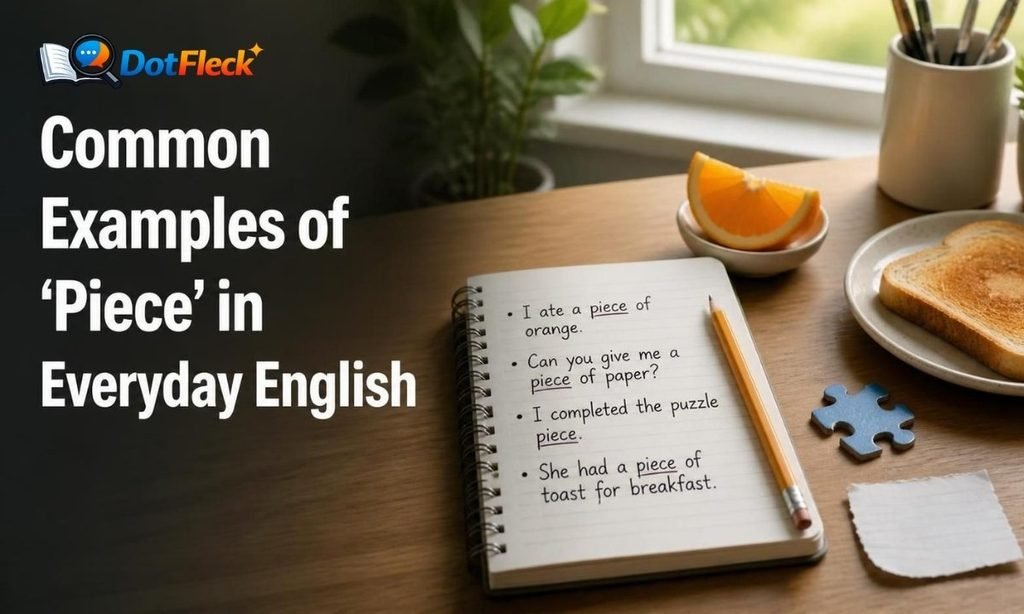
Understanding how piece is used can help you remember its spelling naturally.
In Emails and Professional Writing
- Please send me a piece of information about the project.
- I have attached a piece of the original document.
In Text Messages
- Save me a piece of cake!
- I need one more piece to finish this puzzle.
In School and Academic Writing
- Read the final piece of the story.
- The student wrote a thoughtful piece of analysis.
In Everyday Conversations
- Would you like a piece of pizza?
- That is a beautiful piece of furniture.
These examples show why piece is a useful word in everyday English.
Piece or Peice: Practice Quiz
Test your spelling knowledge with these five sentences.
Choose the correct spelling for each blank.
- I ate a ___ of bread.
- Please give me one ___ of paper.
- She painted a beautiful ___ of art.
- He needs another ___ to complete the puzzle.
- Can I have a ___ of chocolate?
Answers: Piece, piece, piece, piece, piece.
If you answered all five correctly, you understand which spelling to use.
Frequently Asked Questions
Is peice a real word?
No. Peice is a common misspelling of piece and is not accepted as the standard spelling in modern English.
Is it piece or peice?
Piece is correct. Use it when referring to a part, portion, or individual item.
Why do people spell piece as peice?
People often confuse the letter order because English contains words with both ie and ei. Typing quickly can also cause this mistake.
What is the meaning of piece?
Piece means a part or portion of something. For example, a piece of cake is one portion of a cake.
What is the plural of piece?
The plural is pieces.
Example: She cut the cake into six pieces.
What is an easy trick to remember piece?
Think of the phrase “a piece of pie.” Both piece and pie contain ie.
Is piece the correct spelling in American and British English?
Yes. Piece is the standard spelling in both American and British English.
Conclusion
When deciding between piece or peice, always choose piece.
It is the correct spelling for a part, portion, or individual item, while peice is a common spelling error.
To remember the difference, think of the phrase “a piece of pie.”
Keep the letters i and e in the correct order, and you will be able to use piece confidently in emails, schoolwork, and everyday writing.

Ethan Whitmore is an English language writer who enjoys making grammar, word meanings, and modern slang simple and easy to understand. His content focuses on clear explanations, practical examples, and everyday English usage.