
Have you ever typed “forteen” and wondered whether it was correct? You’re not alone. Many English learners and native speakers confuse these spellings because fourteen sounds similar to “for-teen” when spoken quickly.
The correct spelling is fourteen, which represents the number 14. “Forteen” is a common misspelling and is not accepted in standard English.
In this guide, you’ll learn the difference between fourteen and forteen, why the mistake happens, how to remember the correct spelling, and how to use fourteen in everyday writing.
Fourteen or Forteen: Quick Answer
Fourteen is the correct spelling of the number 14. Forteen is incorrect in standard English.
The word fourteen combines “four” and “teen.” It keeps the letter u from “four,” even though that letter may be less noticeable in natural speech.
- Correct: Fourteen
- Incorrect: Forteen
- Numerical form: 14
- Ordinal form: Fourteenth
Examples:
- My brother is fourteen years old.
- We waited fourteen minutes for the train.
- She invited fourteen friends to her birthday party.
Remember this simple rule: Four + teen = fourteen.
What Is the Difference Between Fourteen and Forteen?
The main difference is spelling. Fourteen is the standard English word for the number 14, while forteen is a spelling mistake.
| Feature | Fourteen | Forteen |
| Correct spelling | Yes | No |
| Meaning | The number 14 | No standard meaning as a number |
| Numeral | 14 | Intended to mean 14 |
| Standard English usage | Accepted | Not accepted |
| Example | Fourteen students attended. | Forteen students attended. |
Use fourteen in school assignments, emails, business documents, articles, and everyday conversations whenever you write the number in words.
Why Do People Spell Fourteen as Forteen?
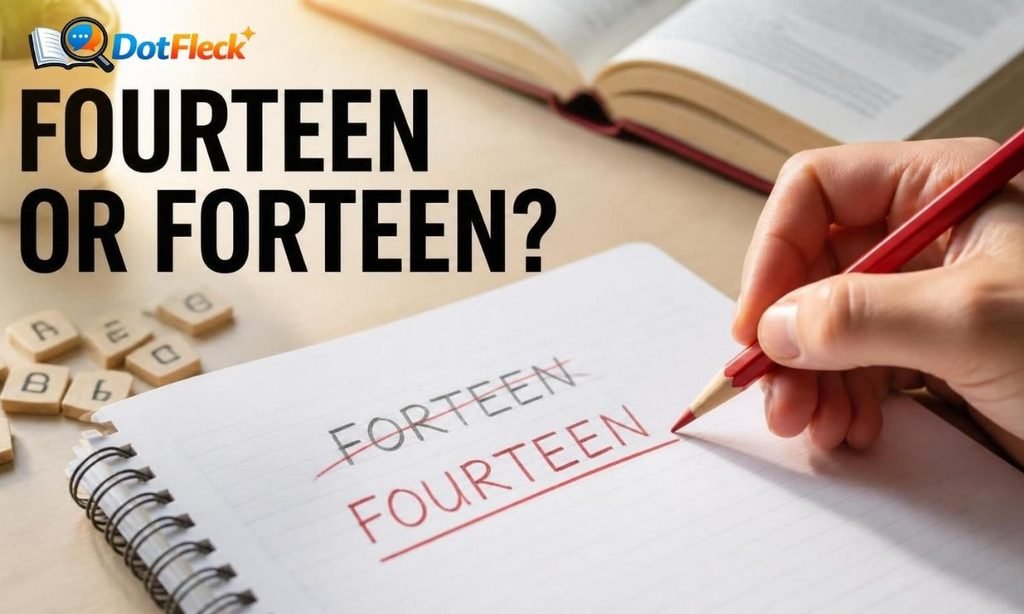
The confusion usually happens because people spell words according to how they sound rather than how they are written.
When spoken quickly, fourteen can sound like “for-teen.” The pronunciation makes it easy to overlook the u in the word, especially when typing in a hurry.
There are three common reasons for this mistake.
1. Pronunciation Can Be Misleading
English spelling does not always match pronunciation perfectly. In fourteen, the vowel sound and the transition between syllables may make the original spelling of “four” less obvious.
As a result, some people write forteen because it appears to match what they hear.
2. The Letter U Is Easy to Forget
The letter u is part of the standard spelling of fourteen. Because it is not strongly emphasized in pronunciation, writers may accidentally leave it out.
However, the spelling does not change simply because a letter is less noticeable when spoken.
3. Fourteen and Forty Cause Confusion
Fourteen and forty are related number words, but their spellings are different.
- Fourteen = 14
- Forty = 40
Fourteen retains the u from four, whereas forty is conventionally spelled without it. Remembering this difference helps prevent both spelling and number-related mistakes.
Is Forteen Ever Correct?
No. Forteen is not an accepted alternative spelling of fourteen in standard modern English.
You may encounter forteen in informal messages, online comments, spelling exercises, or text written by someone unfamiliar with the correct form. Its appearance does not make it a recognized spelling variant.
If you are writing for school, work, a website, or any other formal purpose, use fourteen whenever you need to spell out the number 14.
Fourteen Meaning: What Does It Mean?
Fourteen is a cardinal number that represents one more than thirteen and one less than fifteen. Its numerical form is 14.
The word is used to count people, objects, periods of time, and other quantities.
Examples of fourteen in a sentence:
- Age: My cousin turned fourteen last week.
- Time: The meeting lasted fourteen minutes.
- Quantity: The shop received fourteen new orders.
- Education: Fourteen students completed the assignment.
- Money: The book costs fourteen dollars.
In each example, fourteen expresses the same numerical value.
| Keep Reading These Grammar Articles |
| Signup or Sign Up? Correct Spelling and Difference (2026) |
| Swifty or Swiftie: Which Spelling Is Correct? (2026) |
What Is the Origin of the Word Fourteen?
The word fourteen comes from Old English fēowertīene, a form built from the word for four and an element meaning ten. Its historical development explains why the modern spelling contains a connection to “four.”
The ending -teen appears in the English number words from thirteen through nineteen. These words developed over time, and their spellings reflect historical forms rather than a perfectly uniform modern spelling rule.
Although fourteen and forty share a historical connection to four, they developed different conventional spellings. That is why the u remains in fourteen but does not appear in forty.
“Forteen” should not be treated as an older standard spelling of the modern number. For contemporary English writing, fourteen is the form to use.
British English vs. American English: Is There a Difference?
No. Both British English and American English use the spelling fourteen.
Unlike words such as colour and color, which have established regional spelling differences, fourteen is spelled the same way in both varieties.
| Feature | American English | British English |
| Correct spelling | Fourteen | Fourteen |
| Ordinal form | Fourteenth | Fourteenth |
| Numerical form | 14 | 14 |
| Accepted spelling of the number | Fourteen | Fourteen |
Pronunciation may vary by accent, but that variation does not affect the spelling.
How Do You Pronounce Fourteen?
Fourteen has two syllables and is commonly pronounced for-TEEN, with the primary stress on the second syllable.
Its pronunciation is often represented as /ˌfɔːrˈtiːn/ in a broad transcription, although exact phonetic notation varies by accent.
American English Pronunciation
In most American accents, the r is pronounced clearly. The word may sound like “for-TEEN,” with a distinct r sound.
British English Pronunciation
In many British accents, particularly non-rhotic accents, the r is not pronounced before the consonant in teen. The word may sound closer to “faw-TEEN.”
Neither pronunciation changes the standard spelling: fourteen.
Fourteen vs. Forty: Why Is One Spelled Differently?
Fourteen and forty are two number words that are frequently confused because they look and sound similar.
The correct spellings are:
- Fourteen (14): Four + teen.
- Forty (40): The standard spelling omits the u.
Although fourteen retains the u from four, forty does not. The spelling of forty reflects historical changes in English orthography, and writers should learn it as a conventional exception rather than apply the spelling of fourteen to it.
Examples:
- The class has fourteen students.
- The building has forty rooms.
- She saved fourteen dollars.
- He ran forty miles during the challenge.
A useful reminder is that fourteen contains the letters in four, while forty does not contain a u.
How to Remember the Correct Spelling of Fourteen
If you often confuse fourteen and forteen, use one of these simple memory tricks.
1. Remember Four + Teen
Break the word into two familiar parts:
FOUR + TEEN = FOURTEEN
When you write four first, you are less likely to forget the u before adding teen.
2. Connect Fourteen to the Number Four
Fourteen is based on the number four. Keeping that relationship in mind helps you remember its spelling.
Think of four first, then add a teen. This is especially useful when completing schoolwork or typing quickly.
3. Practice With Example Sentences
Write these sentences to reinforce the correct spelling:
- I have fourteen books on my shelf.
- The journey takes fourteen hours.
- Fourteen people joined the event.
Repeated exposure to the correct form can make it easier to recognize and remember.
Fourteen in Numbers, Dates, and Formal Writing
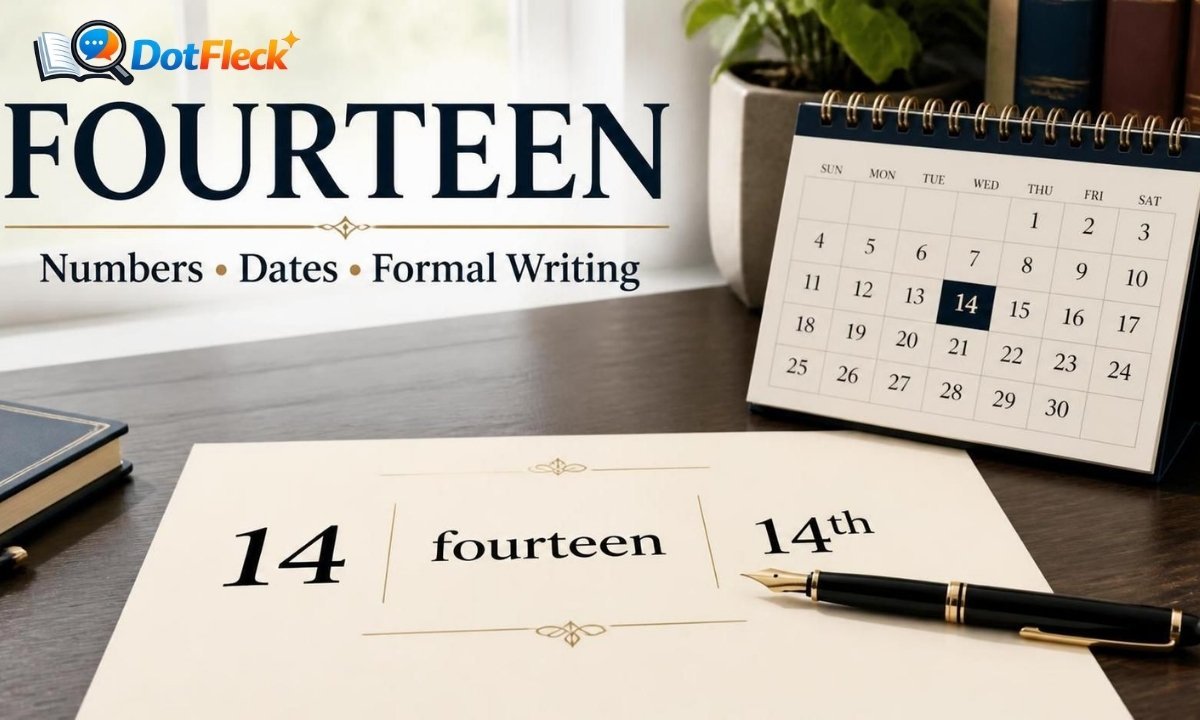
The number 14 can be written as a numeral or spelled out as fourteen. The appropriate choice depends on the type of writing and the relevant style guide.
Fourteen in Dates
You may see the number written as “March 14” or “the fourteenth of March.” Both formats can be correct, depending on the style and sentence structure.
The ordinal form is fourteenth, not “forteenth.”
Fourteen in Formal Documents
When spelling out an amount or quantity, use fourteen. For legal or financial documents, follow the organization’s formatting rules and make sure the written amount agrees with the numeral.
Fourteen in Everyday Writing
Both 14 and fourteen are common in everyday communication. For example, “I bought 14 apples” and “I bought fourteen apples” communicate the same quantity.
The important point is that if you choose to spell out the number, fourteen is the correct form.
Common Mistakes to Avoid
Understanding the following errors can help you use fourteen correctly.
Writing Forteen Instead of Fourteen
Incorrect: She is forteen years old.
Correct: She is fourteen years old.
The incorrect version leaves out the u from four.
Spelling Fourteenth Incorrectly
Incorrect: Today is the forteenth of May.
Correct: Today is the fourteenth of May.
The ordinal form follows the spelling of fourteen.
Confusing Fourteen With Forty
Incorrect: The box contains forteen items, and the warehouse stores forty more.
Correct: The box contains fourteen items, and the warehouse stores forty more.
Remember that fourteen means 14, while forty means 40.
Fourteen or Forteen Quiz
Test your understanding by choosing the correct spelling in each sentence.
- My sister is (fourteen / forteen) years old.
- We ordered (fourteen / forteen) sandwiches.
- The trip will take (fourteen / forteen) hours.
- He finished reading the book on the (fourteenth / forteenth) of June.
- Which spelling is correct for the number 40: fourty or forty?
Answers:
- Fourteen
- Fourteen
- Fourteen
- Fourteenth
- Forty
If you answered all five correctly, you understand the difference between these commonly confused spellings.
Frequently Asked Questions
Is fourteen or forteen correct?
Fourteen is correct. Forteen is a misspelling and is not an accepted standard spelling of the number 14.
Why is fourteen spelled with a u?
Fourteen retains the u from the word four. Its spelling reflects the historical development of the number word and should not be changed to match its pronunciation.
Is forteen a real English word?
Forteen may appear as a typing or spelling error, but it is not the standard English spelling for the number fourteen.
How do you spell 14 in words?
The number 14 is spelled fourteen. Its ordinal form, used for position or dates, is fourteenth.
Is fourteen spelled differently in British and American English?
No. British and American English both use fourteen. There is no standard regional spelling difference.
What is the difference between fourteen and forty?
Fourteen means 14, while forty means 40. Fourteen contains a u, but forty is spelled without one.
How do you remember how to spell fourteen?
Break the word into four and teen. Writing “four” first makes it easier to remember the u in fourteen.
Is fourteenth spelled with an extra e?
No. The correct spelling is fourteenth. It is formed by adding the ordinal ending to fourteen, with the final n retained before the ending.
Should I write 14 or fourteen in an article?
Both forms can be correct. Use the format that fits your sentence and follow your publication’s style guide. Whenever you spell out the number, use fourteen.
Final Thoughts
The answer to “fourteen or forteen” is simple: fourteen is the correct spelling of the number 14, while forteen is incorrect in standard English.
The easiest way to remember it is to start with the word four and add teen. Although the pronunciation may make the u less noticeable, the spelling remains the same in British and American English.
Whether you are writing a school assignment, an email, a website article, or a formal document, choose fourteen whenever you need to spell out the number. Keep the four in fourteen, and you will avoid this common spelling mistake.

Ethan Whitmore is an English language writer who enjoys making grammar, word meanings, and modern slang simple and easy to understand. His content focuses on clear explanations, practical examples, and everyday English usage.