
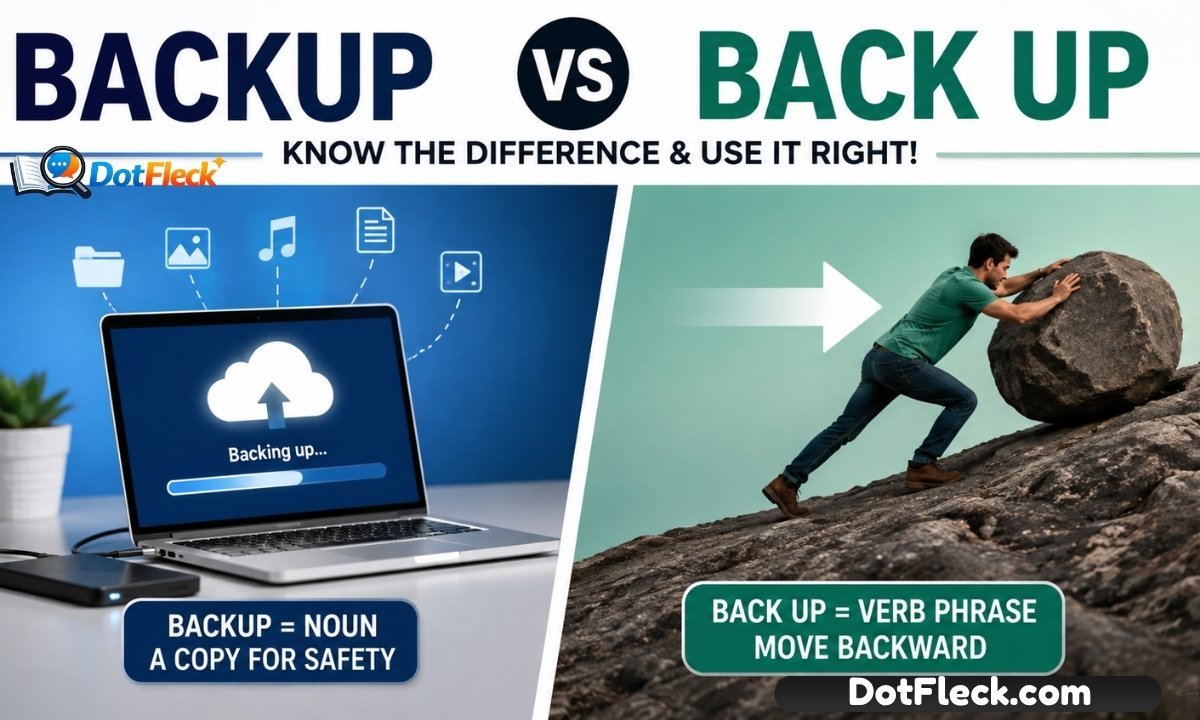
If you’ve ever paused mid-sentence wondering whether to type “Backup vs Back Up,” you’re dealing with one of the most common mix-ups in American English. The confusion happens because both forms sound identical when spoken, so your ear never learns the difference.
Here’s the quick fix: backup is a noun or adjective (a thing), while back up is a verb phrase (an action). If you’re doing something, use two words. If you’re naming something, use one.
What Does “Backup” Mean?

Backup (one word) is a noun that refers to a copy, a substitute, or extra support kept in reserve. It can also work as an adjective describing something that serves as a reserve or replacement.
As a noun:
- “I keep a backup of my photos on an external drive.”
- “The officer called for backup.”
As an adjective:
- “Bring a backup charger just in case.”
- “She’s the team’s backup quarterback.”
A simple test: if you can put “a,” “an,” or “the” in front of the word, you’re almost certainly looking at the noun form, backup.
What Does “Back Up” Mean?
Back up (two words) is a phrasal verb. It describes an action rather than a thing, and it carries a few related meanings depending on context.
Common meanings include:
- To copy data “Remember to back up your laptop before the update.”
- To move backward “Can you back up the car a little?”
- To support or confirm “My coworker will back up my version of events.”
- To accumulate or clog “Traffic tends to back up near that exit.”
If the word is doing something in the sentence, functioning as an action rather than a label, it needs the space: back up.
Why People Mix Them Up “Backup vs Back Up”
The confusion isn’t really about spelling. It’s about sound. Since “backup” and “back up” are pronounced exactly the same way, your brain doesn’t naturally flag which version belongs on the page. English is full of these pairs, where identical pronunciation hides a real grammatical difference (think “setup” vs. “set up” or “login” vs. “log in”).
Because both forms are so common in tech and business writing, the mistake shows up constantly in emails, instructions, and articles.
Read Also : WSP Meaning in Text
Backup vs Back Up: The Core Difference
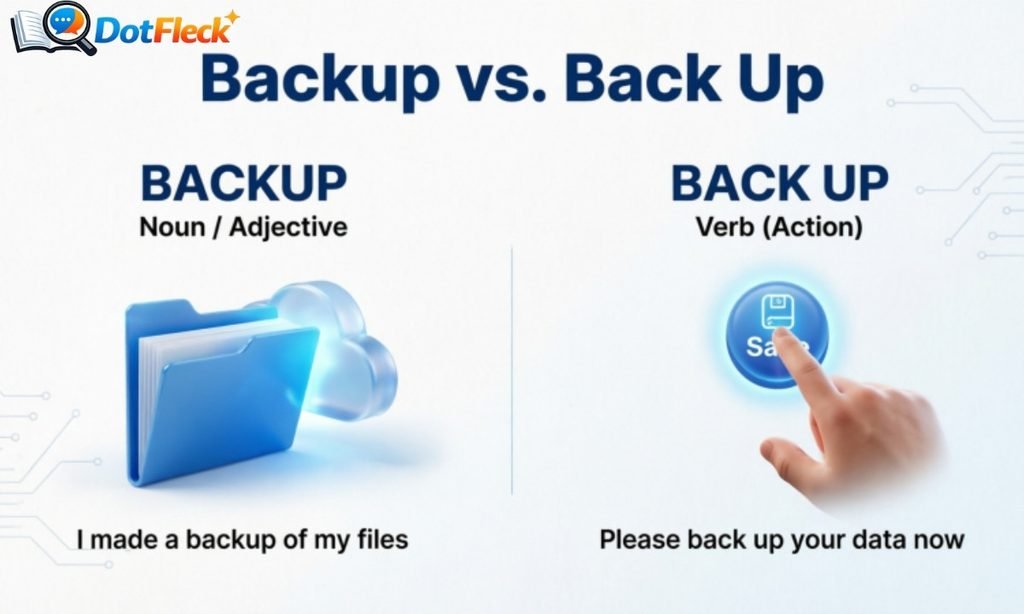
The distinction comes down to part of speech. Backup names something. Back up describes an action being performed. Once you can spot the difference between a noun and a verb in a sentence, the correct spelling follows automatically.
Ask yourself: is this word acting, or is it being talked about as a thing? If it’s acting, add the space.
Quick Comparison Table “Backup vs Back Up”
| Term | Part of Speech | Meaning | Typical Use | Example |
| Backup | Noun / Adjective | A copy, reserve, or support | Naming a thing or describing one | “Save a backup to the cloud.” |
| Back up | Verb phrase | To copy, reverse, support, or clog | Describing an action | “Please back up your files tonight.” |
Real-Life Examples “Backup vs Back Up”
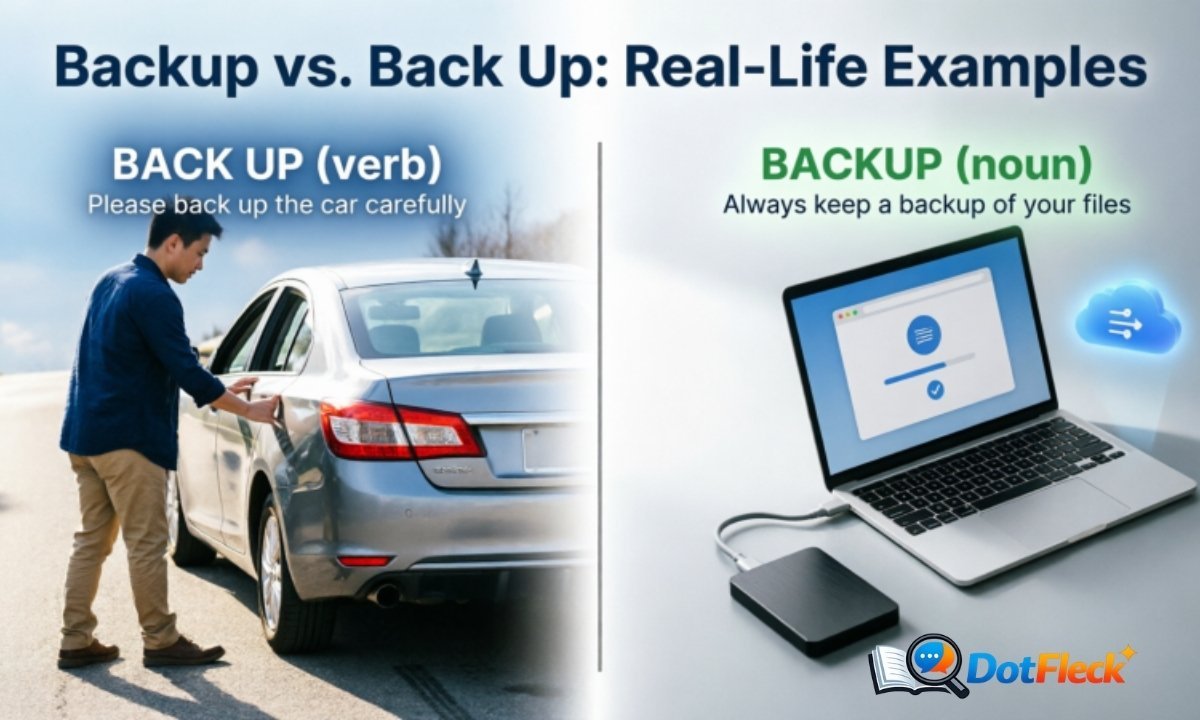
Everyday conversation Backup vs Back Up
- Correct: “Did you back up your phone before the update?”
- Incorrect: “Did you backup your phone before the update?” this uses the noun where an action is needed.
Workplace communication Backup vs Back Up
- Correct: “Attached is a backup of last quarter’s spreadsheet.”
- Incorrect: “Attached is a back up of last quarter’s spreadsheet.” a thing (the file) needs the noun form.
Text messages Backup vs Back Up
- Correct: “Can you back up the truck a bit? It’s blocking the driveway.”
- Incorrect: “Can you backup the truck a bit?” an action requires two words.
Academic or formal writing Backup vs Back Up
- Correct: “Researchers should always keep a backup copy of their raw data.”
- Incorrect: “Researchers should always backup their raw data.” (Here “backup” is being misused as a verb, which isn’t standard.)
Common Mistakes and How to Avoid Them “Backup vs Back Up“
The most frequent error is using backup where a verb is needed, since the one-word form feels shorter and more familiar from everyday tech language (“cloud backup,” “backup plan”). Writers see it so often as a noun that it starts to feel natural in verb slots too.
A second common mistake is the reverse: writing back up when referring to a thing, such as “I saved a back up on my desktop.” Because the words are separated by nothing but a space in speech, it’s easy to guess wrong in either direction.
A simple memory trick: if you could replace the word with “copy” or “reserve” and the sentence still makes sense, use backup. If you could replace it with “support,” “reverse,” or “duplicate” as an action, use back up.
- I need a backup. (a thing noun)
- I need to back up my files. (an action verb)
Practical Usage Guidance “Backup vs Back Up”
When editing your own writing, look at the word right before “backup” or “back up.” If there’s an article like “a,” “an,” or “the,” or a possessive like “my” or “your” describing a thing, you almost always want backup as one word. If the word is following “to,” as in “to back up,” or acting as the main verb of the sentence, keep the space.
This pattern holds across formal writing, workplace emails, and casual texting. The grammar doesn’t shift with tone or context, only the spelling does, based on function.
Related Terms Worth Knowing “Backup vs Back Up”
The backup and back up pattern isn’t unique. English has several other noun/verb pairs that follow the same one-word-versus-two-word logic:
- Setup (noun) vs. set up (verb) “The setup is ready” vs. “Please set up the chairs.”
- Login (noun) vs. log in (verb) “Enter your login” vs. “Please log in now.”
- Workout (noun) vs. work out (verb) “That was a great workout” vs. “Let’s work out together.”
Recognizing this shared pattern makes it much easier to get “backup” and “back up” right without memorizing each pair separately.
Backup vs Back Up in American vs. British English
Both American and British English follow the same core rule here, so there’s no regional split to worry about. Some British style guides occasionally hyphenate the adjective form as “back-up” (as in “a back-up plan”), while American English tends to favor the closed form “backup” for the same use. Either way, the verb phrase stays two words in both varieties.
Frequently Asked Questions
Is “backup” one word or two?
As a noun or adjective, backup is one word for example, “I have a backup of my files.” As a verb, it becomes two words: back up, as in “I need to back up my files.” The spelling depends entirely on how the word functions in the sentence.
What is the difference between “backup” and “back up”?
Backup is a noun or adjective that names a copy, reserve, or support. Back up is a verb phrase that describes the action of copying, reversing, supporting, or clogging. For example: “Save a backup” (thing) versus “Back up your data” (action).
Is “back-up” with a hyphen ever correct?
Yes, in some style guides, especially British ones, “back-up” is hyphenated when used as an adjective, such as “a back-up generator.” American English usually drops the hyphen and writes it as one word, “backup,” in the same role. Either way, the verb form remains two words with no hyphen.
Can “backup” be used as a verb?
No. Standard English treats backup strictly as a noun or adjective. When you need a verb, the correct choice is always the two-word phrase back up, as in “back up your computer” rather than “backup your computer.”
The Takeaway “Backup vs Back Up
The rule behind backup vs back up is simpler than it feels at the moment. One word names a thing; two words describe an action.
Before you type either version, ask whether the word is acting as a noun or a verb in your sentence, and the correct spelling will follow naturally every time.

Ethan Whitmore is an English language writer who enjoys making grammar, word meanings, and modern slang simple and easy to understand. His content focuses on clear explanations, practical examples, and everyday English usage.