
You write “I say it yesterday,” pause, and stare at the screen. Something feels wrong, but the word looks so simple.
Mixing up say vs said trips up native speakers and learners alike. The fix is short: say is the present tense, and said is the past tense. Match the word to the time of the action, and you are done. The rest of this guide shows you how, with examples you can steal.
What Is the Difference Between Say vs Said?
Say describes speaking now, often, or in the future. Said describes speaking that already happened.
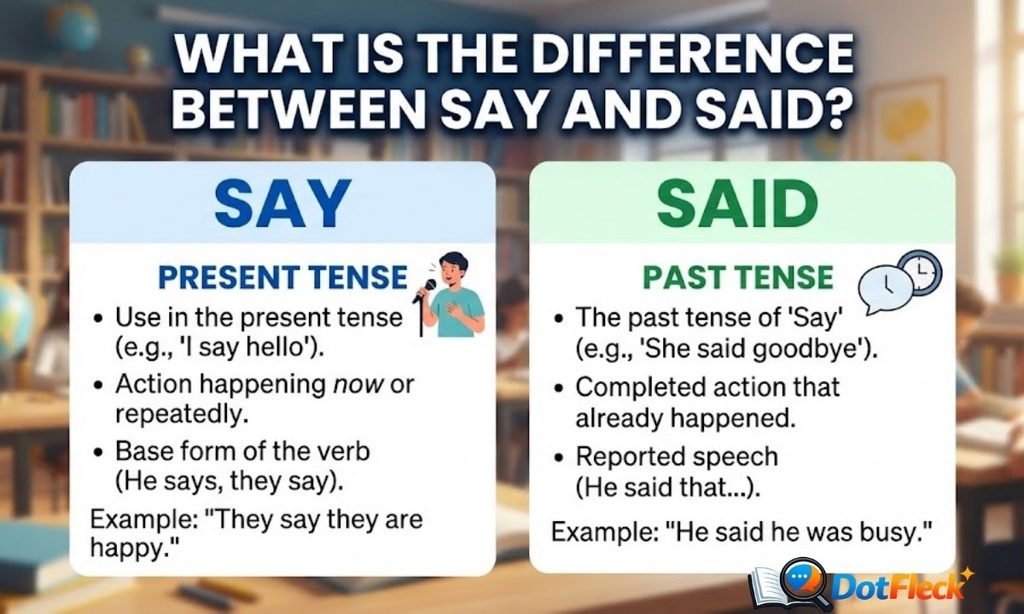
- Present: “I say hello to my neighbor every morning.”
- Past: “I said hello to my neighbor this morning.”
That is the whole rule. Say is the base verb. Said is both the simple past tense and the past participle of say, which means it also works after “have,” “has,” and “had.”
Before we go deeper, let’s put both words side by side.
Say vs Said Quick Comparison Table
| Feature | Say | Said |
| Tense | Present (base form) | Past and past participle |
| Time | Now, habits, future plans | Finished actions |
| Pronunciation | /seɪ/ (rhymes with “day”) | /sɛd/ (rhymes with “bed”) |
| Example | “I say we leave now.” | “She said we should leave.” |
| Works with helpers | will say, can say, do not say | has said, had said, was said |
Notice the pronunciation row. That odd little mismatch causes more spelling trouble than you might expect, and we will solve it in a moment.
What Does “Say” Mean and When Do You Use It?
Say means to speak words, express an idea, or state something in writing. You use it when the action is happening now, happens regularly, or will happen later.
Here are the most common jobs for say:
- Present moment: “I say we order pizza.”
- Habits: “Grandma always says, ‘Eat your vegetables.'”
- Future: “I will say a few words at the wedding.”
- Instructions and general facts: “The sign says ‘No parking.'”
- Commands and questions: “Say cheese!” or “Do you say tomato or tomahto?”
Say also follows helper verbs like will, can, should, and do. After those, the verb always stays in its base form, so “She will said” is out.
| Keep Reading These Articles |
| Barrel or Barrell? |
| Writing vs Writting |
What Does “Said” Mean and When Do You Use It?
Said means the speaking is finished. Something was spoken, written, or stated before this moment.
- “He said he would call back.” (Did he? We will never know.)
- “The manager said yes.”
- “I have said this three times already.” (Frustration included.)
- “What was said in that meeting stays in that meeting.”
Said also works as an adjective in formal and legal writing. “The said contract” means “the contract mentioned earlier.” You will meet it in leases, not in texts to friends.
Where Did Say vs Said Come From?
Here is the fun part. Both words trace back to the Old English verb secgan, meaning “to tell” or “to speak.” The past form was sægde, and over centuries, English speakers squeezed it down into the short word we write today.
That history explains the strange sound. When people shortened the word, the vowel changed too, so said now rhymes with “bed” instead of “day.” Spelling stayed put while pronunciation moved on. English does this a lot, and it is not sorry.
Older texts show the same pattern. In the King James Bible, Genesis 1:3 reads, “And God said, Let there be light.” The same book uses the present form in “Verily I say unto you,” a phrase you will hear in many sermons. Four hundred years later, the tense split works the same way: say for the present voice, said for what already happened.
How Do Say, Says, and Said Work Together?
Say actually has three forms you will use daily, and mixing them causes most errors.
- Say: Use it with I, you, we, and they. “They say it will rain.”
- Says: Use it with he, she, it, and singular nouns. “Mom says dinner is ready.”
- Said: Use it for every subject in the past. “Mom said dinner was ready.”
Here is a curveball. Says is pronounced /sɛz/, not /seɪz/. So the past and third person forms both use the short “e” sound. Only the base form say uses the long “ay” sound.
A quick check works well: if the sentence takes place right now, look at the subject and choose say or says. If it took place earlier, choose said.
How Do You Use Say vs Said in Reported Speech?
Reported speech means telling someone what another person spoke. This is where said shines.
Direct speech repeats the exact words:
- She said, “I am tired.”
Indirect speech shares the idea without quotation marks:
- She said (that) she was tired.
Notice the small change. In indirect speech, the verb inside often shifts one step back in time, so “am” becomes “was.” Grammar teachers call this backshifting. Journalists call it Tuesday.
Also remember the comma rule. Put a comma before a quote that follows said, and place end punctuation inside the closing quotation marks in American English.
Should You Use Said or Told?
This question pops up right after say vs said, so let’s clear it now. Said does not need a listener in the sentence. Told does.
- Correct: “He said he was late.”
- Correct: “He told me he was late.”
- Wrong: “He said me he was late.”
- Wrong: “He told he was late.”
Here is the pattern: say something, but tell someone something. If a person receives the message in your sentence, reach for told. If you only mention the message, use said. Add “to” when you want both: “He said to me that he was late.”
What Are Real Life Examples of Say vs Said?
Examples make the rule stick. Try these across different settings.
At work Say vs Said
- “I say we move the deadline.” (Suggestion now.)
- “The client said the deadline was flexible.” (Report of the past.)
With friends Say vs Said
- “You always say you will cook. You never do.”
- “You said you would cook. The smoke alarm disagrees.”
In the news Say vs Said
- “The mayor said the bridge would reopen in May.”
On signs and labels Say vs Said
- “The label says ‘Keep refrigerated.'”
In everyday chat Say vs Said
- “What did you say?” (Not “What did you said?”)
- “I should have said something earlier.”
Reporters lean on said far more than fancy alternatives like “stated” or “exclaimed,” because it stays neutral and lets the quote do the talking. That is a useful trick for your own writing too.
What Are the Most Common Mistakes With Say and Said?
Most errors fall into a few predictable buckets. Here is your watch list:
- Spelling it “sayed.” The correct past tense is said. “Sayed” and “sayd” do not exist in standard English.
- Using said after “did.” After did, use the base form: “Did you say that?” not “Did you said that?”
- Using said after “will” or “can.” Write “She will say,” not “She will said.”
- Picking says for I or they. Write “I say” and “they say,” not “I says.”
- Mixing tenses in one story. “He walked in and says hello” jumps between past and present. Choose one.
- Confusing said and told. Remember that told needs a person.
The “did” mistake is the sneakiest. The word did already carries the past tense, so the main verb goes back to its plain base form. One tense marker per sentence is plenty.
Which One Should You Use: Say or Said?
Use this three second test:
- Ask when it happened. Finished? Use said. Happening, repeated, or upcoming? Use say or says.
- Check for helper verbs. After do, does, did, will, can, should, would, may, might, use say. After have, has, had, use said.
- Read it aloud. If the sentence sounds like a story from yesterday, said is your word.
Here is a memory hook: said ends with “d,” and so do did, ended, and done. All of them talk about finished business.
Conclusion
Say is the present verb. Said is the past verb. Once you attach each word to a clear time, the confusion fades fast. Add the small extras, like says for he and she, base form after did, and told when a listener appears, and your grammar will hold up in emails, essays, and dinner arguments.
Next time you catch yourself typing “sayed,” smile, fix it, and move on. Everyone has been there.
Frequently Asked Questions
Is “said” the past tense of “say”?
Yes. Said is both the simple past tense and the past participle of say. “I said hello” uses it as past tense, and “I have said hello” uses it as a participle.
Can you say “I say” in the past?
No. Use “I said” for finished actions. The exception is storytelling in the present tense, where speakers sometimes write “So I say to him, ‘Really?'” It sounds casual and lively, but avoid it in formal writing.
Why does “said” sound like “sed” instead of “sayd”?
Over centuries, the Old English past form got shortened, and the vowel sound shortened with it. The spelling stayed the same. That is why said rhymes with “bed,” while say rhymes with “day.”

Ethan Whitmore is an English language writer who enjoys making grammar, word meanings, and modern slang simple and easy to understand. His content focuses on clear explanations, practical examples, and everyday English usage.