

You typed “I need to setup my email” and something felt off. Or maybe you wrote “the set up looks great” and your spell-checker didn’t blink, so you assumed it was fine. This mix-up happens because setup and set up sound identical and share the same root words, but they play completely different grammatical roles.
Here’s the direct answer: setup (one word) is a noun or adjective that names a thing, an arrangement, system, or configuration. Set up (two words) is a verb phrase that names an action the act of arranging, installing, or preparing something. If you’re doing something, use two words. If you’re naming a thing, use one word.
Setup vs. Set Up at a Glance
| Term | Part of Speech | Meaning | Typical Use | Example |
| Setup | Noun / adjective | An arrangement, system, or configuration | Describing a thing that already exists | “The setup took two hours to build.” |
| Set up | Verb phrase | The act of arranging or installing something | Describing an action someone performs | “Please set up the printer before noon.” |
| Set-up | Noun (hyphenated, less common) | Same meaning as setup | Older or British-leaning style | “The set-up was flawless.” |
Setup: The Noun and Adjective Form
When you write setup as one word, you’re naming a thing, not describing an action. It refers to how something is arranged, organized, or configured. It can act as either a noun or an adjective in a sentence.
As a noun, setup is the subject or object of a sentence:
Correct: “My home office setup includes a standing desk and two monitors.” “The setup was simple once I read the instructions.”
As an adjective, setup describes another noun:
Correct: “Follow the setup guide before turning on the router.” “They updated the setup process for new employees.”
One quick test: if you can swap the word for “arrangement,” “system,” or “configuration” without changing the meaning, you want a setup.
Set Up: The Verb Phrase
Set up is a phrasal verb made from “set” plus the preposition “up.” Phrasal verbs like this one describe an action, and English keeps them as two separate words no matter how the sentence is structured.
Correct: “I’ll set up the tent before it gets dark.” “Can you set up a meeting with the design team?” “She set up her laptop in ten minutes.”
Notice that “set up” changes tense the way any verb does “set up” (present or past), “sets up” (third person singular), “setting up” (continuous). The noun setup never changes form this way, which is a useful clue when you’re unsure which one you need.
Why Do People Mix Them Up?
The confusion isn’t really about spelling. It comes from the fact that setup and set up describe two sides of the same idea: the action and the result of that action. You set up a system, and once it’s built, that system is the setup. Because the words look and sound so similar, writers often pick whichever version they typed last time instead of checking the sentence’s function.
Spell-checkers make this worse. Both “setup” and “set up” are correctly spelled English words, so grammar tools frequently miss the error entirely. The mistake isn’t a spelling problem, it’s a word-function problem, and only context can catch it.
The Core Difference in Plain Terms
Everything comes down to one grammatical question: is the word doing something, or is it a thing?
- Set up = an action. Something is happening.
- Setup = a noun. Something exists.
A helpful shortcut: try inserting “up” right after the verb elsewhere in the sentence. “I need to set my computer up” still makes sense, which confirms it’s a verb phrase. You can’t do that with the noun “I need to set my computer setup up” is nonsense, which confirms setup is functioning as a thing, not an action.
Real-World Examples by Context
Everyday conversation: “Can you help me set up the grill for the barbecue?” “Nice gaming setup, did you build it yourself?”
Workplace communication: “IT will set up your new laptop this afternoon.” “The setup for the client demo needs to be ready by nine.”
Text messages: “omw to set up the room for the party” “love your new desk setup”
Academic or formal writing: “Researchers set up the experiment under controlled conditions.” “The experimental setup included three separate testing stations.”
Across every context, the rule holds steady: action gets two words, thing gets one.
Read Also : There vs. Their vs
Common Mistakes to Avoid
The most frequent error is using setup as a verb, which is never correct in standard English.
Incorrect: “Please setup your account before Friday.”
Correct: “Please set up your account before Friday.”
The reverse mistake splitting the noun into two words is just as common, especially in casual writing.
Incorrect: “I love your new desk set up.”
Correct: “I love your new desk setup.”
A simple way to remember the difference: setup sits still (it’s a noun, a fixed thing), while set up moves (it’s a verb, an action in progress). If the word is doing work in the sentence, it needs the space.
What About “Set-Up” With a Hyphen?
You’ll occasionally see set-up written with a hyphen, functioning as a noun. This form is more common in British English and older American writing, but modern American style guides overwhelmingly favor the closed compound setup for the noun and adjective forms. If you’re writing for a US audience, stick with setup (no hyphen, no space) whenever you mean the noun.
Setup vs. Set Up: Quick Usage Rules
- Use setup when the word functions as a noun or adjective.
- Use set up when the word functions as a verb.
- Never use “setup” as a verb. “I will setup the account” is always incorrect.
- If you can replace the word with “install,” “arrange,” or “prepare,” you need the two-word verb form.
- If you can replace the word with “arrangement,” “configuration,” or “system,” you need the one-word noun form.
Practical Way to Remember It
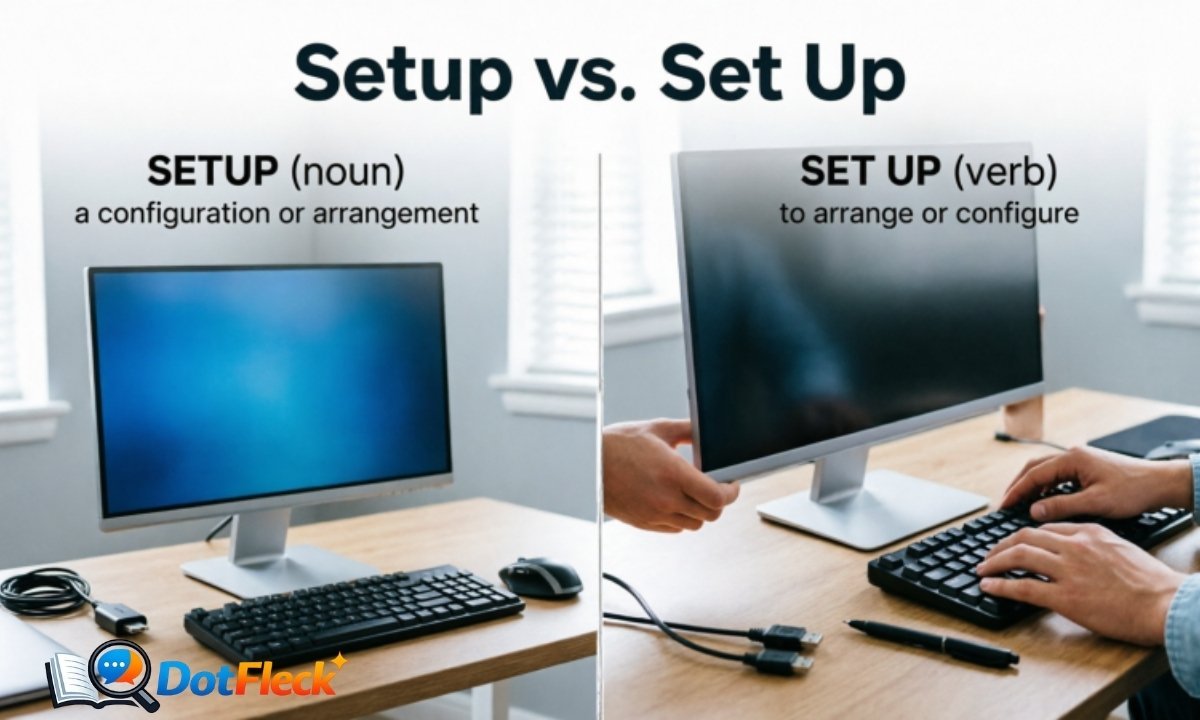
Picture the difference as cause and effect. You set up the stage (the action), and once the crew finishes, you’re looking at the setup (the result). The verb comes first in time; the noun describes what’s left standing afterward. Keeping that order in mind makes the choice almost automatic.
This same one-word-noun, two-word-verb pattern shows up in other English pairs, like login vs. log in and checkout vs. check out. Once the setup pattern clicks, those related pairs get much easier too.
Frequently Asked Questions
Is “setup” one word or two words?
It depends on how you’re using it. Setup is one word when it functions as a noun or adjective, referring to an arrangement or system. It becomes two words, set up, only when it’s functioning as a verb describing an action.
Is “setup” ever correct as a verb?
No. In standard American English, setup is never a verb. If you’re describing an action installing, arranging, or preparing something the correct form is always the two-word verb phrase set up.
What’s the difference between “setup” and “set-up”?
They mean the same thing, but setup (closed, no hyphen) is the standard modern American spelling for the noun. Set-up (hyphenated) is an older or British-leaning variant that’s becoming less common in current style guides.
How can I quickly check which form I need?
Ask whether the word is doing something or naming something. If it’s an action a person performs, use set up. If it’s a thing, system, or arrangement, use setup. Testing whether “arrangement” fits in place of the word is a fast way to confirm you need the noun form.
The Bottom Line
Setup names a thing. Set up names and actions. Once you check whether your sentence needs a noun or a verb, the right choice becomes obvious, and you’ll never second-guess that little space again.

Ethan Whitmore is an English language writer who enjoys making grammar, word meanings, and modern slang simple and easy to understand. His content focuses on clear explanations, practical examples, and everyday English usage.