

You want to say something happens all the time. So you type “Everyday vs Daily” and then you stop. Which one is actually correct here? Here is the short answer. Everyday is an adjective that describes something ordinary or routine, and it sits right before a noun.
Daily can be an adjective or an adverb, and it means something happens every single day. They overlap in meaning sometimes, but they do not work the same way inside a sentence. Once you see the pattern, you will never second guess it again.
Quick Answer: Everyday vs Daily in One Sentence
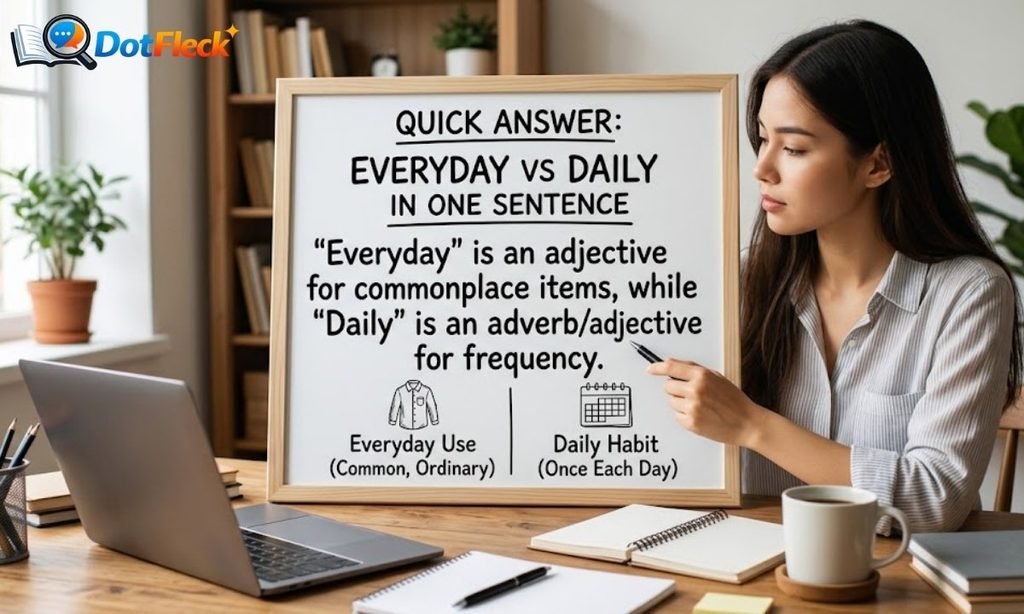
If a noun comes right after the word, use it everyday. 📌 “My everyday routine includes coffee and a walk.”
If the word is describing how often something happens, use it daily. 📌 “I walk my dog daily.”
That single test solves most of the confusion in under five seconds. But there is more nuance worth knowing, especially if you write for work, school, or social media. Keep reading, because the small details are where most people actually slip up.
What Does “Everyday” Mean?

Everyday is one word, no space in the middle. It is an adjective, which means its only job is to describe a noun. It means ordinary, common, routine, unremarkable, or typical.
Think about the phrase “everyday life.” That phrase does not mean life that literally repeats every single day in an identical loop. It means normal, unremarkable life, the kind most people experience.
Because it is an adjective, everyday almost always shows up right before the noun it describes. There is rarely a verb anywhere close to it. If you scan the sentence and see a noun sitting directly next to the word, that is your first clue.
✅ Correct examples:
- “These are my everyday shoes.”
- “Traffic jams are an everyday problem in this city.”
- “She has an everyday skincare routine.”
- “It’s just an everyday Tuesday, nothing special.”
- “He wore his everyday jacket to the store.”
- “This is an everyday occurrence around here.”
In every one of these sentences, a noun follows the word everyday. Shoes, problem, routine, Tuesday, jacket, and occurrence are all nouns. That pattern is the giveaway, and it barely ever changes.
Pronunciation and Word Origin
Everyday is pronounced with the main stress landing on the first syllable, so it sounds like “EV-ree-day.” The word formed centuries ago by combining “every” and “day” into a single compound adjective. Over time, English speakers fused the two words together because the combined meaning, ordinary or routine, became distinct from the literal phrase “each day.” That is actually the whole reason this confusion exists in the first place. The spelling split carries real grammatical weight, even though the words sound almost identical out loud.
What Does “Daily” Mean?
Daily is more flexible than everyday, and that flexibility is the real key to this whole comparison. It can work as an adjective or an adverb, depending on where you place it.
As an adjective, daily describes a noun, similar to how everyday works. “I read the daily newspaper” means the newspaper comes out every day.
As an adverb, daily describes a verb. It tells you how often an action happens, and it usually sits near the end of the sentence. “I check my email daily” means the checking happens every single day.
✅ Correct examples:
- “We have a daily meeting at 9 a.m.” (adjective, describes “meeting”)
- “Take this medication daily.” (adverb, describes “take”)
- “The gym is open daily.” (adverb, describes “is open”)
- “Our daily schedule starts with breakfast.” (adjective, describes “schedule”)
- “She updates the blog daily.” (adverb, describes “updates”)
- “The daily grind can wear anyone down.” (adjective, describes “grind”)
Notice that daily can move around the sentence more freely than everyday ever can. That structural flexibility is the biggest functional difference between the two words, more important than the meaning overlap.
Pronunciation and Word Origin
Daily is pronounced “DAY-lee,” with the stress on the first syllable. It comes directly from the word “day” plus the suffix “-ly,” which English commonly uses to form adjectives and adverbs. That same “-ly” pattern shows up in words like weekly, monthly, and yearly, all of which describe frequency or recurring time periods. Because daily was built with that flexible suffix, it naturally picked up the ability to function as both an adjective and an adverb.
Everyday vs Daily: Quick Comparison Table
| Term | Part of Speech | Meaning | Typical Position | Example |
| Everyday | Adjective only | Ordinary, common, routine | Before a noun | “an everyday habit” |
| Daily | Adjective or adverb | Happening every day | Before a noun, or after a verb | “a daily habit” / “I exercise daily” |
| Every day | Adverbial phrase | Happening each day | After a verb | “I exercise every day” |
This table is the fastest way to settle the debate mid sentence. If you are unsure, ask yourself two quick questions. Is a noun sitting right after the word you are choosing? Could the word instead be describing how often something happens?
Why People Mix Up Everyday vs Daily

Both words point toward something repeated or routine, so the meanings blur together in casual speech. Native speakers use them almost interchangeably in everyday conversation, and honestly, most listeners never notice. “My everyday coffee” and “my daily coffee” both sound completely natural out loud.
But in writing, especially formal or professional writing, the underlying grammar rules still apply. Everyday cannot function as an adverb, full stop. You cannot say “I exercise everyday” and be grammatically correct, even though people type that exact sentence constantly on social media.
That single mistake is the most common one tied to this topic, and it deserves its own full section.
The Most Common Mistake: “I Do This Everyday”
Here is the sentence that trips up almost everyone at some point.
❌ Incorrect: “I go to the gym everyday.”
✅ Correct: “I go to the gym every day.”
Why is this wrong? “Everyday” is an adjective, and adjectives describe nouns, not verbs. In that sentence, the word is describing how often you go, which is an adverbial job, not an adjective job. So you need either daily or the two-word phrase every day instead.
✅ Correct: “I go to the gym daily.”
✅ Also correct: “I go to the gym every day.”
❌ Incorrect: “She calls her mom everyday.”
✅ Correct: “She calls her mom every day.”
❌ Incorrect: “We meet everyday at noon.”
✅ Correct: “We meet daily at noon.”
This is worth memorizing on its own, separate from the everyday vs daily comparison, because it shows up constantly in texts, emails, captions, and even resumes.
Everyday vs Every Day: A Quick Related Note

Since this mistake involves a third term, it helps to clear that up here too. Every day (two words) is an adverbial phrase that means “each day.” It functions the same way daily does when daily is being used as an adverb.
✅ Correct: “I water the plants every day.”
✅ Also correct: “I water the plants daily.”
❌ Incorrect: “I water the plants everyday.”
So when you are choosing between everyday, daily, and every day, here is the simple breakdown you can lean on.
- 🌿 Use everyday only when a noun follows it.
- 🌿 Use daily before a noun, or after a verb to describe frequency.
- 🌿 Use every day after a verb, the same way you would use daily.
A handy trick many editors use is swapping in the word “each.” If “each day” fits naturally in the sentence, you want the two-word phrase or daily. If “each day” sounds off, everyday is almost certainly the word you need.
Everyday vs Daily in Real Life Examples

Everyday Conversation “Everyday vs Daily”
“I need new everyday sunglasses, mine broke.” “We had our daily check in this morning.” “That’s such an everyday excuse, come on.” “I take vitamins daily, no matter what.”
Workplace Communication “Everyday vs Daily”
“Please review the daily sales report before the meeting.” “This software glitch has become an everyday annoyance for the whole team.” “Our daily standup starts at 9 a.m. sharp.” “Everyday tasks like email and scheduling still take up half my morning.”
School and Academic Writing “Everyday vs Daily”
“The study tracked participants’ daily water intake over six weeks.” “Poverty affects the everyday lives of millions of families.” “Students recorded their daily study hours in a shared spreadsheet.” “The novel focuses on the everyday struggles of a working class family.”
Text Messages and Social Media “Everyday vs Daily”
“just my everyday fit today lol” “drinking my daily iced coffee, don’t judge me” “this app has become part of my everyday routine ngl” “reminder to drink water daily, y’all”
Formal Writing “Everyday vs Daily”
“The committee reviews applications on a daily basis.” “Everyday interactions between staff and customers shape the brand’s reputation.” “Daily attendance records must be submitted by 5 p.m.” “The report highlights everyday inefficiencies within the current system.”
Across every one of these contexts, the same underlying rule holds up without exception. Check whether a noun follows the word, or whether the word is instead describing the frequency of an action.
Don’t Miss : BFF Meaning in Text
5 Easy Rules to Never Mix These Up Again “Everyday vs Daily”
- 🔑 If a noun comes right after the word, use everyday.
- 🔑 If the word describes how often an action happens, use daily or every day.
- 🔑 Never write “everyday” when you actually mean “each day.”
- 🔑 Try replacing the word with “ordinary.” If it still makes sense, everyday is correct.
- 🔑 Try replacing the word with “each day.” If it still makes sense, use daily or every day instead.
Those last two rules are the fastest mental shortcut you can use in the moment. Read your sentence back with the replacement word, and the correct choice usually becomes obvious right away.
Daily as a Noun
There is one more use worth mentioning, mostly seen in British English and journalism. Daily can act as a noun when referring to a newspaper that gets published every day.
“He picks up the daily on his way to work.”
This usage is less common in American English, but you may still run into it in older texts or British publications. It does not change the everyday vs daily comparison much, but it explains why you might spot “daily” standing alone as a noun in certain articles or headlines.
British vs American English
Both American and British English follow the same core grammar rule here. Everyday stays an adjective, and daily stays flexible as an adjective or adverb, on both sides of the Atlantic.
The one small difference shows up with that noun usage mentioned above. British publications use “the daily” to refer to a daily newspaper more often than American publications do. Outside of that one detail, American and British writers make this choice the exact same way.
Formal vs Informal Usage
In texting, captions, and casual chats, people blend everyday and daily constantly, and honestly, nobody usually corrects it. “my everyday vibe” and “my daily vibe” both read completely fine in that casual context.
In resumes, reports, academic papers, and professional emails, the distinction matters quite a bit more. Recruiters, teachers, and editors notice when “everyday” gets used incorrectly as an adverb in place of “daily” or “every day.” Getting this right signals attention to detail, and that small detail matters more in formal writing than most people realize.
A Simple Way to Remember the Difference “Everyday vs Daily”
Picture the word everyday glued directly onto a noun, almost like a label stuck to the front of it. “Everyday shoes.” “Everyday stress.” “Everyday choices.” The noun is always sitting right there next to it, no exceptions.
Now picture daily as more of a floating word that can move around. It can sit before a noun like an adjective, or it can hop over next to a verb like an adverb. “Daily routine” places it before a noun. “I journal daily” places it after a verb instead.
If you can picture that glued versus floating difference, the grammar becomes visual instead of abstract, and it tends to stick a lot longer.
Related Words and Expressions “Everyday vs Daily”
A few nearby terms come up often enough that they deserve a quick mention.
- 📎 Day to day works a lot like daily, as in “we handle issues day to day.”
- 📎 On a daily basis means the same thing as daily, just with more words.
- 📎 Routine is a close synonym for everyday when used as an adjective, as in “a routine checkup.”
- 📎 Ordinary can often replace everyday directly without changing the meaning.
- 📎 Regularly overlaps with daily in casual speech, though it can mean less frequent than every single day.
Knowing these related terms helps you vary your writing so you are not repeating everyday or daily in every other sentence.
A Step by Step Test You Can Run in Your Head
Sometimes the glued versus floating picture is not enough, especially in longer sentences with several nouns and verbs packed together. When that happens, run through this short checklist instead.
- 🧩 Find the word right after everyday or daily in the sentence.
- 🧩 Ask if that word is a noun. If yes, everyday is likely correct.
- 🧩 If there is no noun close by, look for the nearest verb instead.
- 🧩 Ask if the word is explaining how often that verb happens. If yes, use daily or every day.
- 🧩 Read the full sentence out loud with your chosen word in place, and trust how it sounds once you slow down.
This checklist works even in messy, run-on sentences where the noun and verb are far apart. It also works well when you are editing someone else’s writing and need a quick, reliable rule to apply.
Everyday vs Daily in Marketing and Content Writing
Anyone who writes marketing copy, product descriptions, or social captions runs into this choice constantly. Brands love the word everyday because it signals warmth, familiarity, and accessibility. “Everyday essentials,” “everyday luxury,” and “everyday skincare” all show up across ads because the word makes a product feel approachable rather than fancy or out of reach.
Daily shows up more often in routines, subscriptions, and health related content. “Daily vitamins,” “daily newsletter,” and “daily deals” all lean on the idea of consistent, repeated action. Notice how daily fits naturally into subscription language, since subscriptions are built around recurring, scheduled events.
Getting this distinction right in marketing copy is not just a grammar nitpick. A phrase like “shop our everyday low prices” reads smoothly because everyday correctly modifies “prices,” a noun. A phrase like “we ship everyday” reads as a mistake to anyone paying close attention, because everyday is trying to modify the verb “ship,” which is not its job.
Common Mistakes People Make With These Words
Beyond the classic “I do this everyday” error, a few other patterns show up often enough to call out directly.
❌ Incorrect: “That’s an every day occurrence around here.”
✅ Correct: “That’s an everyday occurrence around here.”
This flips the earlier mistake, since “occurrence” is a noun sitting right after the word, which calls for the one word adjective form.
❌ Incorrect: “He checks the mail everyday morning.”
✅ Correct: “He checks the mail every morning.”
Here, “everyday” is unnecessary altogether, since “every morning” already communicates the frequency clearly on its own.
❌ Incorrect: “Our daily is packed with meetings.”
✅ Correct: “Our daily schedule is packed with meetings.”
Unless you actually mean a daily newspaper, daily usually needs a noun attached to it in American English, unlike the British newspaper usage mentioned earlier.
A simple way to catch these mistakes while proofreading is to read your draft one sentence at a time, out loud, and pause any time you hit the word everyday or daily. Ask yourself which grammatical job that word is doing in the sentence, and the error usually becomes obvious within a second or two.
Frequently Asked Questions
Is “everyday” one word or two words?
Everyday is one word when it functions as an adjective describing a noun, such as in “everyday life.” When you mean “each day,” you need the two-word phrase every day instead, as in “I read every day.”
Can “everyday” and “daily” be used interchangeably?
Sometimes, but not always, so it depends on the sentence. Both words can describe a noun, so “everyday routine” and “daily routine” are both correct. Daily can also work as an adverb, but everyday cannot, so “I exercise daily” is correct while “I exercise everyday” is not.
What is the difference between daily and every day?
They work almost identically when daily functions as an adverb. Both describe how often an action happens, so “I meditate daily” and “I meditate every day” mean the same thing and are both grammatically correct.
Is it grammatically correct to say “on a daily basis”?
Yes, it is grammatically correct, though it is a wordier way of saying “daily” or “every day.” Many editors prefer the shorter form in tight writing, but “on a daily basis” is not a grammar error by any measure.
Why does spell check not catch “I do this everyday”?
Spell check tools flag misspelled words, not grammar mistakes tied to word choice. “Everyday” is a real, correctly spelled word, so spell check has no reason to flag it, even when it is used in the wrong grammatical role. That is exactly why this particular mistake slips through so often, even in professional writing that has been proofread carefully.
Everyday vs Daily: The Short Version to Save
If you only remember one thing from this entire guide, remember this. Everyday describes a noun and means ordinary. Daily describes frequency and can sit next to a noun or a verb. When in doubt, swap in “ordinary” for everyday or “each day” for daily, and read the sentence back. Whichever swap makes sense tells you exactly which word belongs in your sentence.
Final Takeaway
The everyday vs daily choice comes down to one simple question: is a noun sitting right next to the word? If yes, everyday works. If the word is describing how often something happens instead, reach for daily or every day instead.
Keep the glued versus floating picture in your head, and this mix up disappears for good.

Ethan Whitmore is an English language writer who enjoys making grammar, word meanings, and modern slang simple and easy to understand. His content focuses on clear explanations, practical examples, and everyday English usage.