
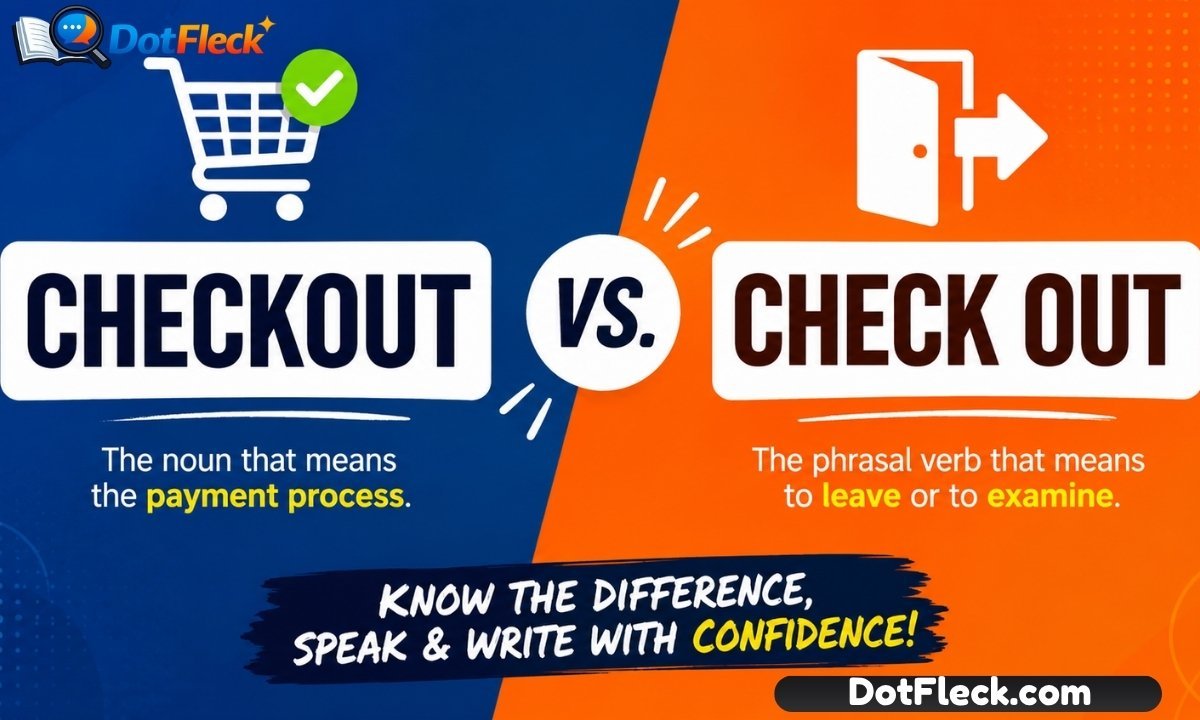
If you’ve ever paused mid-sentence wondering whether to write “Checkout vs Check Out,” you’re dealing with one of the most common mix-ups in American English. The confusion happens because both forms sound identical when spoken, but they belong to different parts of speech.
Here’s the short answer: “checkout” is a noun or adjective, and “check out” is a verb. Once you know which job the word is doing in your sentence, the choice becomes automatic.
The Quick Answer “Checkout vs Check Out”
Use checkout (one word) when you’re naming a thing, a place, a process, or a moment in time. Use check out (two words) when you’re describing an action something someone does.
- “I paid at the checkout.” (noun a place)
- “Please check out before noon.” (verb an action)
That single distinction solves almost every mistake people make with these two forms.
What Does “Checkout” Mean?
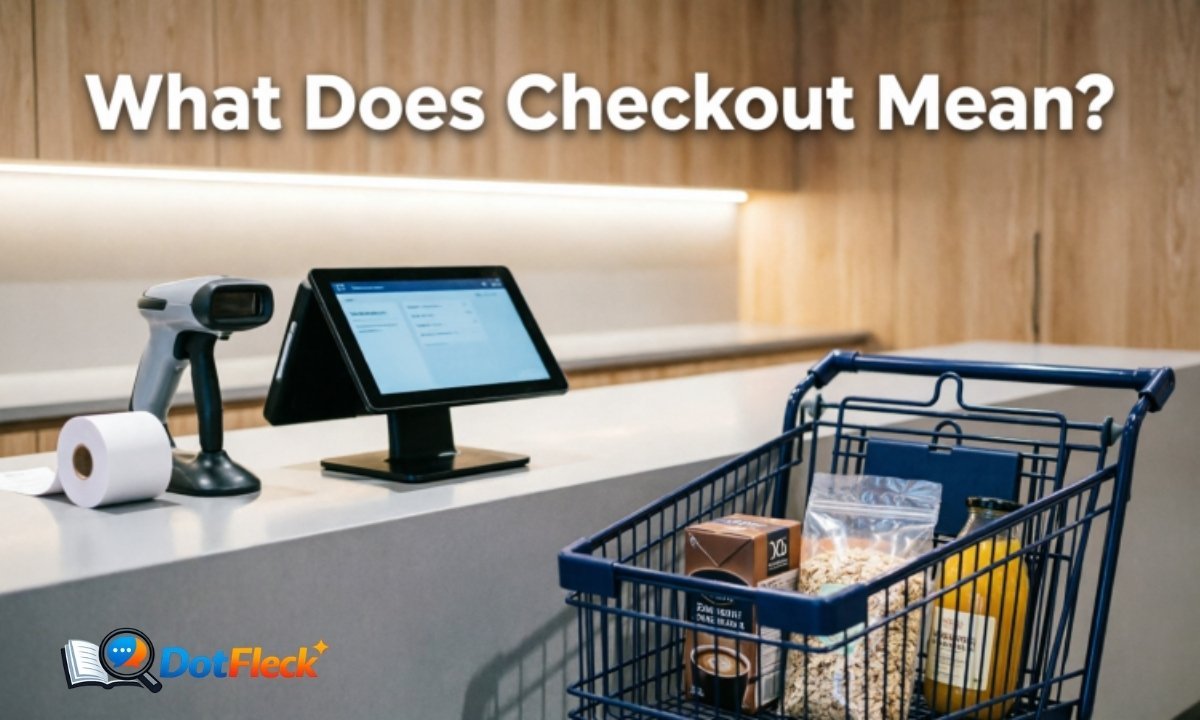
Checkout is a noun that refers to the point where a purchase is completed or where a stay ends. In a store, it’s the register or the line where you pay. In a hotel, it’s both the act of leaving and the deadline for doing so.
Checkout can also work as an adjective, describing a noun that follows it, such as “checkout counter,” “checkout page,” or “checkout time.” In every one of these cases, checkout is naming or describing something not doing something.
Examples:
- The grocery store had only one checkout open.
- Our hotel’s checkout time is 11 a.m.
- The website’s checkout process took less than a minute.
- She works the checkout counter on weekends.
What Does “Check Out” Mean?
Check out is a phrasal verb, meaning it’s made of a verb (“check”) plus a particle (“out”) that together create a new meaning. As a verb, it describes an action someone performs, and it always stays as two separate words.
Check out has a few related meanings depending on context:
- To complete a purchase or leave a hotel “We need to check out of our room by noon.”
- To examine or look at something “Check out this article before you reply.”
- To borrow something, especially from a library “I checked out three books today.”
- Informally, to stop paying attention “He checked out halfway through the meeting.”
Examples:
- Don’t forget to check out before the front desk closes.
- You should check out the new bakery on Main Street.
- I need to check out these library books before Friday.
- The cashier will check you out at register four.
Why the Confusion Happens “Checkout vs Check Out”
English speakers hear no real difference between “checkout” and “check out” in casual conversation, since the pause between the two words is subtle. The confusion grows because both forms share the same root idea completing a transaction or leaving a place so writers assume they’re interchangeable spellings of the same word.
They aren’t. The deciding factor isn’t meaning; it’s grammatical function. Ask yourself whether the word is naming something (noun/adjective) or doing something (verb). That question resolves the ambiguity every time.
Checkout vs Check Out: Quick Comparison Table
| Term | Part of Speech | Meaning | Typical Use | Example |
| Checkout | Noun / Adjective | A place, process, or deadline | Naming a thing | “The checkout line was long.” |
| Check out | Verb (phrasal) | To pay, leave, examine, or borrow | Describing an action | “Please check out by 11 a.m.” |
| Check-out | Noun (hyphenated variant) | Same as checkout, less common | Formal or British usage | “Hotel check-out is at noon.” |
A Simple Test to Choose the Right Form “Checkout vs Check Out”
If you’re still unsure which one fits, try this two-step test before you write the sentence:
- Can you replace the word with “payment,” “departure,” or “the register”? If yes, use checkout.
- Can you replace the word with “look at,” “examine,” or “leave”? If yes, use check out.
For example, “I’m heading to the checkout” works because you could say “I’m heading to the register.” But “I’m going to check out that movie” works because you could say “I’m going to look at that movie.” The substitution test removes the guesswork almost instantly.
Common Mistakes People Make “Checkout vs Check Out”
Mistake 1: Using “checkout” as a verb.
Incorrect: “Please checkout at the front desk.” Correct: “Please check out at the front desk.”
Since checkout is a noun, it can never perform an action in a sentence. If the word follows “please,” “will,” “can,” or any helping verb, it needs to be two words.
Mistake 2: Splitting “checkout” when it’s a noun or adjective.
Incorrect: “The check out line was too long.” Correct: “The checkout line was too long.”
Here, “checkout” describes the noun “line,” which makes it an adjective and adjectives formed this way stay as one word.
Mistake 3: Assuming hyphenation is required.
Incorrect: “Check-out my new project.” Correct: “Check out my new project.”
The hyphenated form, “check-out,” is sometimes used as an alternative noun spelling (especially in British or formal writing), but it should never replace the verb phrase “check out.”
A simple memory trick: If you can put “the” in front of the word and it still makes sense (“the checkout”), it’s the noun. If you can put “to” in front of it (“to check out”), it’s the verb.
Checkout vs Check Out in Real-Life Contexts

Online shopping “Checkout vs Check Out“: “Add the item to your cart, then proceed to checkout.” (noun) vs. “Check out these deals before they expire.” (verb)
Hotel stays “Checkout vs Check Ou“: “Checkout is at 11 a.m.” (noun) vs. “We need to check out early tomorrow.” (verb)
Workplace email “Checkout vs Check Out: “The new checkout system launches Monday.” (adjective + noun) vs. “Can you check out this document before the meeting?” (verb)
Text messages “Checkout vs Check Out“: : “omg check out this photo” (verb) vs. “line at the checkout is insane rn” (noun)
Across every context retail, travel, business writing, or casual texting the same rule applies without exception.
British English vs. American English
Both British and American English follow the identical grammar rule: checkout is a noun or adjective, and check out is a verb.
The only stylistic difference is that British writing uses the hyphenated form “check-out” slightly more often for the noun, while American English overwhelmingly prefers the closed, one-word spelling “checkout.” Neither region ever treats “checkout” as an acceptable verb form.
Related Forms Worth Knowing “Checkout vs Check Out”
A few related expressions follow the same noun-versus-verb logic:
- Login (noun/adjective) vs. log in (verb) “Enter your login” vs. “Please log in.”
- Setup (noun/adjective) vs. set up (verb) “Check the setup” vs. “Set up the account.”
- Signup (noun/adjective) vs. sign up (verb) “Complete the signup” vs. “Sign up today.”
Recognizing this pattern makes it much easier to handle similar word pairs correctly in the future.
Frequently Asked Questions “Checkout vs Check Out”
Is “checkout” one word or two?
Checkout is one word when it functions as a noun or an adjective, such as “checkout counter” or “hotel checkout.” It becomes two words, “check out,” only when it’s used as a verb describing an action, like “check out of your room.”
What is the difference between checkout and check out?
Checkout names a place, process, or deadline (a noun or adjective), while check out describes the act of paying, leaving, examining, or borrowing something (a verb). For example, “The checkout was fast” describes a thing, while “I need to check out now” describes an action.
Is “check-out” with a hyphen ever correct?
Yes, “check-out” is an accepted hyphenated variant of the noun form, most common in British and formal writing, as in “hotel check-out.” It should not be used for the verb phrase “check out.”
Why do people confuse checkout and check out so often?
The two forms sound almost identical in speech, and they relate to the same general idea of completing a purchase or leaving a location. The confusion disappears once you identify whether the word is naming something or performing an action in the sentence.
The Bottom Line “Checkout vs Check Out”
Choosing between checkout and check out comes down to one question: is the word naming something, or is it doing something? Checkout labels a place, process, or point in time. Check out describes the action of paying, leaving, examining, or borrowing.
Keep that distinction in mind, run the quick substitution test when you’re unsure, and you’ll spell it correctly every time whether you’re writing a hotel email, building an e-commerce page, or texting a friend about a great new restaurant.

Ethan Whitmore is an English language writer who enjoys making grammar, word meanings, and modern slang simple and easy to understand. His content focuses on clear explanations, practical examples, and everyday English usage.