
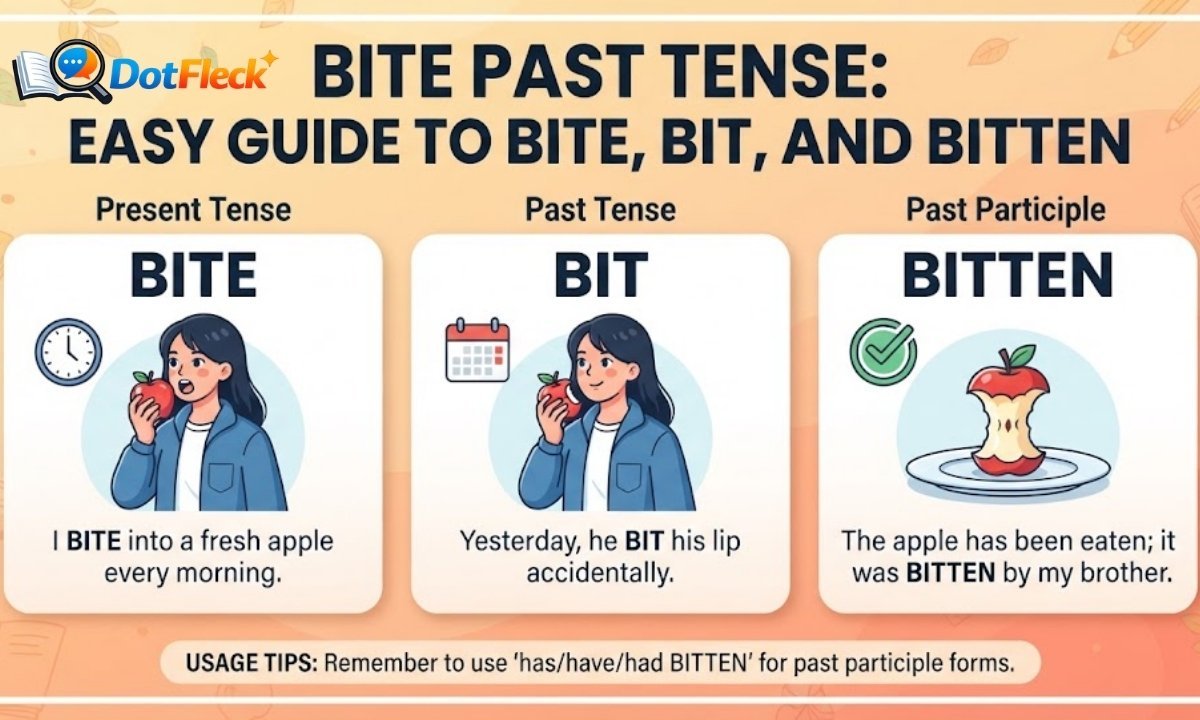
If you’re wondering about the past tense of bite, the correct answer is bit. The verb bite is irregular, so it does not become “bited” in the past tense.
Here’s the simple pattern to remember:
Bite → Bit → Bitten
- Bite = present/base form
- Bit = simple past
- Bitten = past participle
Once you understand when to use each form, this common English verb becomes much easier.
What Is the Past Tense of Bite?
The past tense of bite is “bit.”
For example:
“The dog bit my hand.”
The action happened in the past, so bit is the correct form.
You should not say:
❌ “The dog bited my hand.”
Instead, use:
✅ “The dog bit my hand.”
“Bite” is an irregular verb, which means its past form does not follow the usual -ed pattern used by regular verbs.
Bite Verb Forms at a Glance
| Verb Form | Correct Word | Example |
| Base form | bite | Dogs can bite. |
| Simple past | bit | The dog bit me. |
| Past participle | bitten | The dog has bitten me. |
| Present participle | biting | The dog is biting the toy. |
| Third-person singular | bites | The dog sometimes bites. |
The three forms most English learners need to remember are:
Bite → Bit → Bitten
What Does “Bite” Mean?
Bite means to use your teeth to cut, hold, grip, or break something. It can describe people, animals, insects, and sometimes objects or situations.
For example:
- “Be careful because the dog might bite.”
- “I sometimes bite my nails.”
- “Mosquitoes bite people.”
- “The baby tried to bite the toy.”
The meaning stays related to the action, but the verb form changes depending on the tense and sentence structure.
When to Use “Bite”
Use bite as the base or present form of the verb.
You’ll commonly use bite when talking about something happening now, something that happens regularly, or something that may happen in the future.
Examples
- “Some dogs bite when they are scared.”
- “Be careful not to bite your tongue.”
- “The puppy may bite the toy.”
- “Mosquitoes bite more often during warm weather.”
You can also use bite after modal verbs such as:
- can
- could
- may
- might
- will
- should
For example:
“The dog might bite.”
Not:
❌ “The dog might bit.”
When to Use “Bit”
Use bit when talking about an action that happened in the past.
Because bit is the simple past form of bite, it can stand on its own without an auxiliary verb such as “has” or “have.”
Examples
- “The dog bit the mail carrier.”
- “I bit my lip yesterday.”
- “She bit into the apple.”
- “A mosquito bit my arm.”
- “The puppy bit my shoe.”
A useful clue is a completed past-time expression such as yesterday, last night, last week, earlier, or a few minutes ago.
For example:
“I bit my tongue yesterday.”
| Don’t Miss These Articles |
| Say vs Said: Discover the Key Difference |
| FYP Meaning in Text |
When to Use “Bitten”
Bitten is the past participle of bite. It is usually used with an auxiliary verb, especially has, have, or had.
Examples
- “The dog has bitten several people.”
- “I have never been bitten by a snake.”
- “She had bitten into the sandwich before she noticed the filling.”
- “He has bitten his nails for years.”
“Bitten” is also common in the passive voice:
“She was bitten by a mosquito.”
Here, was bitten is correct.
Bite vs. Bit vs. Bitten
The easiest way to understand the difference is to look at how each form works in a sentence.
| Word | Main Use | Example |
| Bite | Present/base form | “Dogs can bite.” |
| Bit | Simple past | “The dog bit me.” |
| Bitten | Past participle | “The dog has bitten me.” |
Think of the pattern this way:
Today → bite
Yesterday → bit
Has/have/had → bitten
This simple pattern can help you choose the correct form quickly.
Is “Bited” a Word?
In standard modern English, “bited” is not the correct past tense of bite.
The correct past tense is:
bite → bit
So write:
❌ “The dog bited him.”
Instead:
✅ “The dog bit him.”
The reason is that bite is an irregular verb. Its past form changes instead of simply adding -ed.
Bit or Bitten: Which One Is Correct?
Both bit and bitten are correct English words, but they serve different grammatical purposes.
Use bit for the simple past:
“The dog bit me yesterday.”
Use bitten as the past participle:
“The dog has bitten me before.”
A quick comparison:
- I bit my lip. → simple past
- I have bitten my lip before. → past participle
The word following an auxiliary verb is an important clue.
Common Mistakes With Bite
1. Using “bited” instead of “bit”
Incorrect:
❌ “The puppy bited my shoe.”
Correct:
✅ “The puppy bit my shoe.”
2. Using “bit” after “has”
Incorrect:
❌ “The dog has bit me.”
Correct:
✅ “The dog has bitten me.”
3. Using “bitten” as the simple past
Incorrect:
❌ “The dog bitten me yesterday.”
Correct:
✅ “The dog bit me yesterday.”
4. Using “bit” after “have”
Incorrect:
❌ “I have bit my tongue.”
Correct:
✅ “I have bitten my tongue.”
Remember:
Simple past = bit
Past participle = bitten
Bite in Everyday American English
You’ll hear and see all three forms frequently in everyday American English.
At Home
- “I bit my tongue while eating.”
- “The baby likes to bite toys.”
- “He has bitten his nails again.”
Around Animals
- “The dog might bite if you get too close.”
- “The puppy bit my shoe.”
- “She has been bitten by a dog before.”
Outdoors
- “A mosquito bit me last night.”
- “Some insects can bite.”
- “I’ve been bitten by mosquitoes all summer.”
In Stories
- “The wolf bit the hunter.”
- “The vampire had bitten his neck.”
- “The creature might bite if it feels threatened.”
Bite in Different Tenses
Understanding the other forms of bite can make the past tense easier to remember.
Present
“Dogs sometimes bite.”
Simple Past
“The dog bit me.”
Present Perfect
“The dog has bitten me before.”
Past Perfect
“The dog had bitten him before the owner arrived.”
Present Continuous
“The puppy is biting the toy.”
Future
“The dog may bite if you bother it.”
Notice how bit and bitten have different grammatical jobs.
How to Remember Bite, Bit, and Bitten
Use this simple three-word pattern:
Bite → Bit → Bitten
Then connect each form to a time or grammar clue:
- Bite → present/base form
- Bit → completed past action
- Bitten → used with helping verbs such as has, have, and had
For example:
I bite.
I bit.
I have bitten.
Practicing these three sentences aloud can make the pattern easier to remember.
Quick Grammar Test
Choose the correct word in each sentence.
- “The dog ___ me yesterday.”
- “The dog has ___ me before.”
- “Some dogs may ___ strangers.”
- “I have never been ___ by a snake.”
Answers
- bit
- bitten
- bite
- bitten
The pattern is consistent:
Past = bit
Past participle = bitten
FAQ About the Past Tense of Bite
What is the past tense of bite?
The past tense of bite is bit.
Example:
“The dog bit my hand.”
What is the past participle of bite?
The past participle is bitten.
Example:
“The dog has bitten my hand before.”
Is “bited” correct?
No. Bited is not the standard past-tense form of bite. Use bit instead.
Is bite a regular or irregular verb?
Bite is an irregular verb because its simple past form is bit, rather than “bited.”
What is the difference between bit and bitten?
Bit is the simple past form, while bitten is the past participle.
- “She bit the apple.”
- “She has bitten the apple.”
Can I say “has bit”?
In standard American English, use has bitten rather than “has bit.”
Correct: “He has bitten his nails.”
What is the past tense of “bite” in American English?
In American English, the simple past is bit, and the past participle is bitten.
What is the easiest way to remember bite, bit, and bitten?
Remember:
Bite = present
Bit = past
Bitten = past participle
Final Answer
The correct forms of bite are:
- Bite — base/present form
- Bit — simple past
- Bitten — past participle
- Biting — present participle
The most important rule is:
Bite → Bit → Bitten
So if you’re talking about something that happened yesterday, use bit:
“The dog bit me yesterday.”
If you’re using has, have, or had, use bitten:
“The dog has bitten me before.”
And remember: “bited” is not the standard English form.

Ethan Whitmore is an English language writer who enjoys making grammar, word meanings, and modern slang simple and easy to understand. His content focuses on clear explanations, practical examples, and everyday English usage.