
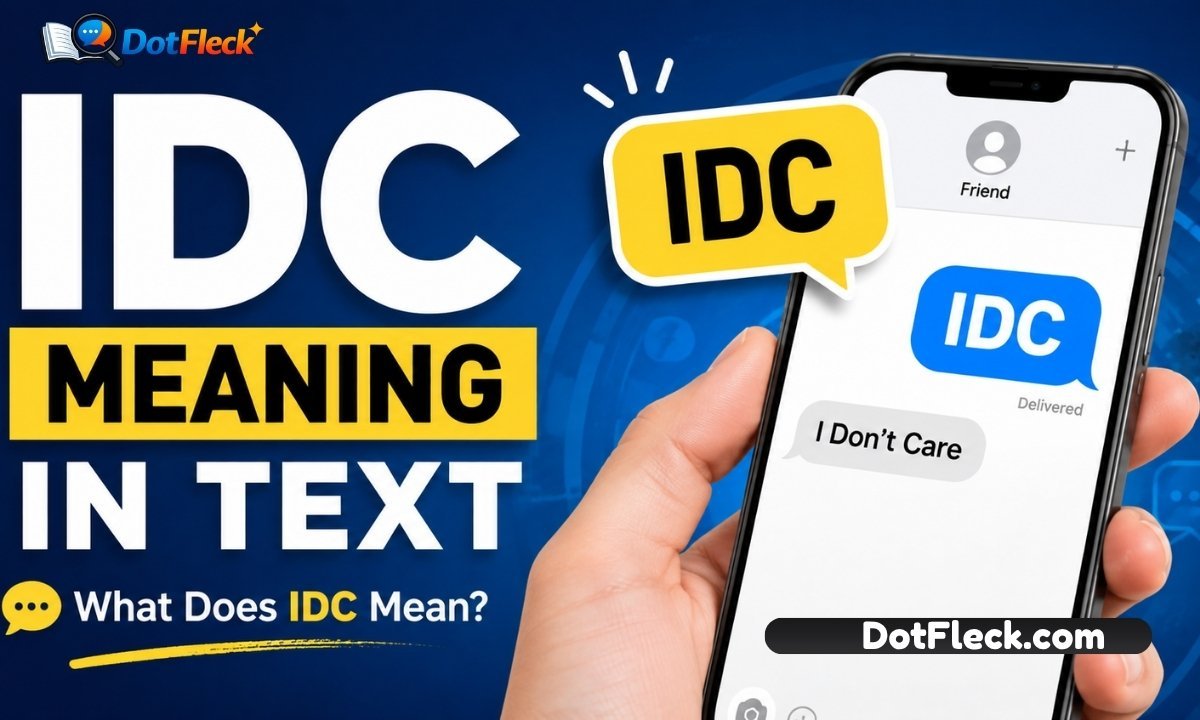
IDC in text means “I don’t care.” It’s a quick way to show you’re indifferent about something, whether that’s a decision, a plan, or someone’s opinion. The tone can be genuinely relaxed, mildly annoyed, or even a little sarcastic, depending on who sends it and when.
Quick Answer
IDC = I Don’t Care
It shows up in texts, DMs, and comments when someone wants to signal indifference fast, without typing the full phrase. The real meaning almost always depends on context and the relationship between the people texting.
What IDC Actually Means in Everyday Texting
At its core, IDC is just a shortcut. People type it because it’s faster than “I don’t care” and it fits naturally into casual conversation.
But abbreviations like this rarely have one fixed emotional weight. A friend texting “idc, you pick the movie” is being easygoing. Someone replying “idc anymore” after an argument is expressing frustration or emotional distance.
That gap between the literal words and the actual feeling behind them is where most confusion happens. Reading the conversation before the message usually tells you more than the abbreviation itself.
IDC Meaning From a Girl
When a girl sends IDC, it’s often less about the specific topic and more about avoiding conflict or keeping things low pressure. If she’s replying to “what do you want to eat,” it’s probably genuine, she just doesn’t have a preference.
If IDC shows up after a question about feelings, plans, or where things stand between two people, it can carry more weight. It might mean she’s holding back, feels hurt, or wants the other person to make the first move instead.
Tone matters here more than the abbreviation. “idc lol” reads very differently than a flat “idc.” with no punctuation softening it.
IDC Meaning From a Guy
Guys tend to use IDC the same way, mostly to keep things simple. Asked to choose between two restaurants or two plans, “idc” usually just means he’s fine either way.
Where it gets trickier is in emotionally loaded conversations. A guy typing IDC when asked about a relationship issue might genuinely be neutral, or he might be shutting down the conversation because he doesn’t want to deal with it at that moment.
One thing worth noting from actual texting patterns: guys are slightly more likely to pair IDC with humor or a follow up joke to soften it, while a terse, standalone “idc” is more often a sign the topic is closed for now.
IDC in Medical Terms
Outside of texting, IDC has a completely different meaning in healthcare. It most commonly stands for Invasive Ductal Carcinoma, a type of breast cancer that begins in the milk ducts and spreads into surrounding tissue. It’s actually the most common form of breast cancer diagnosed.
In some clinical settings, IDC can also refer to an Indwelling Catheter, a device left in place for ongoing drainage or medication delivery.
If you see IDC in a medical report or doctor’s note, it almost certainly has nothing to do with texting slang. Context clears this up immediately, since medical use and casual texting rarely overlap.
IDC on Instagram and Social Media
On Instagram, TikTok, and similar platforms, IDC shows up in captions, comments, and bios. It’s used the same way as in texts, mostly to project a relaxed or unbothered attitude.
A caption like “idc what people think” is a fairly common way to express confidence or distance from criticism. In comment sections, it often responds to debates or opinions someone doesn’t want to engage with further.
It’s worth noting that on social media, IDC leans slightly more performative than in a private text. People sometimes use it publicly to signal a mood rather than to describe an actual internal state.
Where the Abbreviation Comes From
There’s no single documented origin for IDC. It emerged the same way most texting abbreviations did, through the shift to SMS and instant messaging in the early 2000s, when character limits and typing speed pushed people toward shorthand.
It sits in the same family as IDK (I don’t know), NVM (never mind), and IDGAF, all of which trimmed common phrases down for faster typing. IDC simply stuck around because “I don’t care” comes up constantly in everyday conversation.
Real Conversation Examples
Casual and genuine: Friend: “Pizza or tacos tonight?” You: “idc, both sound good”
Slightly annoyed: “You still mad about earlier?” “idc anymore, it’s fine”
Group chat, low stakes: “What time should we meet tomorrow?” “idc whenever works for everyone else”
More emotionally loaded: “Are we still doing this or not?” “idc, do whatever you want”
Notice how the same three letters shift meaning depending on the question and the punctuation around them. That’s the pattern to watch for, not the abbreviation in isolation.
When to Use IDC and When to Avoid It
IDC works well in low stakes situations where you genuinely have no preference. Picking a restaurant, choosing a time, deciding on background music for a group hangout, these are all fine spots for it.
It works less well in serious conversations. Texting IDC in response to something emotionally important can come across as dismissive, even if that’s not the intent. If a friend shares bad news or asks for real input on a decision, a flat “idc” can land as careless.
A useful rule: if the question took the other person effort or vulnerability to ask, IDC is usually the wrong reply, even when it’s technically true.
Common Mistakes People Make With IDC
One mistake is assuming IDC always means total indifference. Often it’s a way to avoid conflict rather than a genuine lack of opinion, especially in relationships or family group chats.
Another common issue is missing tone shifts. People read IDC as always neutral or always rude, when really the surrounding words and punctuation change everything.
A mistake that’s gotten more common recently is using IDC in professional messaging, like a work Slack or a client email thread. It reads as unprofessional fast, even when meant lightly, since workplace communication generally expects more clarity than texting shorthand.
Similar Texting Abbreviations
| Abbreviation | Meaning |
| IDK | I don’t know |
| IDGAF | I don’t give a f*** |
| NVM | Never mind |
| TBH | To be honest |
| IMO | In my opinion |
| SMH | Shaking my head |
These abbreviations often appear together in the same conversations, since they all serve the same purpose of keeping casual texting fast and low effort.
Frequently Asked Questions
Does IDC always mean someone is upset?
No. Most of the time IDC just means genuine indifference about something small, like food choices or plans. It only signals frustration when it follows a tense or emotional question, so context matters more than the letters themselves.
Is IDC rude to send?
It depends entirely on the situation. In casual, low stakes conversations it’s completely normal. In serious or emotional conversations, it can come across as dismissive even if that wasn’t the intention behind it.
What’s the difference between IDC and IDK?
IDC means “I don’t care,” showing indifference. IDK means “I don’t know,” showing a lack of information. They get mixed up sometimes because both are short, casual, and often typed quickly without much thought.
Can IDC mean something other than “I don’t care”?
In texting, no, IDC almost always means “I don’t care.” Outside of texting, particularly in medical contexts, IDC can stand for Invasive Ductal Carcinoma or Indwelling Catheter, which have nothing to do with the slang usage.
Why do people use IDC instead of typing the full phrase?
It’s faster and fits the casual, low effort tone of texting and social media. Abbreviations like this became common once messaging shifted to mobile devices, where quick replies matter more than full sentences.
Final Thoughts
IDC is one of those abbreviations that seems simple on the surface but shifts meaning constantly depending on who’s typing it and why. Reading it correctly usually comes down to context, tone, and the conversation leading up to it, not the three letters alone.
Whether it shows up in a group chat, an Instagram comment, or a medical chart, the safest approach is the same: look at where it’s coming from before deciding what it actually means.

Ethan Whitmore is an English language writer who enjoys making grammar, word meanings, and modern slang simple and easy to understand. His content focuses on clear explanations, practical examples, and everyday English usage.