
YN in text usually stands for “Your Name,” used as a placeholder in stories, roleplay, and templates so the reader can mentally swap in their own name.
You’ll also see it written as Y/N. Less often, especially in quick chats or polls, YN is shorthand for “yes/no.” The right meaning almost always depends on where you saw it.
Quick Answer
| Context | What YN Means |
| Fanfiction, Wattpad, roleplay | “Your Name” or “Y/N” (reader insert placeholder) |
| Texting, group chats, surveys | “Yes/No” |
| Character sheets, forms | “Yes/No” field |
| TikTok, Twitter/X captions | Usually “Your Name” |
If you’re not sure which one applies, look at the sentence. If it reads like a story addressing you directly, it’s “Your Name.” If it’s asking for a decision or confirmation, it’s “yes/no.”
Read Slang : PMO Meaning in Text
Where the “Your Name” Meaning Comes From
This use of YN grew out of fanfiction communities, especially on sites like Wattpad and Archive of Our Own. Writers create “reader insert” stories where the main character is left blank on purpose, so anyone reading can imagine themselves as the protagonist. Instead of typing out a made-up name every time, authors write Y/N or YN as a stand-in.
A typical line might read: “YN looked up at him and smiled.” The reader is meant to picture their own name in that spot. Some writers even format it so readers can plug in a name digitally, which is where “Y/N generator” tools came from.
This habit spread beyond fanfiction. It shows up in Discord roleplay servers, TikTok skits, and even meme templates where someone wants the audience to feel personally addressed. When people type “yn” casually in captions or comments, they’re borrowing that same self-insert idea, just without the slash.
Read Also : PSA Meaning in Text
The “Yes or No” Meaning
Outside of fandom spaces, YN is a much older and simpler abbreviation. It just means yes/no, the same way you’d see Y/N on a printed form asking you to circle one option.
You’ll run into this version in:
- Text polls (“Coming tonight? YN”)
- Spreadsheets and databases as a column header
- Quick group chat check-ins
- Customer forms or surveys
This meaning has nothing to do with storytelling. It’s purely functional, a fast way to request or record a binary answer.
Real Examples of Each Meaning
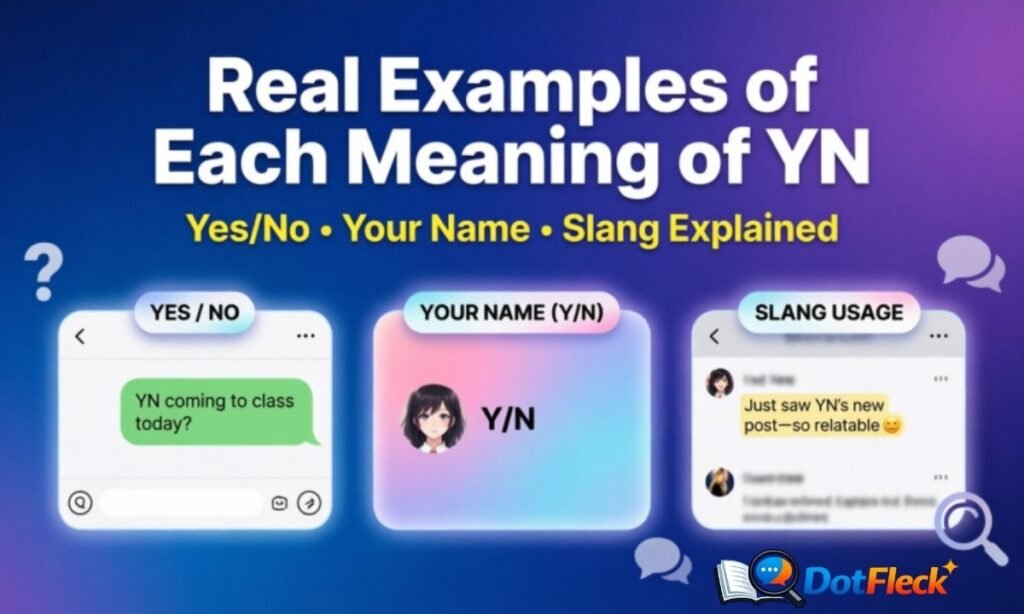
Story or roleplay context: “YN walked into the room and everyone went silent.” “He grabbed YN’s hand before she could leave.”
Yes/No context: “Can you make it to the meeting? YN” “Field 4: Attended (YN)”
Casual texting context (borrowed from fandom): “POV: YN just found out the truth 😭” “tag urself as YN in this scenario”
Notice how the story version treats YN almost like a name itself, capitalized and used as a subject in the sentence. The yes/no version usually sits at the end of a question or inside brackets, more like a label than a character.
Read More : FR Meaning in Text
When to Use It (and When Not To)
Using YN as “Your Name” works well in casual, creative writing where you want the reader to feel like part of the story. It’s common in fan communities, so people there will instantly understand it. Outside those spaces, though, it can come across as confusing or even like a typo, since most people outside fandom culture haven’t seen this convention.
Using YN for “yes/no” is safe almost anywhere informal, like texts between friends or quick internal notes. It’s not something you’d want in a formal email or a professional document, where spelling out “yes or no” avoids any ambiguity.
A small thing most guides skip: context clues matter more than the letters themselves. If someone texts you “YN?” after asking about weekend plans, that’s yes/no. If a friend sends you a TikTok caption starting with “YN,” they’re probably tagging you into a roleplay scenario, not asking a question at all. Reading the sentence around it, not just the abbreviation, is the fastest way to avoid misreading it.
Common Mistakes People Make

One mix-up happens when someone new to fandom spaces sees “Y/N” in a story and assumes it’s an actual character’s name, only to get confused later when it clearly stands for a blank. Another common slip is writing “YN” in a professional or academic message meant to mean yes/no, not realizing how informal it is.
There’s also a newer wrinkle. Some AI chatbot platforms and roleplay apps now auto-fill YN with the user’s actual display name, which has made the term spread to people who never touched fanfiction in their life. If you’ve seen YN pop up in an AI chat app and wondered why, that’s likely why. The placeholder function is the same, it’s just automated now instead of left for the reader to imagine.
Read Also : FYP Meaning in Text
Related and Similar Terms
- Y/N – the slash version of the same reader insert placeholder
- Self-insert – broader fandom term for stories where the reader becomes a character
- Reader insert – the genre name for YN-style fanfiction
- OC – “original character,” the opposite idea, a fully defined character rather than a blank
- POV – often paired with YN in captions (“POV: YN is late again”)
- Fill-in-the-blank – the general concept YN is built on
- Yes/No field – the formal version of the abbreviation on forms
Frequently Asked Questions
Does YN always mean “Your Name”?
No. It depends on context. In fanfiction, roleplay, or story-style captions, it almost always means “Your Name.” In texting, forms, or quick questions, it’s more likely shorthand for yes/no. The surrounding sentence usually makes it clear which one applies.
Is Y/N the same as YN?
Yes, they’re the same idea written two ways. Y/N with a slash is more common in formal fanfiction writing, while YN without the slash shows up more in casual texting, captions, and comments.
Why do people use YN instead of a real name in stories?
It lets any reader imagine themselves as the main character instead of a specific, named person. This is the whole point of reader insert fiction, and it’s a big part of why these stories feel personal to fans.
Can YN mean something else entirely?
Occasionally. In some niche contexts it can stand for other short phrases, but “Your Name” and “yes/no” cover the vast majority of everyday uses in texts, comments, and captions.
Is it rude or weird to use YN in a normal conversation?
Not rude, just potentially confusing. If you’re texting someone unfamiliar with fandom slang, they might not immediately understand the “Your Name” meaning. Sticking to the yes/no meaning is usually safer in mixed or professional group chats.
Wrapping It Up
YN isn’t one fixed abbreviation with a single dictionary definition, it shifts depending on where you’re reading it. In fanfiction and roleplay spaces, it’s a placeholder standing in for whoever’s reading.
In everyday texting or forms, it’s just a fast way to ask yes or no. Once you know both meanings, spotting which one applies takes a second, not a guessing game.

Ethan Whitmore is an English language writer who enjoys making grammar, word meanings, and modern slang simple and easy to understand. His content focuses on clear explanations, practical examples, and everyday English usage.