
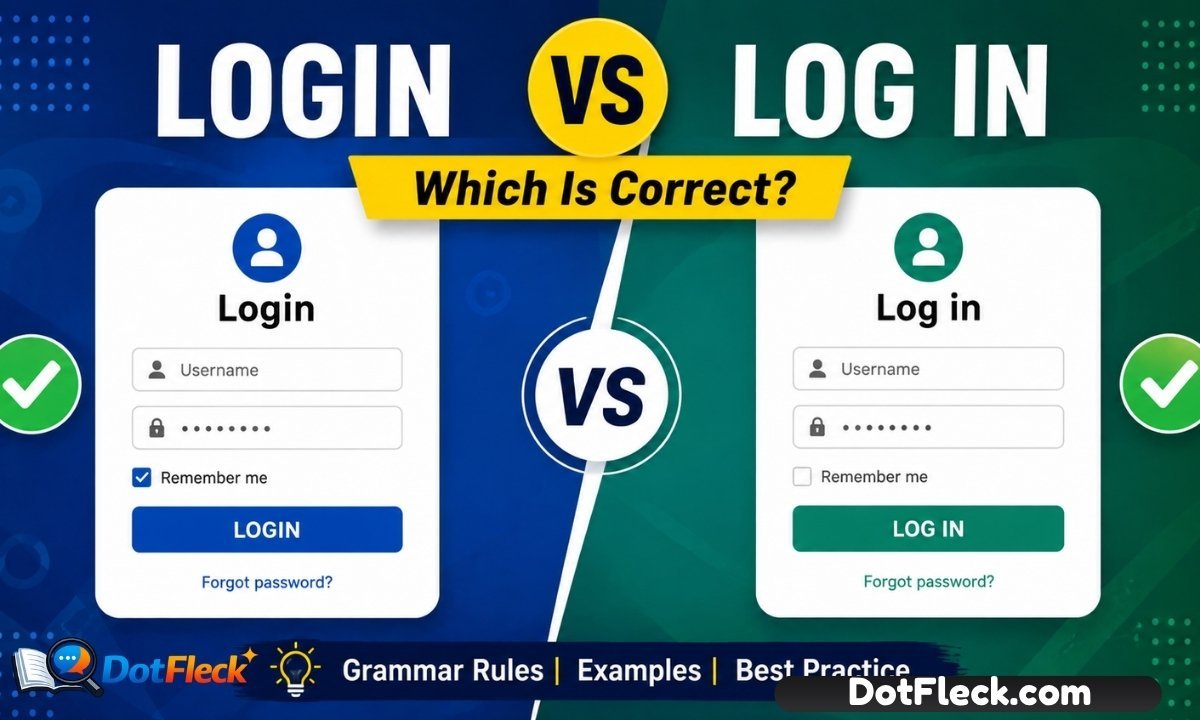
If you’ve ever paused mid-sentence wondering whether to write “click the login” or “please log in,” you’re not alone. The confusion is understandable because both forms look almost identical and both relate to the same basic action: accessing an account. Here’s the short answer: “login” is a noun or adjective, while “log in” is a verb. Once you know which job the word is doing in your sentence, the choice becomes automatic.
The Quick Answer “Login vs. Log In”
Login (one word) names a thing your username and password, or the screen where you enter them. Log in (two words) describes an action: the act of entering your credentials to access a system.
Think of it like this: you use your login to log in. The noun is the tool; the verb is the task.
What “Login” Means

As a noun, login refers to the credentials a username, email, or password combination that let you into a restricted system. It’s what.
- “I forgot my login for the payroll portal.”
- “Enter your login below to continue.”
As an adjective, login describes something related to that access process, most often a page, screen, or button.
- “The login page keeps timing out.”
- “Click the login button in the top right corner.”
Notice that in both roles, login is a single, solid word with no space and no hyphen in standard American usage.
What “Log In” Means
Log in is a phrasal verb, a verb (“log”) paired with a preposition (“in”) that together create a new meaning. It describes the action of entering a system, not the credentials themselves.
- “Please log in before 9 a.m. to join the meeting.”
- “I can’t log in because the site is down.”
Because it’s a verb, “log in” changes form depending on tense, just like any other verb: logging in, logged in, logs in.
- “She logged in five minutes late.”
- “He’s logging in from his phone right now.”
Why People Mix Them Up “Login vs. Log In”
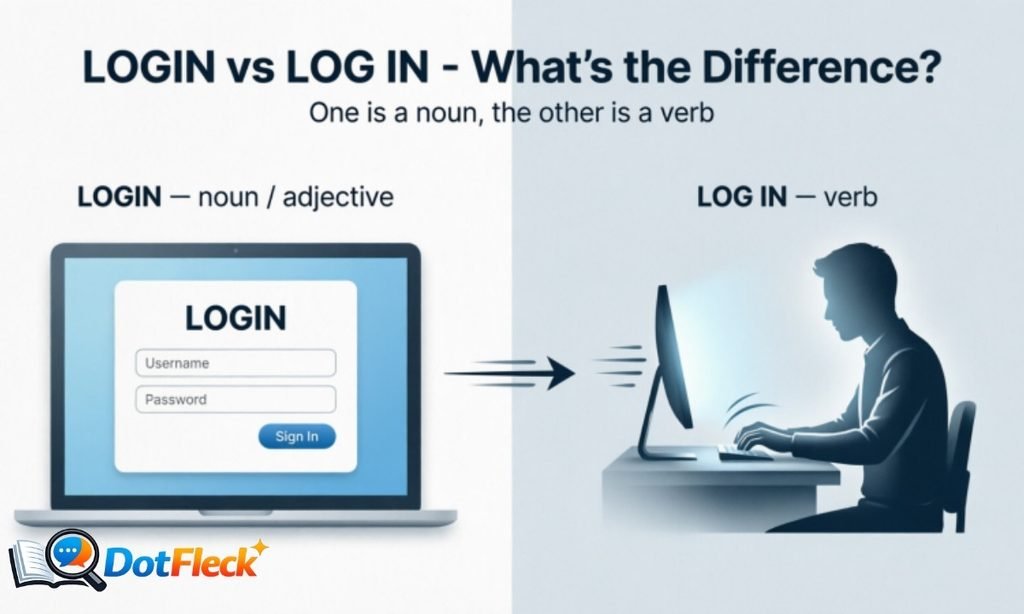
The confusion isn’t really about spelling, it’s about grammar. Both words trace back to the same root idea, and English speakers naturally shorten verb phrases into single-word nouns over time (think “workout” from “work out,” or “setup” from “set up”). “Login” followed that exact pattern as computing became part of everyday life in the 1980s.
Because the noun and the verb sound almost the same when spoken, and because software interfaces often abbreviate labels (“Login” as a button, “Log In” as an instruction), readers absorb both forms without ever learning which one is grammatically correct in which spot. The result is a word pair that looks interchangeable but isn’t.
Login vs. Log In: Quick Comparison Table
| Term | Part of Speech | Meaning | Typical Use | Example |
| Login | Noun / Adjective | The credentials or the access screen | Labeling a field, button, or page | “Reset your login.” |
| Log in | Verb (phrasal) | The act of entering a system | Giving an instruction or describing an action | “Log in to view your account.” |
| Logged in | Verb (past tense/participle) | Already signed into a system | Describing a completed action or current state | “You’re already logged in.” |
| Log-in | Informal noun variant | Same as “login” | Occasionally seen in older or hyphenated style guides | “Type your log-in here.” |
Most current American style guides, including AP Style, favor the closed form login for the noun and skip the hyphen entirely.
How to Tell Which One You Need “Login vs. Log In”
Here’s a simple test you can run in three seconds: Ask whether the word is doing something or naming something.
- If it’s naming a thing, credentials, a screen, a button, use login.
- If it’s describing an action someone performs typing in a username and clicking submit use log in.
- If you can replace the word with another verb, like “enter” or “connect,” you need log in.
- If you can replace it with another noun, like “password” or “account,” you need login.
A quick memory trick: login looks like one solid word because it is one solid thing your credentials. Log in stays two words because it takes two steps: the act of logging, plus in.
Real-Life Examples in Context “Login vs. Log In”
Everyday conversation: Correct: “I can’t remember my login for the Wi-Fi.” Incorrect: “I can’t remember my log in for the Wi-Fi.” Why it’s wrong: The sentence needs a noun (the credentials), not a verb.
Workplace email: Correct: “Please log in to the shared drive before the meeting.” Incorrect: “Please login to the shared drive before the meeting.” Why it’s wrong: “Log in” here is an instruction to act, so it needs the verb form.
Text message: Correct: “Just logged in, give me a sec.” Incorrect: “Just logins, give me a sec.” Why it’s wrong: “Logins” as written isn’t a verb form at all; the sentence needs the past tense of “log in.”
Formal writing: Correct: “Users must complete the login process within ten minutes.” Incorrect: “Users must complete the log in process within ten minutes.” Why it’s wrong: “Process” is a noun being described, so it needs the adjective form, login.
Common Mistakes to Avoid “Login vs. Log In”
The most frequent error is using login where a verb is needed, especially in instructions like buttons, error messages, and how-to guides. “Login here” technically tells the reader to do something with a noun, which doesn’t work grammatically. It should read “Log in here.”
The second most common mistake goes the other way: writing log in where a noun is required, such as “My log in isn’t working.” Since credentials are being described, the correct word is “login.”
A smaller but real source of confusion is the hyphenated form log-in. It shows up in older publications and some British English writing, but it’s largely fallen out of favor in current American usage. Stick with the solid noun login and the two-word verb log in, and you’ll match what most style guides and tech companies use today.
Login vs. Log In vs. Log On
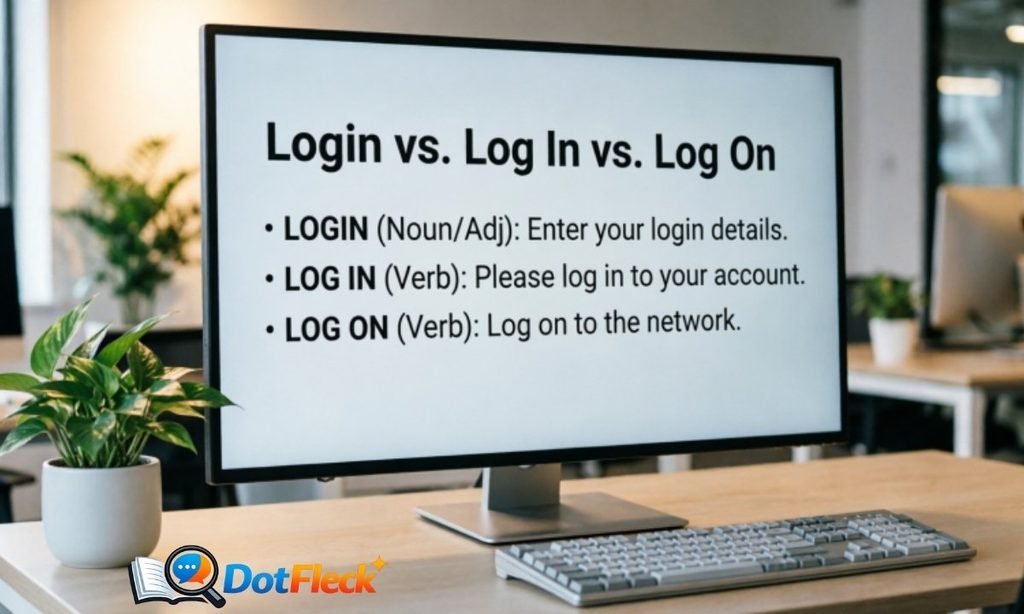
You may also see log on used interchangeably with log in, particularly in Windows and older enterprise software. The two verbs mean the same thing connecting to a computer system and the choice is mostly a matter of platform convention rather than grammar. Apple and most modern web apps favor “log in,” while some Microsoft products still use “log on.” Either is acceptable; just stay consistent within the same piece of writing.
Login vs. Log In: Formal and Informal Usage
In casual writing, such as texts or social media, small slips between login and log in rarely cause real confusion because context fills the gap. In professional and academic writing, though, the distinction matters more. Style guides used by tech companies, UX writers, and editors treat this as a real grammar rule, not a stylistic preference, because interface instructions need to be unambiguous. A button that says “Login” instead of “Log In” is a small thing, but it signals attention to detail or the lack of it.
Practical Guidance for Writers “Login vs. Log In”
If you’re drafting anything with a call to action, a button label, an email instruction, a help article, pause and ask whether you’re telling someone to act or naming something they’ll use. Buttons that trigger an action (“Log In”) should use the verb form. Labels for a field or link (“Login” or “Username”) should use the noun form.
When editing your own writing, search your document for every instance of “login” and “log in,” then check each one against the noun-or-verb test above. This single pass catches the vast majority of errors, since most writers use one form correctly out of habit and slip only occasionally with the other.
FAQs “Login vs. Log In”
Is “login” one word or two?
As a noun or adjective, login is always written as one word with no space or hyphen in standard American English. It only becomes two words when it’s functioning as a verb: “log in.”
Which is correct on a website button: “Login” or “Log In”?
Since a button triggers an action, the grammatically correct label is “Log In.” Many websites still use “Login” as a button label, and readers understand it either way, but it isn’t strictly correct grammar.
Is “log-in” with a hyphen ever correct?
The hyphenated form log-in was more common in earlier decades and still appears in some British and older American publications. Current US style guides generally prefer the solid noun login without a hyphen.
What’s the difference between “log in” and “sign in”?
They’re functionally the same action entering credentials to access an account and both are correct verb phrases. “Log in” has stronger ties to computing history, while “sign in” is often used for lighter, consumer-facing apps, but neither is more grammatically correct than the other.
The Bottom Line “Login vs. Log In”
Login is a noun or adjective naming your credentials or the access screen. Log in is a verb describing the act of entering them. Test each sentence by asking whether the word names something or does something, and you’ll never mix them up again.

Ethan Whitmore is an English language writer who enjoys making grammar, word meanings, and modern slang simple and easy to understand. His content focuses on clear explanations, practical examples, and everyday English usage.