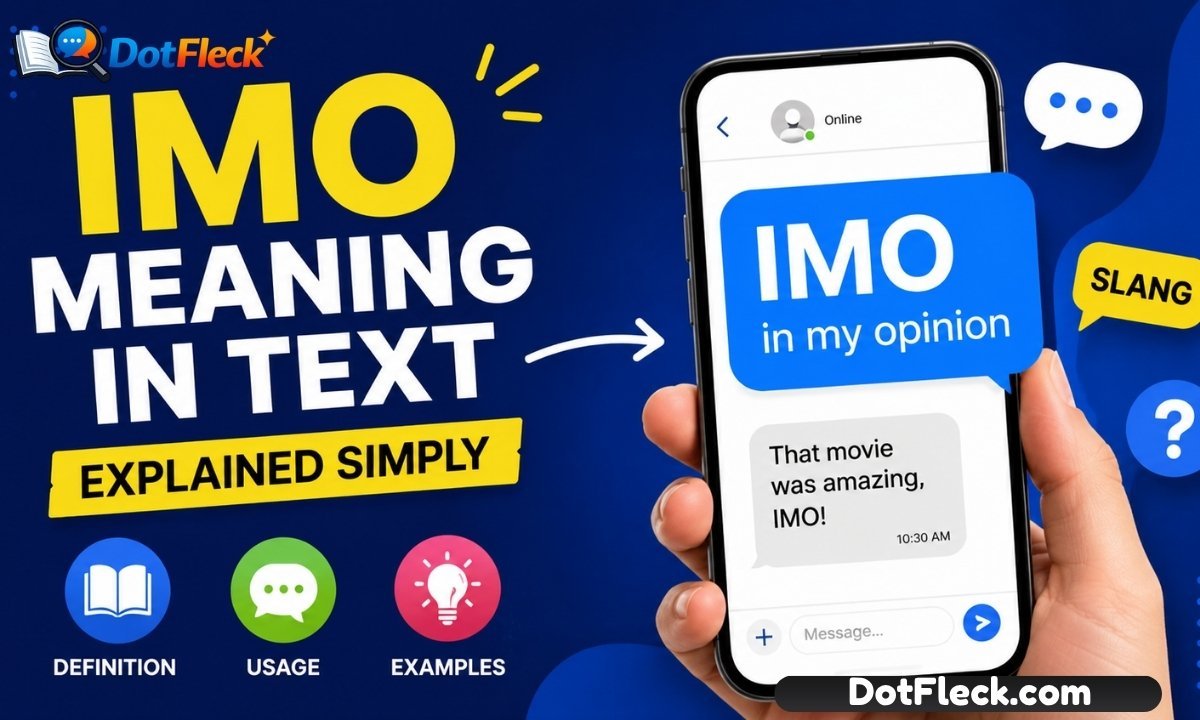
IMO stands for “in my opinion.” When someone drops IMO in a text, they’re softening what they’re about to say, letting you know it’s their personal take and not a statement of fact.
It’s one of the most common abbreviations in texting, group chats, and social media comments, and it shows up more often than people realize once you start paying attention.
Quick Answer
IMO = In My Opinion. Used to signal that a statement is personal, not universal fact.
- Common in texts, DMs, comments, and group chats
- Softens disagreements or strong statements
- Sometimes written as IMHO (“in my humble opinion”)
- Rarely capitalized in casual texting (imo vs IMO, same meaning)
What IMO Actually Means in a Conversation
At its core, the IMO meaning in text is pretty simple. It’s a verbal flag that says “this is just how I see it, feel free to disagree.” People tack it onto the front or end of a sentence to take the edge off.
For example: “That restaurant is overrated imo.” The person isn’t claiming a fact. They’re admitting it’s a matter of taste, and they’re not trying to start an argument about it.
This matters more than it seems. Text lacks tone of voice. A blunt opinion can read as an attack even when it wasn’t meant that way. IMO acts like a small verbal cushion, letting the other person know you’re aware this is subjective.
Meaning From a Girl
When a girl uses IMO in a text, it usually works the same way it does for anyone else, but context often shifts the tone slightly. It can soften a critique so it doesn’t sound harsh, especially in conversations about someone’s outfit, decision, or relationship drama.
Example: “I think you should talk to him first, imo.” Here it reads as gentle advice rather than a demand. It leaves room for the other person to push back without it feeling like a fight.
Meaning From a Guy
From a guy, IMO tends to show up in more direct or debate-style texts, like sports arguments, tech opinions, or ranking things. It’s less about softening feelings and more about flagging “this is subjective, don’t quote me on it.”
Example: “That trade was a mistake imo, but we’ll see.” It’s a way of committing to an opinion while leaving an exit if he turns out to be wrong.
There isn’t a hard rule splitting these by gender. Both uses overlap constantly. The difference is more about context, like whether the text is emotional or debate-driven, than who’s typing it.
IMO Meaning on Instagram and Social Media
On Instagram, TikTok, and Twitter/X, IMO shows up mostly in comment sections and captions. People use it when giving a take on a post, a trend, a celebrity look, or a hot take they know might get pushback.
A caption like “Best album of the year imo, fight me” is half opinion, half invitation for debate. It’s become almost a built-in disclaimer before people share something controversial online, since comment sections can get heated fast.
One thing worth noting: on social media, IMO sometimes gets used a little sarcastically, almost like a wink that says “I know this is spicy, but I’m saying it anyway.” That tone doesn’t always translate the same way in a private text.
IMO in Medical or Formal Contexts

Outside of casual texting, IMO occasionally shows up in medical or clinical shorthand, but it means something completely different there. In some healthcare and prescription contexts, IMO can stand for terms specific to that field, unrelated to “in my opinion.”
If you ever see IMO in a medical chart, prescription note, or clinical document, don’t assume it means the texting version. Context always decides the meaning, and mixing these up can genuinely cause confusion. This is a distinction most texting-slang articles skip entirely, and it’s worth flagging because IMO is one of those abbreviations that isn’t unique to casual chat.
Real Examples in Everyday Texts
Seeing IMO in context makes the meaning click faster than any definition. Here are a few different ways it shows up:
Casual opinion: “That movie was way too long imo.”
Advice among friends: “You should just block him, imo. It’s not worth the stress.”
Group chat debate: “Pineapple on pizza is actually good imo, don’t @ me.”
Softening feedback: “Your first draft was strong, but the ending felt rushed imo.”
Notice how the tone shifts depending on the sentence. IMO doesn’t have one fixed emotional weight. It bends to whatever conversation it’s dropped into.
Read Article : BFF Meaning in Text
When to Use IMO (and When to Skip It)
IMO works well when you’re stating a preference, a debatable take, or feedback that could come across too strong without it. It’s genuinely useful in group chats, comment threads, or any conversation where people might disagree.
It’s less useful, and sometimes even a little odd, when you’re stating something that’s already obviously subjective, like your favorite color. In that case, adding IMO is redundant since nobody’s expecting a fact.
Skip it in formal writing, work emails, or anything professional. IMO reads casually, and using it in a serious context can undercut how credible your message sounds, even if the point itself is solid.
Common Mistakes People Make With IMO
A few things trip people up, even fluent texters:
- Confusing IMO with IMHO. They’re close but not identical. IMHO (“in my humble opinion”) is meant to sound more modest, even if it’s often used the exact same way.
- Overusing it in a single message, which starts to feel like padding rather than genuine hedging.
- Assuming it always means the same thing across every context, when in medical or technical documents it can mean something else entirely, as mentioned above.
- Reading it as sarcasm when it isn’t, or missing sarcasm when it actually is one. Tone in text is genuinely hard to pin down, and IMO doesn’t fix that on its own.
Related and Similar Terms

A handful of abbreviations travel in the same lane as IMO. Knowing them helps you read texts faster and understand the subtle differences between each one.
| Abbreviation | Meaning | Tone |
| IMO | In my opinion | Neutral, direct |
| IMHO | In my humble opinion | Slightly softer, more modest |
| TBH | To be honest | Signals candor, sometimes blunt |
| IDK | I don’t know | Uncertainty, not opinion |
| FWIW | For what it’s worth | Low-stakes opinion or suggestion |
| NGL | Not gonna lie | Honest admission, casual |
Frequently Asked Questions
Does IMO mean the same thing as IMHO?
Basically yes, but IMHO leans more modest since “humble” is built into it. IMO it is more neutral and direct. In practice, most people use them interchangeably without thinking too hard about the difference.
Is IMO rude to use in a text?
Not usually. It actually softens statements rather than making them harsher, since it signals the message is opinion, not fact. It only feels off if it’s overused or dropped into a context where it doesn’t fit.
Can IMO be used in professional messages?
It’s better to avoid it in emails or workplace chats meant to sound formal. It reads casual, and while it’s not offensive, it can weaken how confident or authoritative your message comes across in that setting.
Why do people write imo in lowercase?
Texting culture generally skips capitalization for common abbreviations. Lowercase imo, tbh, and idk are just faster to type and read as more casual, which fits the tone of most everyday conversations.
Is IMO always used to disagree with someone?
No, not at all. It’s often used to agree, add a preference, or share a take on something neutral, like a movie or restaurant. It’s about marking an opinion, not necessarily signaling conflict.
Final Thoughts
IMO is a small abbreviation that does a lot of quiet work in everyday texting. It softens strong statements, signals that a take is personal rather than factual, and helps conversations stay lighter than they might otherwise feel.
Once you notice it, you’ll see it everywhere, from group chats to Instagram comments to casual debates with friends. Understanding when to use it, and when to leave it out, makes your texting sound more natural and a little more self-aware.

Ethan Whitmore is an English language writer who enjoys making grammar, word meanings, and modern slang simple and easy to understand. His content focuses on clear explanations, practical examples, and everyday English usage.